
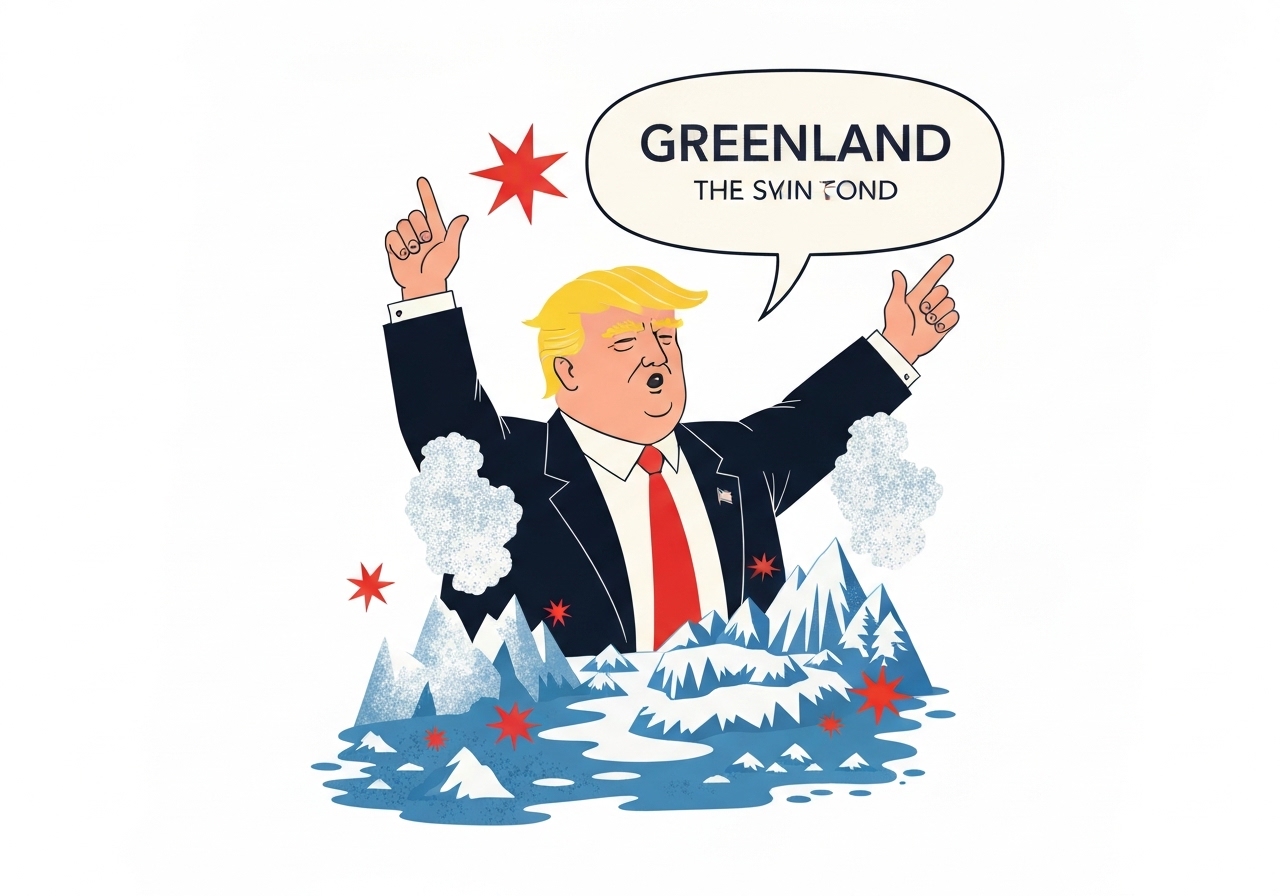
Lead: President Donald Trump, speaking ahead of the World Economic Forum in Davos on Jan. 20, reiterated his interest in acquiring Greenland and said repeatedly that observers would “find out” how far he was willing to go. He tied the move to trade pressure, threatening tariffs on several European countries if they oppose a U.S. claim to Greenland. European leaders, notably President Emmanuel Macron, responded with sharp objections, and Denmark and Greenland have publicly rejected any sale. At home, the administration’s broader use of tariffs and legal fights over those powers are drawing scrutiny from the Supreme Court.
Key Takeaways
- At Davos on Jan. 20, President Trump said of seizing Greenland, “You’ll find out,” and confirmed meetings on Greenland during the forum.
- The administration announced targeted tariffs: a 10% rate set to begin Feb. 1 on eight European countries, rising to 25% on June 1 if resistance continues.
- Mr. Trump also threatened a 200% tariff on some French wine products tied to disagreements over a proposed U.S.-led “Board of Peace.”
- Denmark and Greenland have said they will not sell Greenland; Denmark increased its military presence and hosted NATO exercises in the territory this month.
- The Supreme Court is weighing the legality of the president’s tariff authority, a ruling that could affect the administration’s leverage; officials said they would “use something else” if the court rules against them.
- Federal subpoenas were served in Minnesota to at least five Democratic officials, including Gov. Tim Walz and Mayor Jacob Frey, as part of an inquiry linked to responses to immigration enforcement and recent protests.
- The Treasury secretary criticized Federal Reserve Chair Jerome Powell’s attendance at related Supreme Court arguments, while the Justice Department’s personnel moves have intensified scrutiny of U.S. attorney appointments in Virginia.
Background
President Trump’s public pursuit of Greenland is part of a longer pattern in which he has elevated territorial and trade issues as levers of foreign policy. The president has previously floated extreme measures, including reclaiming strategic assets such as the Panama Canal, and has repeatedly used tariffs as diplomatic pressure. Greenland, a large Arctic island and a semiautonomous territory of Denmark, has strategic value in terms of Arctic access and influence relative to Russia and China, which Mr. Trump has cited as motivation for U.S. interest.
Trade threats have become a core tool for the administration. In recent years the White House broadened tariff use to extract concessions from allies and rivals, while offering compensatory aid to domestic constituencies harmed by retaliatory measures. That approach has provoked legal challenges now before the Supreme Court and political pushback from U.S. trading partners. European governments are considering countermeasures, including use of the European Union’s anti-coercion instrument to respond to what they describe as coercive economic pressure.
Main Event
At a Davos press moment on Jan. 20, Mr. Trump declined to fully detail his approach to Greenland, alternating between coyness and blunt threats. Asked directly how far he would go to “acquire” the island, he answered, “You’ll find out.” He also said negotiations over Greenland and related meetings were planned during the forum. When questioned about the possibility of military action, he suggested diplomatic and economic measures were primary, but did not rule out other options.
The president tied Greenland to his tariff strategy, saying tariffs were “the best, the strongest, the fastest” tool he favored and that, if the Supreme Court limited that authority, he would “use something else.” He defended stimulus-like aid to farmers, describing payouts as compensation for being “screwed by other nations” in trade disputes. Administration officials have already announced billions in aid to agricultural producers affected by retaliatory tariffs.
European responses were swift. President Macron of France denounced attempts to bully European sovereignty and framed the dispute as part of a broader erosion of cooperative multilateralism. Denmark publicly reiterated it would not cede Greenland and increased deployments to the island, sending roughly 100 additional troops and highlighting NATO-led exercises. Several European militaries also made small deployments in recent days to demonstrate commitment to Arctic security.
Analysis & Implications
Geopolitically, the episode risks widening transatlantic fractures. NATO cohesion depends in part on predictable alliance behavior and shared threat assessments; using tariffs as leverage over territorial sovereignty challenges that predictability. If the United States pursues acquisition through coercive economic tools, partners may respond with trade countermeasures or seek legal remedies, raising the risk of an escalating tit-for-tat cycle that would damage U.S.-Europe trade flows.
Legally, the Supreme Court’s pending review of presidential tariff authority matters directly. A ruling that curtails unilateral tariff powers would limit the administration’s bargaining options, forcing it to rely on congressional actions, sanctions, or other executive tools. The president’s stated willingness to pivot to “something else” suggests the administration has contingency plans but also signals potential unpredictability in U.S. policy-making.
Domestically, the strategy is double-edged. Tariffs and threats can rally a political base that favors assertive foreign policy but also impose clear economic costs—particularly on agricultural states—necessitating substantial mitigation payments. Those payouts and the legal fights around U.S. attorney appointments and subpoenas in Minnesota add layers of political vulnerability for the administration ahead of 2026 electoral and legislative calendars.
Comparison & Data
| Measure | Targets | Effective / Escalation Dates |
|---|---|---|
| European tariffs (threat) | 8 countries (including France) | 10% from Feb. 1 → 25% on June 1 |
| Wine tariffs (threat) | Selected French wine, including Champagne | 200% (threatened) |
| Fed HQ probe | Federal Reserve | $2.5 billion renovation under investigation |
The table summarizes the administration’s most visible economic threats and legal flash points. The phased tariff escalation gives European governments a window to respond diplomatically or prepare countermeasures; a 200% tariff on specific products would be unusually punitive and disruptive to exporters and importers. The Fed renovation probe and court cases over tariff authority add separate but compounding legal uncertainty.
Reactions & Quotes
European leaders, NATO partners, and Danish authorities have all signaled concern or rejection of U.S. pressure.
“We do prefer respect to bullies.”
President Emmanuel Macron (France)
Mr. Macron made the remark at the World Economic Forum in Davos, framing the episode as an affront to multilateral norms and warning that Europe could use its own trade tools to respond. French officials described threats of punitive tariffs as “blackmail” intended to compel political compliance.
“You’ll find out.”
President Donald Trump
The president used that terse reply when asked directly how far he would go to acquire Greenland, then quickly moved on. Administration officials later emphasized a preference for economic and diplomatic measures while declining to rule out other options.
“It’s shocking because it’s brutal, it’s done to force compliance.”
Annie Genevard, France’s Minister of Agriculture
French ministers and industry groups reacted angrily to the suggestion of sweeping tariffs, warning of damage to exporters and calling for a coordinated European response that could include invoking the EU’s anti-coercion instrument.
Unconfirmed
- That the United States will use military force to seize Greenland remains unverified; officials have suggested economic and diplomatic options as primary levers.
- Reports that Greenlanders will welcome U.S. sovereignty are unconfirmed; Greenland and Danish officials have publicly rejected a sale.
- Details of any internal contingency plans the administration would “use” if the Supreme Court rules against tariff authority have not been disclosed.
Bottom Line
The Greenland episode crystallizes a broader Trump-era approach: blending economic coercion, legal brinkmanship and high-stakes diplomacy. That mix increases strategic leverage in the short term but also risks alienating longstanding allies and provoking coordinated countermeasures that could undercut U.S. influence and economic interests.
Watch for three near-term developments: the Supreme Court’s decision on tariff authority, any formal European countermeasures (including use of the anti-coercion instrument), and follow-up visits or talks in Davos that could either defuse or deepen the standoff. Policy outcomes will hinge on legal rulings, alliance responses, and whether the administration translates threats into sustained, enforceable actions.