
Lead
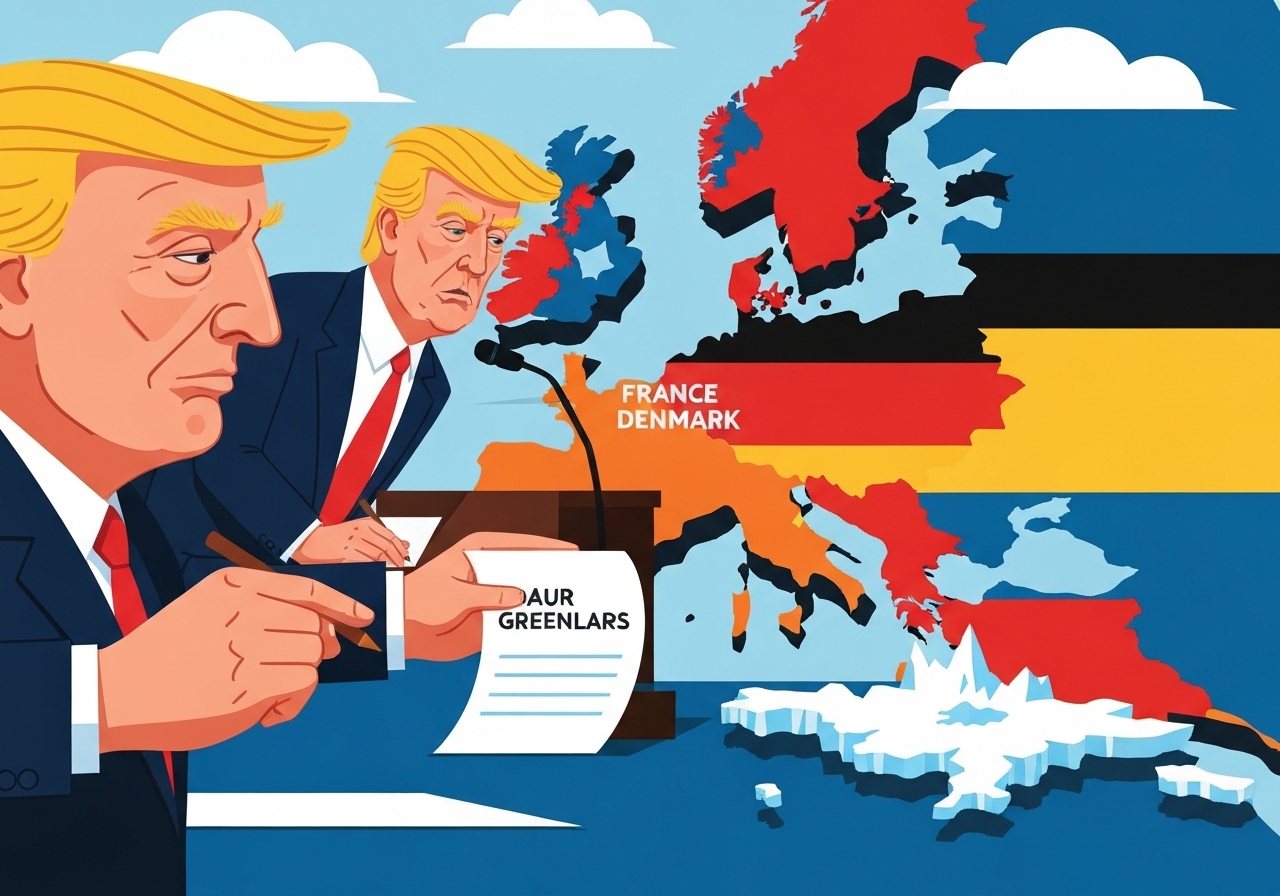
On Jan. 17, 2026, President Donald J. Trump announced new tariffs targeting Denmark and seven European allies as leverage to secure Greenland, a Danish territory. The president said a 10 percent tariff on imports from those countries will take effect Feb. 1, rising to 25 percent on June 1 if his demands are unmet. European leaders and U.S. lawmakers reacted with swift outrage, and the move threatens recent trade arrangements and pending U.S. legal review of presidential tariff authority. The announcement was made in a social media post framing control of Greenland as a strategic necessity to counter Chinese and Russian activity in the Arctic.
Key Takeaways
- The president announced a 10 percent tariff on goods from Denmark, Norway, Sweden, France, Germany, Britain, the Netherlands and Finland effective Feb. 1, 2026.
- Mr. Trump warned the tariff would rise to 25 percent on June 1, 2026, if those countries do not open negotiations to sell Greenland.
- The policy directly affects eight European nations, all NATO members, and risks undermining a recent U.S. trade framework that currently charges 10 percent on British imports and 15 percent on the European Union.
- U.S. legal authority to impose such tariffs is under review by the Supreme Court in a case concerning the International Emergency Economic Powers Act; a decision is expected in the coming weeks.
- Tariffs are paid by importers and are commonly passed through to U.S. consumers, raising the prospect of higher prices for affected goods.
- European capitals expressed unified outrage; some U.S. lawmakers, including members of the president’s party, criticized the approach.
Background
Greenland is an autonomous territory within the Kingdom of Denmark, long of strategic interest because of its Arctic position and natural resources. The United States already maintains a significant presence on the island and has rights stemming from a 1951 agreement with Denmark allowing an expanded U.S. military footprint. Historically, proposals or talk of purchasing Greenland have been rare and politically fraught, drawing domestic and international scrutiny when raised.
Mr. Trump’s move follows months of public pressure from the White House to gain control or influence over Greenland, framed by U.S. officials as countering greater Chinese and Russian activity in the Arctic. European members of NATO have voiced solidarity with Denmark’s refusal to open talks over any sale, viewing sovereignty and territorial integrity as core principles. Those diplomatic alignments set the stage for the tariff announcement as a coercive economic measure rather than a conventional trade negotiation.
Main Event
In a social media message posted on Jan. 17, 2026, the president wrote that the United States will impose a 10 percent tariff on all goods from Denmark and seven other European states beginning Feb. 1. He listed Norway, Sweden, France, Germany, Britain, the Netherlands and Finland alongside Denmark as targets of the levy. The post specified a scheduled escalation to 25 percent on June 1 unless an agreement is reached for what he described as the complete purchase of Greenland.
The announcement immediately drew condemnation from European leaders who called the tactic coercive and destabilizing. Washington lawmakers from both parties criticized the unilateral pressure, with some Republicans distancing themselves from the timing and method. Analysts noted that the tariffs, if implemented, would layer on top of existing U.S. duties — currently 10 percent on British imports and 15 percent on EU imports after limited trade agreements concluded last year.
Practical implementation would raise questions about enforcement, exemptions, and whether importers or consumers would bear the final cost. Commerce and customs agencies would need to define affected product codes and origins, while trading partners could retaliate or seek dispute resolution at international forums. The president defended the measure as necessary to secure U.S. strategic interests in the Arctic and to deter China and Russia, even as critics said defense and diplomatic channels already provide avenues for U.S. presence.
Analysis & Implications
The tariff announcement is unusual in combining national-security rhetoric with an explicit demand to purchase foreign territory. If carried out, it would mark a rare use of broad economic penalties aimed at forcing territorial negotiation rather than resolving a trade dispute. This sets a precedent for leveraging tariffs as geopolitical bargaining chips, a shift from their more typical use as tools for addressing market access or unfair trade practices.
Legally and politically, the move faces immediate constraints. The Supreme Court is poised to rule on limits to presidential power under the International Emergency Economic Powers Act; an adverse decision could block the legal mechanism the administration would likely cite to impose these tariffs. Even if legally permissible, the tariffs could upend recent bilateral and regional trade arrangements and complicate cooperation with NATO partners on defense and intelligence-sharing in the Arctic.
Economically, adding a 10 percent levy — and threatening 25 percent — risks higher input costs for U.S. manufacturers and higher retail prices for consumers. Importers generally pay tariffs but pass much of the cost downstream, so businesses that rely on goods from the affected countries could see margins squeezed. Market participants will also watch for retaliatory measures by European governments or coordinated responses through the World Trade Organization or other multilateral venues.
Comparison & Data
| Category | Current U.S. Duty | Announced Additional Tariff | Total if Imposed |
|---|---|---|---|
| United Kingdom | 10% | 10% (from Feb 1) | 20% |
| European Union (France, Germany, Netherlands, etc.) | 15% | 10% (from Feb 1) | 25% |
| Denmark, Norway, Sweden, Finland | Varies / subject to agreements | 10% (from Feb 1) | 10%+ existing duties |
The table above summarizes how the announced tariffs would interact with existing U.S. duties: the new levies are presented as additive to current rates, which include a 10 percent general rate on U.K. imports and a 15 percent general rate on many EU imports after last year’s limited deals. The final applied rate would depend on how customs authorities interpret product origins and on any exemptions granted to specific goods or sectors.
Reactions & Quotes
European capitals framed the move as an affront to alliance norms and to Danish sovereignty. Political leaders emphasized diplomatic channels over coercive economic pressure, and some promised coordinated responses.
This tactic undermines trust among allies and will not compel a sovereign government to sell its territory.
European official
The White House defended the step as necessary to secure strategic U.S. interests in the Arctic, pointing to growing Chinese and Russian activity as justification.
The United States must act to protect its position in the Arctic and prevent hostile powers from gaining influence.
White House statement
U.S. lawmakers expressed concern about the legal basis and economic fallout, with voices from both parties calling for Congressional consultations before further escalation.
Using tariffs to force the sale of foreign land is not a credible long-term strategy and merits congressional review.
U.S. lawmaker
Unconfirmed
- Whether the tariffs will actually be implemented on Feb. 1 if the Supreme Court rules against the administration remains unresolved.
- It is not yet confirmed how customs authorities would apply the announced levies to goods with complex origins or to firms with existing trade exemptions.
- There is no confirmed agreement from any European government to enter negotiations to sell Greenland; reports of back-channel talks are not substantiated.
Bottom Line
The Jan. 17 tariff announcement elevates an already tense diplomatic episode into a full-blown trade confrontation with several NATO allies. It substitutes economic coercion for diplomacy in pursuit of a strategic objective, raising legal, political and market risks both domestically and abroad. A pending Supreme Court decision on presidential trade authority adds a pivotal legal uncertainty that could block the plan before it starts.
In the near term, watch for coordinated European responses, potential retaliation measures, and statements from the Supreme Court and Congress. For businesses and consumers, the most immediate impact would be higher costs on affected imports if tariffs are applied; for geopolitics, the episode could strain alliance cohesion at a moment when Arctic cooperation is increasingly important.
Sources
- The New York Times (Media report summarizing the announcement and reactions)
- U.S. Supreme Court (Official — docket and pending decisions on IEEPA)
- NATO (Official — alliance statements and member context)