
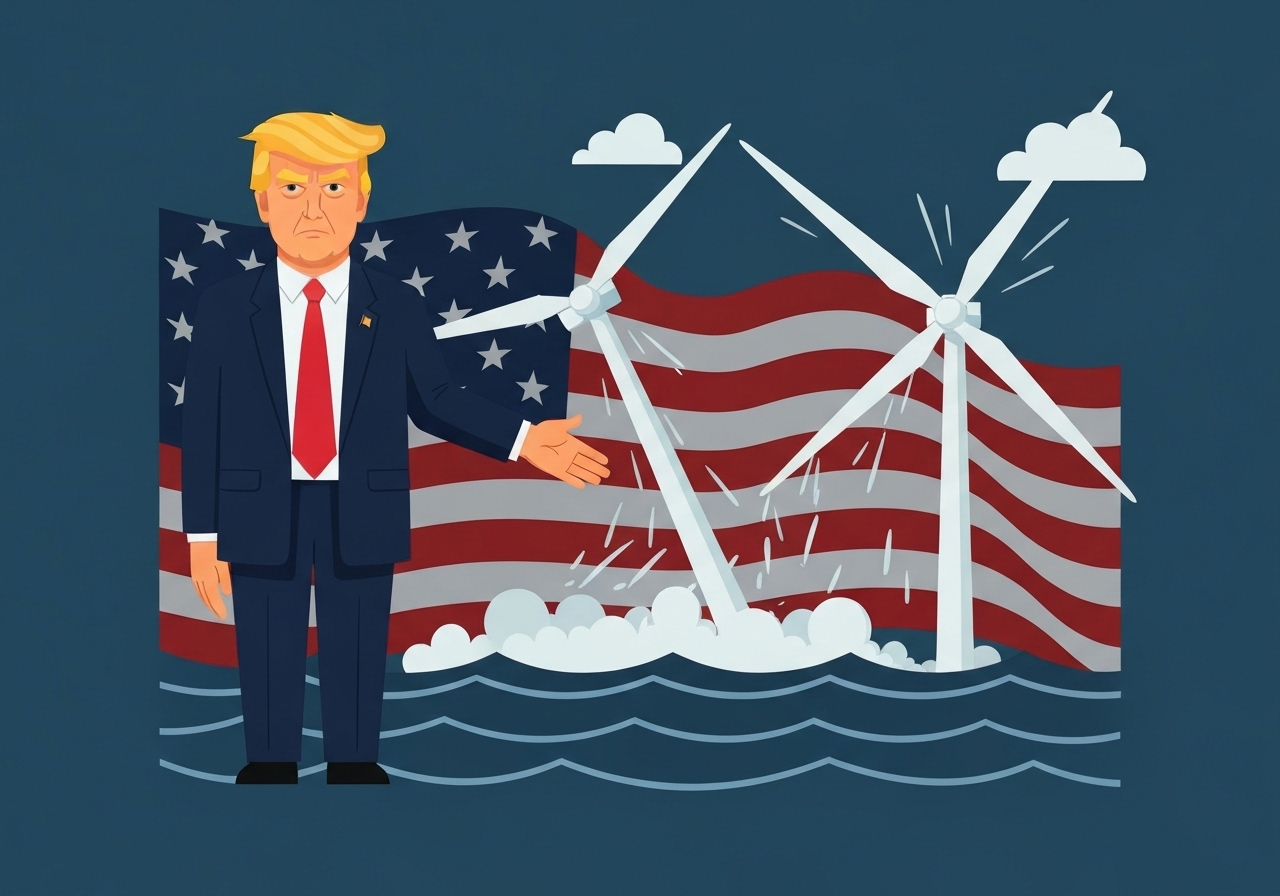
— The U.S. Interior Department announced on Monday that it is pausing leases for five major offshore wind projects after the Department of Defense flagged national security concerns in classified reports. The move affects Vineyard Wind 1, Revolution Wind, Coastal Virginia Offshore Wind (CVOW), Sunrise Wind and Empire Wind 1 and follows public, unclassified federal analyses pointing to radar interference risks from turbine blades and reflective towers. Interior Secretary Doug Burgum described the projects as costly and unreliable in a social media post while the administration declined to disclose the detailed Defense findings. The action comes two weeks after a federal judge vacated a January executive order that broadly attempted to block offshore wind leasing.
Key Takeaways
- The Interior Department paused leases on five projects on Dec. 22, 2025: Vineyard Wind 1, Revolution Wind, CVOW, Sunrise Wind and Empire Wind 1.
- The Department of Defense raised classified security concerns; Interior cited unclassified reports that turbines can create radar “clutter” that complicates target identification.
- Vineyard Wind 1 is planned to include 62 turbines about 15 miles south of Martha’s Vineyard and Nantucket and once complete would supply power to roughly 400,000 homes and businesses in Massachusetts.
- Revolution Wind was reported at about 80% complete; CVOW is the largest planned U.S. offshore project with 176 turbines and a projected in-service date around end of 2026.
- Industry operators named in the pause include Ørsted (Revolution Wind, Sunrise Wind), Dominion Energy (CVOW) and Equinor (Empire Wind); several companies had not immediately responded to requests for comment.
- The pause follows a court ruling by U.S. District Judge Patti Saris that vacated President Trump’s Jan. 20 executive order which had attempted to halt offshore wind leasing and permitting.
- Interior Secretary Doug Burgum posted that one natural gas pipeline supplies as much energy as the five projects combined; that specific equivalence was stated by the Secretary but not independently verified in the administration statement.
Background
Offshore wind has been a focal point of U.S. clean-energy policy and private investment over the past decade, with federal leasing intended to scale up large projects off the Northeast coast. Investors and state governments have promoted these projects as critical to emissions reductions, local jobs and energy diversification. Federal agencies, however, must also weigh national security and navigational safety; the Department of Defense has previously raised concerns in classified and unclassified reports about how large turbine arrays can interfere with radar and sensor systems.
President Trump’s Jan. 20 executive order sought sweeping restrictions on wind leasing and permitting, prompting legal challenges from states and industry. On Dec. 8, 2025, U.S. District Judge Patti Saris of Massachusetts vacated that Day One order as “arbitrary and capricious,” siding with a coalition of 17 state attorneys general and Washington, D.C., led by New York Attorney General Letitia James. The litigation underscored tension between federal executive policy, judicial review and state-level commitments to offshore renewables.
Main Event
On Dec. 22, 2025 the Interior Department said it would pause leasing actions for five named projects after receiving Department of Defense assessments it described as raising national security issues. The department did not publicly release the classified DoD material, instead pointing to long-standing, unclassified analyses noting that rotating blades and turbine structures can create radar signal reflections — so-called “clutter” — that may mask or complicate the detection of moving targets.
The affected projects are at different stages of development. Vineyard Wind 1, roughly 15 miles south of Martha’s Vineyard and Nantucket, is designed for 62 turbines and had about half its turbines operational in October, according to local reporting; it is intended to serve roughly 400,000 Massachusetts homes and businesses when complete. Revolution Wind, off Rhode Island, was reported to be about 80% complete and is operated by Ørsted. CVOW (Coastal Virginia Offshore Wind), run by Dominion Energy, is planned as the largest U.S. offshore project with 176 turbines and had a projected in-service target near the end of 2026.
Sunrise Wind and Empire Wind 1 — both sited off New York’s Long Island and developed by Ørsted and Equinor respectively — were in construction or pre-operation phases, with expected online dates in the mid-2020s. Company spokespeople had not immediately published responses at the time of the Interior announcement. The administration framed the pause as a precaution tied to security reviews rather than an immediate cancellation of projects.
Analysis & Implications
The Interior pause places national security criteria at the center of an energy policy dispute that also implicates climate goals and regional economic plans. If the Defense Department’s classified concerns prove significant and hard to mitigate quickly, the result could be multi-year delays for projects that states and utilities have relied on for decarbonization targets. That in turn may slow progress on emissions reductions and prolong dependence on fossil fuels in certain regions.
For industry and investors, the pause injects new political and regulatory risk into a sector that requires long lead times and heavy capital. Developers and supply-chain firms could face workforce disruptions, contract renegotiations and higher financing costs if the pause leads to protracted reviews or litigation. States that have integrated these projects into renewable energy portfolios may seek federal assurances or legislative solutions to restore timelines.
Conversely, the administration’s action may prompt accelerated technical work on radar mitigation, sensor upgrades, and siting adjustments that could allow projects to proceed under revised safeguards. The Department of Defense, Interior and industry could pursue technical mitigation — such as improved radar signal processing, exclusion zones, or alternative turbine siting — but the effectiveness and timelines for such solutions remain uncertain and would likely require coordinated federal funding and oversight.
Comparison & Data
| Project | Planned Turbines | Status (as reported) | Approx. Distance from Shore | Target Online |
|---|---|---|---|---|
| Vineyard Wind 1 | 62 | ~50% operational (Oct. report) | ~15 miles | Under development |
| Revolution Wind | (site-specific) | ~80% complete | Off Rhode Island | In progress |
| CVOW (Coastal Virginia) | 176 | Planned | Off Virginia coast | ~end of 2026 |
| Sunrise Wind | (site-specific) | Under development | ~30 miles (Long Island) | ~2027 |
| Empire Wind 1 | (site-specific) | Under construction | Off Long Island | Under construction |
These figures show a mix of operational, partially completed and planned projects. Vineyard Wind’s estimated capacity to serve about 400,000 homes is a commonly cited developer projection; CVOW’s 176 turbines make it the largest by turbine count in current U.S. plans. Any pause affecting multiple projects will reduce near-term offshore wind additions to the grid and has measurable implications for regional capacity forecasts.
Reactions & Quotes
“We are PAUSING leases for 5 expensive, unreliable, heavily subsidized offshore wind farms! ONE natural gas pipeline supplies as much energy as these 5 projects COMBINED,”
Doug Burgum, U.S. Interior Secretary (social media post)
The Secretary’s social post framed the pause in economic terms; the administration did not provide independent analysis for the pipeline-versus-wind energy equivalence in its statement.
“The Court finds the executive order arbitrary and capricious,”
U.S. District Judge Patti Saris (Dec. ruling)
Judge Saris’s ruling vacated the Jan. 20 executive order that had sought broad restrictions on leasing and permitting; that legal decision remains a separate but related chapter in the dispute over federal authority and wind policy.
“State and industry partners have expressed concern about delays to projects that underpin local jobs and decarbonization plans,”
Statement by coalition of state attorneys general (legal challenge)
State officials leading the legal challenge argued that rapid, unexplained pauses undermine predictable permitting and state-level climate commitments.
Unconfirmed
- The specific contents and severity of the Department of Defense’s classified reports have not been released publicly and remain undisclosed.
- The administration’s assertion that one natural gas pipeline supplies as much energy as the five projects combined was stated by the Interior Secretary but not independently verified in the public statement.
- The precise timeline and technical feasibility for radar or sensor mitigations that would allow the paused projects to resume are not yet established.
Bottom Line
The Interior Department’s pause on five major offshore wind leases places national security considerations at cross-purposes with climate and economic priorities that have driven rapid offshore wind development in the Northeast. The decision preserves classified Defense assessments from public view while triggering immediate policy, legal and commercial uncertainty for projects meant to deliver large-scale renewable capacity.
Outcomes will depend on whether the Department of Defense and Interior can identify specific, timely mitigations that allow construction and operation without degrading defense capabilities. If technical fixes are viable, projects may be delayed but recoverable; if not, the action could force significant redesigns, compensation disputes and renewed litigation — and slow state and regional decarbonization plans that rely on offshore wind capacity.
Sources
- CBS News (News report)
- U.S. Department of the Interior (Federal agency statement)
- U.S. Department of Defense (Federal agency — classified reports referenced)
- U.S. District Court for the District of Massachusetts (Court ruling by Judge Patti Saris)