
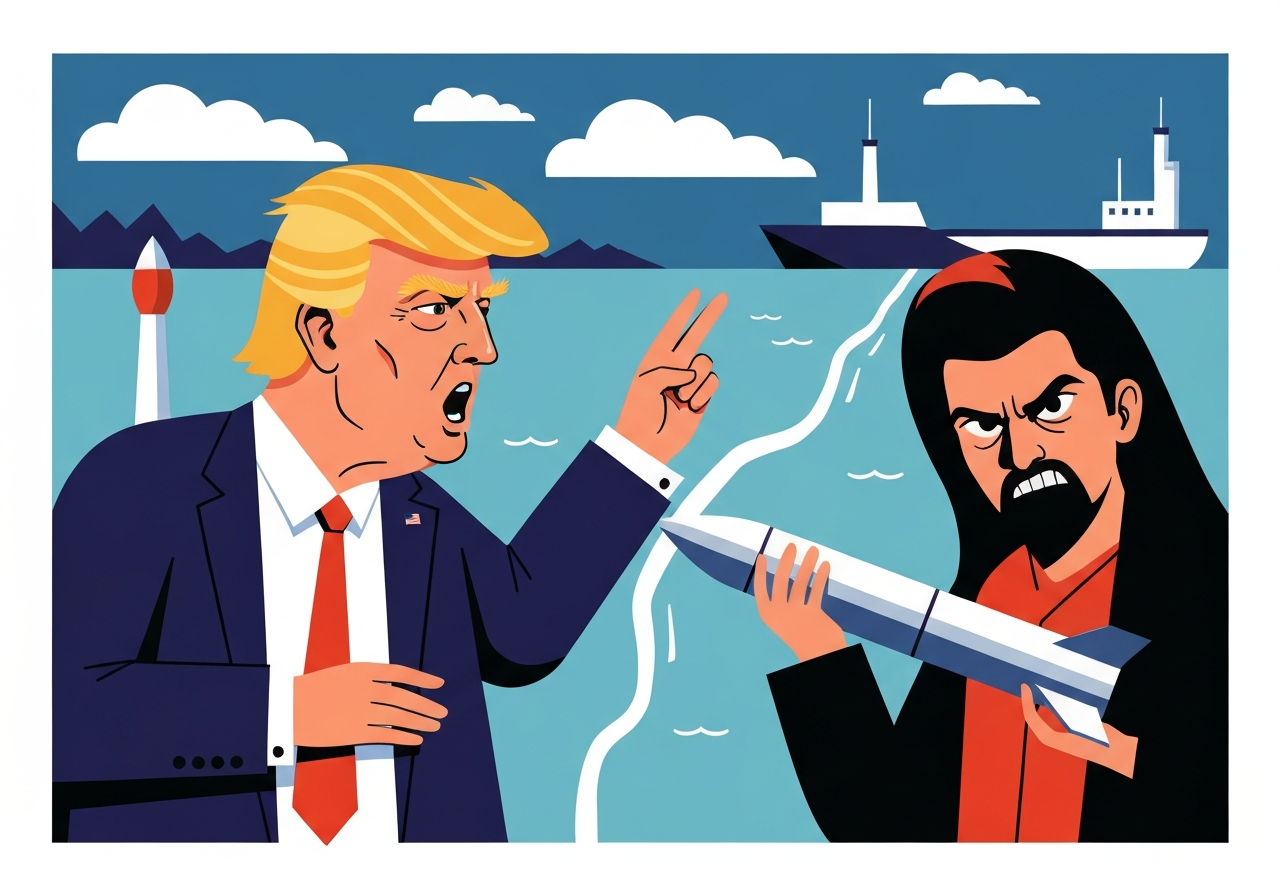
President Donald Trump on Saturday renewed a call for other nations to send naval assets to reopen and secure the Strait of Hormuz after Tehran’s moves have severely disrupted commercial traffic. The appeal came amid fresh Iranian warnings that it will target US-linked energy infrastructure across the Middle East if strikes on its own oil and gas facilities continue. Regional violence continued: two drones struck the US Embassy in Baghdad, Israel continued air campaigns inside Iran and Lebanon, and attacks on commercial vessels have forced shipping reroutes. The disruptions have already raised energy prices and raised fears of a wider escalation.
Key takeaways
- The president urged China, France, Japan, South Korea, the UK and others to help secure the Strait of Hormuz to restore shipping through the choke point.
- Iran’s military and the Islamic Revolutionary Guard Corps warned they will strike energy and port infrastructure tied to US companies if Iran’s energy sites are attacked.
- At least 17 vessels have been attacked in and around the Persian Gulf, Strait of Hormuz and Gulf of Oman since Feb. 28, according to UKMTO reporting.
- US retail gasoline prices climbed to an average of $3.68 per gallon, a roughly 23% rise since the conflict began, with diesel averaging $4.85 per gallon (AAA).
- Israel says it has conducted about 400 waves of airstrikes in western and central Iran since the war began two weeks ago, including the reported killing of two senior Iranian intelligence officials.
- Lebanese authorities report at least 826 people killed in Lebanon from Israeli strikes, including 106 children, and hundreds of thousands displaced.
- Major shippers including Maersk and Hapag-Lloyd are diverting vessels away from the region, adding transit time and cost to global logistics.
Background
Tensions escalated after a sequence of strikes struck Iranian oil and industrial sites beginning late February, prompting a series of retaliatory operations by Iran, the United States and Israel. The Strait of Hormuz, a narrow chokepoint controlled in part by Iran, handles roughly 20 million barrels of oil per day—about one-fifth of global crude flows—making any interruption a major global economic risk (U.S. EIA).
Maritime attacks rose rapidly: UK Maritime Trade Operations has recorded multiple incidents in the Strait, Persian Gulf and Gulf of Oman dating from March 1 onward, including projectile strikes, drone incidents and onboard explosions. The attacks have produced at least one confirmed seafarer fatality and growing insurance and diversion costs for commercial firms. Regional actors and external powers have been drawn in rhetorically and operationally, complicating diplomatic avenues for de-escalation.
Main event
On Saturday President Trump posted that he expects other nations to deploy warships “in conjunction” with the United States to keep the Strait of Hormuz open and safe. The White House was asked to clarify which partners would join; the UK said discussions are underway, while China declined to confirm any deployment and called for de-escalation. French officials have signaled support for a coordinated coalition but said organizing such an effort will take time.
Iran’s Revolutionary Guard issued a public advisory urging American-affiliated industrial facilities and civilians near ports linked to US business shareholders to vacate those areas to avoid harm if escalatory strikes continue. Iranian state media also reported civilian casualties at some industrial sites that were hit in previous days. Tehran’s foreign ministry and military spokespeople reiterated that attacks on Iran’s energy infrastructure will be answered by strikes on infrastructure associated with American interests in the region.
Meanwhile combat operations and strikes have spread across several theaters. Israel reported large numbers of strikes inside Iran—including, it said, hits on missile launchers, air defenses and a space-research center—and announced the deaths of two senior Iranian intelligence figures, Abdollah Jalali-Nasab and Amir Shariat. In Lebanon, repeated Israeli bombardment has produced high civilian tolls and mass displacement; the UN secretary-general urged both sides to halt fighting.
Maritime incidents continued: port facilities in the UAE experienced fire and operational suspensions after drone debris and direct attacks. UKMTO and other authorities documented a sequence of vessel incidents between March 1 and March 12, prompting major carriers to reroute ships and leading to supply-chain knock-on effects.
Analysis & implications
Operationally, multinational naval cooperation in the Strait of Hormuz faces political and logistical obstacles. Nations with major trading ties to the Gulf may be reluctant to place ships under direct threat of Iranian attack or to be seen as taking sides in a broader regional conflict. Any coalition will need clear rules of engagement, intelligence-sharing mechanisms, and risk-acceptance thresholds before deployment can be effective.
Economically, even partial closures or sustained disruptions of the strait could keep oil and gas prices elevated. Analysts note that about 20 million barrels per day transit the waterway—loss of even a fraction forces rebalancing via more expensive supply routes and raises costs for refined products such as gasoline and jet fuel. Carriers diverting around the Cape of Good Hope and other longer routes increases shipping times and freight costs, with downstream impacts on food, fertilizer and consumer goods.
Strategically, Iran’s stated intent to strike facilities tied to American companies—explicitly including sites where US firms are shareholders—expands the conflict’s potential target set beyond purely military installations. That broad formulation increases the risk of damage to global corporate assets and could pull private-sector infrastructure into state-on-state dynamics, complicating diplomatic channels and raising insurance and corporate-security questions.
Diplomatically, the fragmentation of response among global powers matters. China’s public call for de-escalation and its refusal to confirm naval participation, combined with the UK and France signaling only preliminary talks, suggests any multinational maritime effort will be uneven and slow to form. That lag increases the window in which Iran or proxy actors can continue disruptive actions at sea and ashore.
| Date | Incident type | Reported vessels affected |
|---|---|---|
| March 1 | Projectiles, near-miss detonations | 3–5 (including docked tanker) |
| March 3–4 | Projectiles, drones, explosions onboard | 3–4 |
| March 6–12 | Projectile strikes, drone hits, fires | 5–6 |
The table aggregates UKMTO updates between March 1 and March 12 and shows the clustering of attacks in the first two weeks of March. While not exhaustive, the pattern of repeated surface and aerial incidents has prompted insurers and operators to treat the region as high-risk, forcing reroutes and operational pauses at key ports.
Reactions & quotes
Several leaders and institutions responded publicly on Saturday, underlining the split international posture.
“Stop the fighting. Stop the bombing. There is no military solution,”
António Guterres, UN Secretary-General
The UN chief made the plea during a visit to Beirut, stressing the humanitarian toll and urging restraint from both Israel and Hezbollah.
“It is only closed to American, Israeli ships and tankers, and not to others,”
Abbas Araghchi, Iranian foreign minister
Araghchi pushed back on claims the strait was universally shut and reiterated Iran’s framing that actions are targeted at US and Israeli vessels; he also warned of retaliation for strikes on Iranian energy infrastructure.
“The United States of America has beaten and completely decimated Iran… but the countries of the world that receive oil through the Hormuz Strait must take care of that passage,”
Donald Trump, US President (Truth Social post)
The president’s post framed the situation as a global responsibility and urged allied naval assistance, though several governments have not confirmed deployments.
Unconfirmed
- Which specific countries have formally agreed to send warships alongside the United States remains unclear; China and the UK did not confirm deployments to CNN.
- Claims that Iran’s new supreme leader Mojtaba Khamenei was wounded and disfigured are disputed; Iranian officials denied the allegation.
- Attribution for some recent maritime incidents remains contested in available public statements and has not been independently verified.
Bottom line
The president’s push for allied naval deployments signals Washington’s priority to reopen a vital energy route, but forming a multinational operational coalition will take time and invite diplomatic friction. Iran’s broader warnings—targeting facilities tied to US business interests, including ports and energy hubs—raise the prospect of damage to civilian and commercial infrastructure beyond strictly military targets.
In the near term, markets and shippers should expect continued volatility: insurers, carriers and energy traders are already pricing the risk of further interruptions. The most probable path to sustained stability remains a negotiated de-escalation combined with targeted maritime security measures—an outcome that will demand difficult, multilateral diplomacy and credible risk-reduction guarantees.