
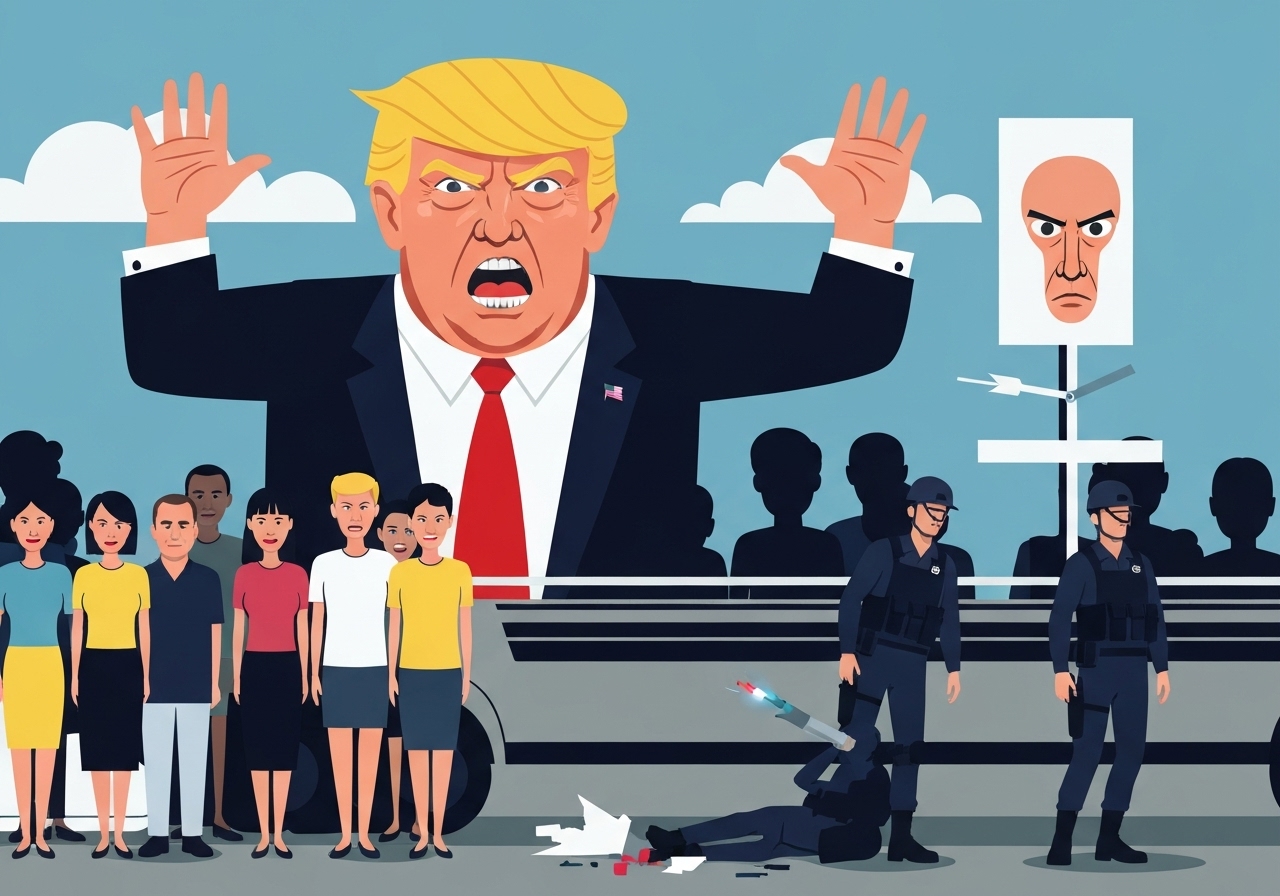
President Donald Trump on Nov. 26, 2025 renewed his pledge to tighten immigration controls after the fatal shooting of two National Guard members in Washington, D.C. The White House circulated a video in which Trump called the attack an “act of hatred,” and pointed to the suspect, identified as Rahmanullah Lakanwal, an Afghan national who arrived in the United States following the August 2021 U.S. withdrawal from Afghanistan. The administration moved quickly to pause certain Afghan immigration processing and to order broad reviews of existing visas and green cards. The episode has intensified debate over vetting, asylum policy and the treatment of entire refugee communities.
Key Takeaways
- Two National Guard members were shot in Washington, D.C.; authorities identified the suspect as Rahmanullah Lakanwal, an Afghan national linked to the incident.
- Trump said the suspect was among those transported to the U.S. during and after the August 2021 withdrawal and called for a reexamination of Afghan arrivals; he spoke publicly on Nov. 26, 2025.
- U.S. Citizenship and Immigration Services (USCIS) announced an immediate pause on immigration requests tied to Afghan nationals pending a security and vetting review.
- USCIS Director Joseph Edlow said he was ordered to conduct a “full scale, rigorous reexamination” of green cards for people from countries of concern.
- Officials have confirmed Lakanwal previously worked with the CIA and U.S. military in Afghanistan; public records show he applied for asylum in 2024 and was granted asylum in April 2025 under the current administration.
- Advocacy groups and a U.N. human-rights official warned against collective punishment of Afghan communities and urged targeted accountability for the perpetrator.
- Trump also used the remarks to criticize Somali communities in Minnesota as he moves to end Temporary Protected Status (TPS) for Somali nationals.
Background
The U.S. withdrawal from Afghanistan in August 2021 resulted in large-scale evacuations and resettlement programs, including Operation Allies Welcome, which transported many Afghans to the United States. Those arrivals prompted extensive screening efforts at the time, but vetting processes have remained politically contested across administrations. The individual at the center of this case, Rahmanullah Lakanwal, was among Afghans who arrived during that period, according to public statements by senior officials.
Over the past four years asylum and resettlement policy have been a flashpoint in U.S. politics, with divergent views on national security, humanitarian obligations and the adequacy of background checks. Immigration agencies have built multi-layered vetting procedures for wartime allies and evacuees, but critics say gaps persist. The shooting in Washington has reopened those debates and produced immediate administrative responses from the executive branch.
Main Event
In a video posted by the White House on Nov. 26, 2025, President Trump described the attack as an “act of hatred” and blamed prior administrations for permitting what he characterized as unsafe levels of immigration. He singled out Afghans admitted after the 2021 withdrawal and urged a nationwide reexamination of those arrivals. The president also renewed a broader immigration hardline, saying individuals who do not “love our country” should not remain.
Shortly after the president’s remarks, USCIS announced it had halted processing of immigration requests related to Afghan nationals, saying the pause was effective immediately and would remain until a review of security and vetting protocols concluded. USCIS Director Joseph Edlow said he had been directed to reexamine green cards for aliens from countries the administration deems of concern.
Homeland Security Secretary Kristi Noem posted that the suspect entered the United States “under Operation Allies Welcome on September 8, 2021,” though officials noted it was not yet clear whether the flight was part of evacuation flights or later resettlement efforts. Separately, investigators have released details that Lakanwal had worked with U.S. intelligence and military personnel in Afghanistan before coming to the United States.
Records publicly reported show Lakanwal applied for asylum in 2024 and was granted asylum in April 2025 during the current presidential term. The shooting itself prompted swift statements from the White House and also immediate pushback from refugee advocates and some local elected officials who warned against broad punitive measures targeting entire communities.
Analysis & Implications
The administration’s response combines criminal-justice and immigration-policy actions, signaling a shift toward more expansive vetting and enforcement measures. Ordering a sweeping review of green cards across “countries of concern” could affect thousands of lawful permanent residents and create significant administrative workload for USCIS. That review also raises legal and logistical questions about due process, record access and interagency coordination.
Suspending Afghan-related immigration processing is likely to slow family reunifications and resettlement pipelines that already operate under complex humanitarian criteria. Advocates say these populations underwent extensive screening upon arrival; officials argue the shooting demonstrates the need to reassess protocols. Both positions carry electoral and humanitarian stakes ahead of policy debates in Congress and state-level governance.
Politically, the president’s remarks sharpen divisions: supporters will view the measures as decisive action on national security, while critics describe them as scapegoating that stigmatizes entire ethnic or refugee communities. Moves to terminate or curtail Temporary Protected Status for groups such as Somalis in Minnesota escalate tensions with state leaders and service providers who argue TPS is a lifesaving protection and that removal would be disruptive and costly.
Comparison & Data
| Event | Date |
|---|---|
| U.S. withdrawal from Afghanistan | August 2021 |
| Suspect entry noted (Operation Allies Welcome) | Sept. 8, 2021 |
| Asylum application filed | 2024 |
| Asylum granted | April 2025 |
| President’s public remarks | Nov. 26, 2025 |
The timeline above places the suspect’s arrival during the broader evacuation and resettlement period following the August 2021 withdrawal. While many evacuees were processed through multiple security checks, asylum and resettlement cases can span years; the suspect’s application and final asylum determination occurred well after initial arrival. Any policy changes to vetting or status reviews will take time to implement and could affect pending and future cases.
Reactions & Quotes
“The perpetrator should face accountability but the entire Afghan community must not be punished due to the actions of one individual.”
Richard Bennett, U.N. Special Rapporteur on human rights in Afghanistan (public statement)
Bennett urged targeted law-enforcement action rather than measures that would stigmatize or collective-punish Afghan communities already navigating resettlement challenges.
“Afghan immigrants and wartime allies who resettle in the United States undergo some of the most extensive security vetting of any population entering the country.”
Shawn VanDiver, President, Afghan Evac (advocacy group)
VanDiver condemned the suspect’s alleged act but warned leaders against demonizing broader communities and highlighted vetting practices used for wartime allies.
“It’s not surprising that the President has chosen to broadly target an entire community. This is what he does to change the subject.”
Gov. Tim Walz, Minnesota (state official)
Minnesota’s governor criticized the national response and linked it to the administration’s move to end TPS protections for Somali nationals, framing the announcement as politically motivated.
Unconfirmed
- Whether the suspect’s September 8, 2021 flight was an evacuation flight or part of a later resettlement transport remains unclear and unverified.
- Claims that “20 million unknown and unvetted foreigners” entered the country reflect a presidential assertion that is not supported by an independent, itemized public roster and should be treated as an unverified statement.
- Any direct link between the suspect’s motives and wider Afghan or Somali communities has not been established and remains under investigation.
Bottom Line
The shooting in Washington has triggered immediate policy moves: a public presidential demand for sweeping reexaminations of arrivals, a USCIS pause on Afghan-related immigration requests, and intensified rhetoric about immigrants from specific countries. Those steps respond to security concerns but also risk disrupting long-standing resettlement and asylum processes that involve thousands of people.
Policymakers now face a trade-off between expedited security reviews and preserving due process and humanitarian commitments. The unfolding administrative actions and judicial, legislative or civil responses will determine whether this episode leads to targeted reforms or broader restrictions that affect entire communities and legal immigrants.
Sources
- ABC News (news organization) — original reporting summarizing White House remarks and agency actions.
- U.S. Citizenship and Immigration Services (USCIS) (official agency) — agency statements and public notices on processing and vetting.
- The White House (official government) — presidential statements and posted videos.
- Office of the United Nations High Commissioner for Human Rights (OHCHR) (international body) — statements and mandates from U.N. special rapporteurs.