
Lead
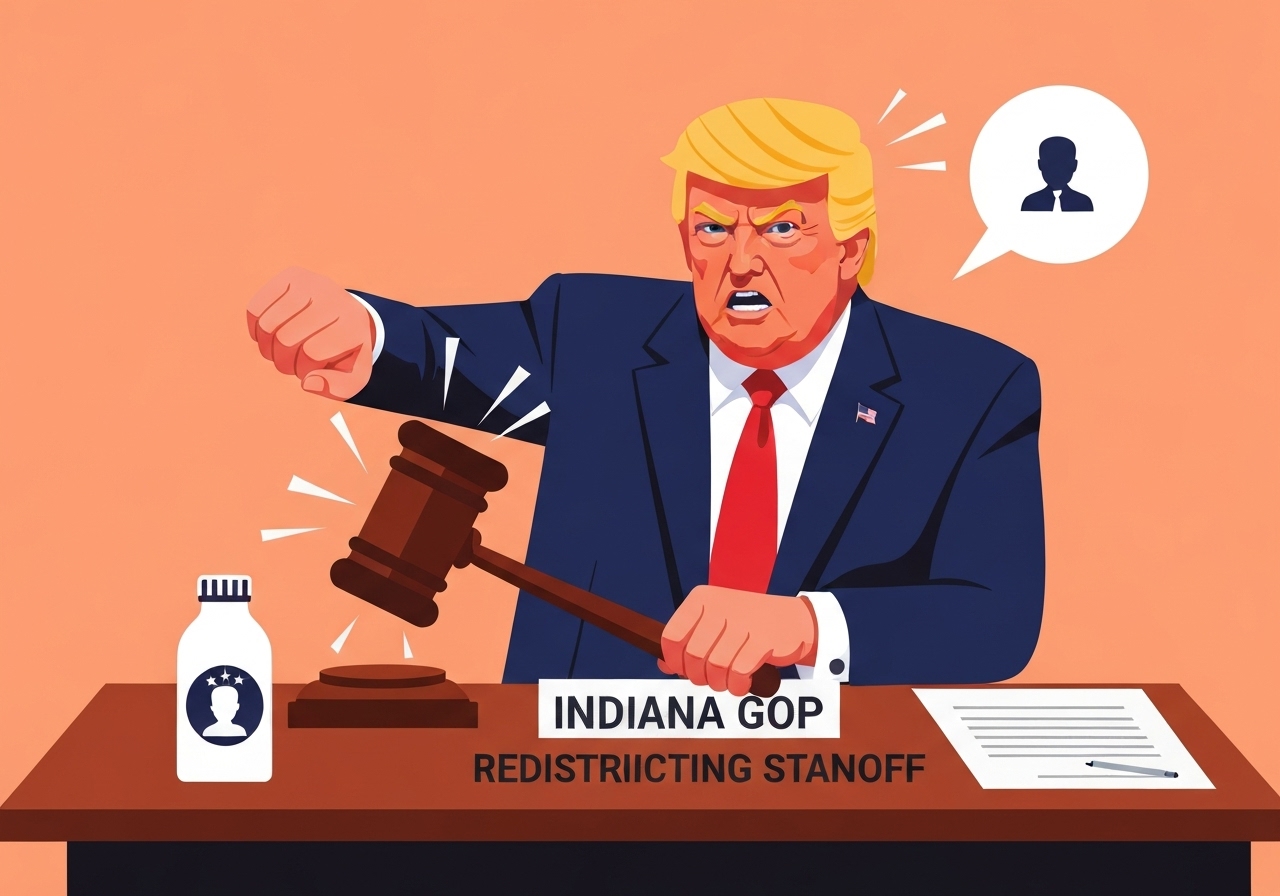
On Sunday, former President Donald Trump publicly chastised Republican state lawmakers in Indiana for declining to pursue mid-decade congressional redistricting, naming Senate leader Rodric Bray and state Sen. Greg Goode. He argued their reluctance could cost Republicans a House majority and urged primary challenges against GOP legislators who oppose map changes. The dispute follows a wave of redistricting fights nationwide after Texas’ recent push and comes amid pressure from Trump allies and visits by national figures to Indiana. Senate leadership has said there are not enough votes to advance new maps and that the chamber will not reconvene in December.
Key Takeaways
- Donald Trump posted on Truth Social that he was “very disappointed in Indiana State Senate Republicans,” singling out Senate President Pro Tempore Rodric Bray and state Sen. Greg Goode.
- Trump warned that Republicans who oppose redistricting should face primary challenges and urged Indiana GOP lawmakers to “do their job” or be removed from office “ASAP.”
- Senate leader Rodric Bray announced the chamber lacks sufficient support to pursue redistricting and said the Senate will not reconvene in December.
- Gov. Mike Braun previously called a special legislative session in October to consider new congressional maps and has continued to press senators to act.
- Vice President J.D. Vance visited Indiana and the Trump administration has actively encouraged GOP-led redistricting to improve midterm prospects.
- The push follows a broader national pattern set off by Texas’ mid-decade redistricting effort and recent voter action in California earlier this month supporting a map-related measure backed by Gov. Gavin Newsom.
Background
Mid-decade redistricting—when state legislatures redraw congressional boundaries between decennial censuses—has become a flashpoint in U.S. politics. Texas’ recent initiative sparked a string of partisan efforts in state capitols, with both parties seeking lines that favor their House candidates ahead of next year’s midterm elections. Republicans see new maps as a mechanism to strengthen their congressional prospects; Democrats and ballot measures in several states have pushed back or sought reforms.
Indiana’s leaders have been pulled into that national contest. Gov. Mike Braun convened a special session in October to consider redrawing the state’s congressional maps, signaling executive interest in moving the process forward. At the same time, state Senate Republicans, led by Rodric Bray, studied the idea for months but concluded they lacked the votes to proceed. That internal disagreement within the state GOP has created a high-profile confrontation with national Republicans who want decisive action.
Main Event
On Sunday, Trump used Truth Social to lambaste Indiana lawmakers for not advancing new congressional lines, explicitly naming Bray and Goode and accusing them of acting in ways that could cost Republicans a majority in the U.S. House. He characterized the two as “politically correct type ‘gentlemen'” and urged aggressive political consequences for those who resist redistricting. Trump’s intervention intensified pressure on state legislators already weighing procedural and political risks.
Bray responded earlier in the week with a public statement saying Senate Republicans had carefully reviewed the possibility of redrawing maps but that “there are not enough votes to move that idea forward,” and announced the Senate would not reconvene in December. The announcement came despite outreach from the Trump camp and visits by national leaders intended to sway lawmakers.
A spokesperson for state Sen. Greg Goode, Lance Gideon, reiterated Goode’s stance that he would not take a public position until an official map and bill were formally introduced on the Senate floor. That restraint highlights a procedural posture among some senators who prefer to see legislation before committing, even as advocates demand immediate action.
Gov. Braun has continued to press for new maps, framing the issue as a matter of doing the right thing and urging senators to show up and vote for what he called “fair maps.” Representatives for both Braun and Bray did not immediately respond to requests for further comment on weekend postings and subsequent developments.
Analysis & Implications
The clash in Indiana underscores how mid-decade redistricting has shifted from occasional state-level maneuvering to a nationalized partisan strategy. For Republicans, winning congressional seats in next year’s midterms depends in part on favorable state maps; that incentive explains the intensity of pressure from former President Trump and allies. Conversely, the intra-party split in Indiana reveals limits to centralized influence when state legislators prioritize local politics, legal risk, or procedural caution.
Threats of primary challenges, as advocated by Trump, can reshape internal GOP dynamics, forcing vulnerable incumbents to weigh the costs of yielding to national leaders versus standing on procedural principles. Primarying sitting lawmakers can produce more ideologically driven candidates but also risks intra-party fractures that could weaken general-election prospects. In Indiana specifically, the decision not to reconvene in December closes an immediate legislative pathway to new maps, at least for the short term.
Nationally, continued attempts at mid-decade redistricting raise legal and political questions. Courts have sometimes rebuked maps drawn for overt partisan purposes, and state-level ballot measures—like the one approved in California—signal voter appetite for reforms or countermeasures. If more states pursue mid-decade changes, expect a mix of legislative fights, executive interventions, and litigation in the months ahead.
Comparison & Data
| State | Recent Action | Current Status |
|---|---|---|
| Texas | Launched mid-decade redistricting push | Map effort initiated; spurred national responses |
| California | Voters approved a redistricting-related measure earlier this month | Ballot-backed reform enacted |
| Indiana | Governor called special session in October; Senate studied maps | Senate reports insufficient votes; will not reconvene in December |
The table highlights divergent state outcomes: Texas’ aggressive action catalyzed other states, California moved by ballot measure, and Indiana remains stalled after legislative review. Those differences reflect varying institutional choices—executive calls for sessions, legislative majorities, and direct voter interventions—that shape the feasibility of mid-decade map changes.
Reactions & Quotes
Trump’s public remarks were brief but pointed; they increased national attention on a state issue and signaled that party leaders may seek to punish inaction.
“I was very disappointed in Indiana State Senate Republicans,”
Donald J. Trump (Truth Social post)
Bray framed the decision as the outcome of deliberation within the Senate, emphasizing procedural realities and vote counts rather than political pressure.
“There are not enough votes to move that idea forward, and the Senate will not reconvene in December,”
Rodric Bray (Senate statement)
Goode’s office stressed a cautious, procedural approach: the senator said he would wait to see any formal map or legislation before taking a public position, signaling that some lawmakers are reluctant to endorse hypotheticals.
“He would not take a public stance unless and until he saw an officially introduced map and legislation on the floor of the State Senate,”
Lance Gideon (spokesperson for Sen. Greg Goode)
Unconfirmed
- Whether Trump’s social‑media intervention materially influenced any individual senator’s vote remains unclear and unverified by direct admission from lawmakers.
- It is not confirmed that primary challenges will be filed against the specific Indiana senators named; such campaigns are likely but not yet announced.
- Any downstream effect on the House majority attributable specifically to Indiana’s decision is speculative and depends on future map configurations and electoral outcomes.
Bottom Line
The dispute in Indiana illustrates how national agendas can collide with state legislative realities: Trump and allied Republicans demand swift redistricting to improve midterm prospects, while some state senators prioritize procedure, vote counts, and risk management. With the Indiana Senate declaring insufficient support and declining to reconvene in December, the immediate pathway to new maps is blocked.
Expect continued pressure from national figures and potential political consequences for holdouts, including calls for primaries. At the same time, legal, political, and institutional barriers mean that map contests will likely play out over many months, with significant implications for party strategy leading into next year’s midterm elections.
Sources
- NBC News (national news report)