
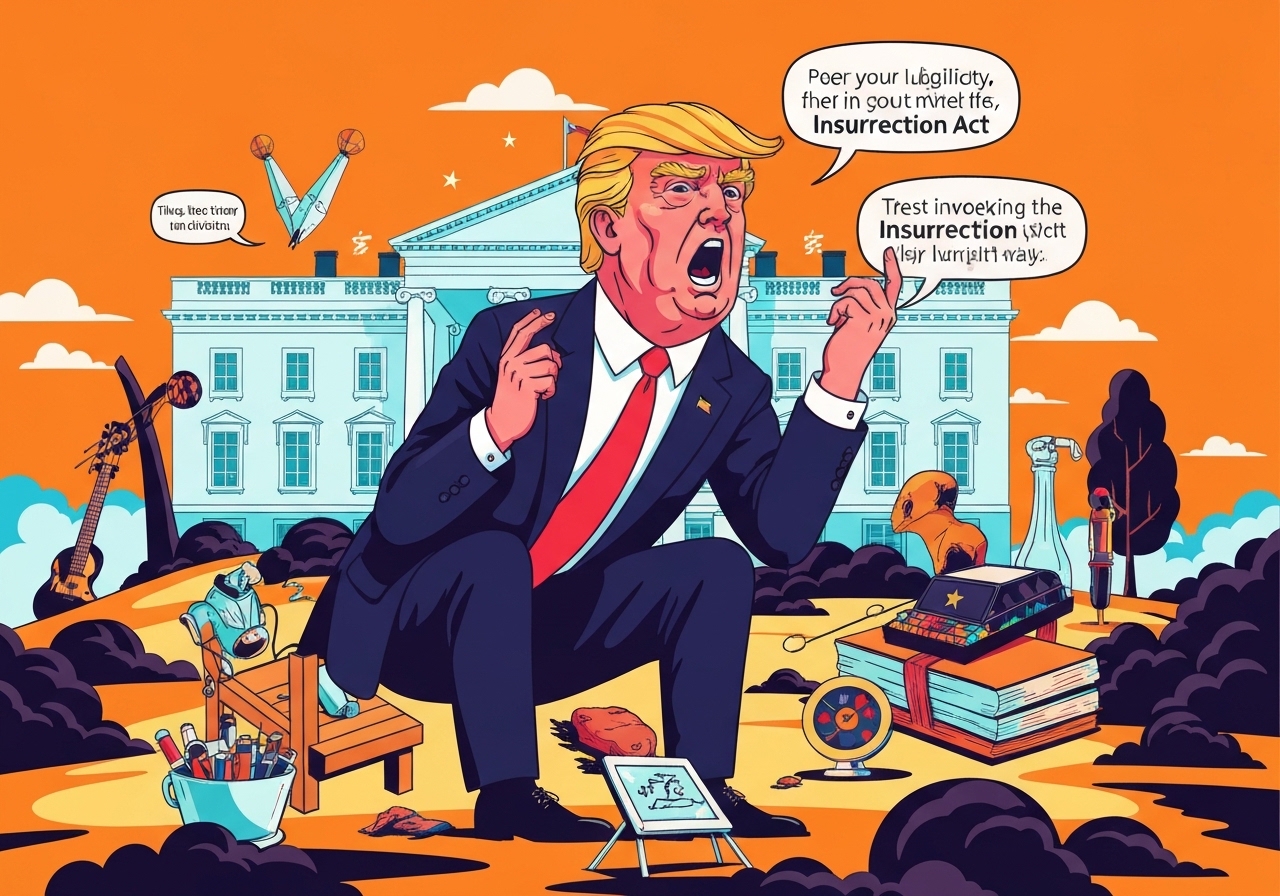
Lead: Former President Donald Trump, 79, told NewsNation on Tuesday he would not hesitate to invoke the Insurrection Act if federal officials deemed it necessary amid rising tensions around Immigration and Customs Enforcement (ICE) activity near Minneapolis, Minnesota. He said the situation there did not yet require deploying active-duty forces, but insisted military deployment would be an option he would use without reluctance. Trump also argued the statute has a long history of presidential use, a claim that overstates the frequency by some measures. His comments followed heated debate over ICE tactics after the fatal shooting of Renee Nicole Good earlier this month.
Key Takeaways
- Trump told NewsNation he would “not have any problem” invoking the Insurrection Act if he judged it necessary; the remark came during a discussion about ICE operations around Minneapolis.
- The Insurrection Act was enacted in 1807; Brennan Center records show 15 presidents invoked it a total of 30 times, with the most recent major use during the 1992 Los Angeles riots.
- Measured against 45 presidencies, the Brennan Center’s tally implies roughly 33% usage; counting distinct presidents (42 individuals) gives just under 36%.
- Trump has publicly suggested invoking the Act in a Truth Social post criticizing Minnesota officials and accusing “professional agitators” of attacking ICE agents.
- Debate over using military forces for domestic law enforcement raises constitutional, legal and political questions that would likely trigger litigation and congressional scrutiny.
Background
The Insurrection Act, first passed in 1807, grants the president authority to deploy the military within the United States to suppress insurrection, domestic violence, or unlawful obstruction of laws when local authorities are unable or unwilling to enforce order. Historically, presidents have turned to the law in a range of circumstances—from early 19th-century insurrections to civil rights-era interventions and the 1992 Los Angeles riots. Its use has always been politically charged because it involves active-duty forces operating on U.S. soil, blurring lines between military and civilian law enforcement.
Concerns over federal intervention have intensified as high-profile incidents involving immigration enforcement draw national attention. This month’s case in Minneapolis—the fatal shooting of Renee Nicole Good by an ICE agent—has become a focal point for opponents of ICE tactics and for commentators arguing for stronger federal action. The tension has revived earlier debates: during 2020 unrest, and late last year when White House officials reportedly weighed deploying National Guard forces to cities and discussed the legal mechanics of invoking the Act.
Main Event
In the NewsNation interview, Trump said he did not currently see a need to activate the Insurrection Act for the Minneapolis area but framed the statute as a ready tool. He suggested critics overplay the severity of invoking it and pointed to presidential precedent as proof of its routine application. He also described the Act as a way to bypass ordinary judicial processes—a claim he presented as an operational advantage.
Trump’s remarks included an assertion that more than 40% of presidents have used the law; that percentage is higher than the Brennan Center’s historical accounting. Officials and analysts note that while the Act has been invoked multiple times, the picture is uneven—several presidents invoked it repeatedly while many others never did. Trump reiterated his willingness to order military intervention in a Truth Social post that singled out Minnesota’s state and local officials.
The context of the interview was a panel discussion on ICE tactics and community responses in Minneapolis. Trump tied the possible use of the Act to his view that local authorities might be failing to control organizers he called “professional agitators,” and he framed federal intervention as necessary to protect ICE personnel performing their duties.
Analysis & Implications
Legal scholars say invoking the Insurrection Act would trigger immediate constitutional and statutory scrutiny. Once a president orders federal troops into a domestic law-enforcement role, affected parties—states, municipalities, civil liberties groups—can and likely would seek rapid judicial review, raising questions about separation of powers, Posse Comitatus implications, and the scope of the president’s emergency authority. Courts have not been uniformly deferential on such uses, and litigation timelines could complicate a swift, unchallenged deployment.
Politically, the move would deepen partisan divisions and could provoke resistance from state and local leaders, especially in jurisdictions where officials oppose federal intervention. Deploying forces to protect federal agents or enforce federal statutes in a state that objects would place governors, mayors and federal executives in a direct conflict—with political and operational consequences for local policing, community trust, and public safety coordination.
Operationally, using active-duty military inside U.S. cities presents logistical and training questions: troops are trained for combat and national defense, not routine policing. Historical deployments have sometimes led to escalations, misunderstandings, and criticism when military personnel engaged in crowd control or law enforcement tasks. Any large-scale use would likely necessitate careful rules of engagement and coordination with the Defense Department and the Department of Justice.
Comparison & Data
| Measure | Value |
|---|---|
| Total presidencies considered | 45 presidencies |
| Distinct presidents who invoked Act | 15 presidents |
| Total invocations (historical) | 30 times |
| Usage rate (by presidencies) | ~33% |
The Brennan Center’s count—15 presidents invoking the Act 30 times—provides a baseline for assessing Trump’s assertion that the law is “very common.” Depending on how one measures prevalence (by distinct presidents or by number of presidencies), the figure ranges from about 33% upward to just under 36% when excluding repeated presidencies; both are lower than the “over 40%” figure Trump offered. The most recent major presidential use cited in public records occurred during the 1992 Los Angeles riots.
Reactions & Quotes
“I would not have any problem with invoking it if we needed it.”
Donald Trump, NewsNation interview
Trump used that language to signal readiness to use extraordinary federal authority while also saying he preferred not to do so if unnecessary.
“It is actually very common—…it’s been used by over 40 percent of the presidents during their term.”
Donald Trump, NewsNation interview
That characterization prompted fact-checking: independent analysts and the Brennan Center reported lower historical rates of invocation.
“I will institute the INSURRECTION ACT, which many Presidents have done before me, and quickly put an end to the travesty that is taking place in that once great State.”
Donald Trump, Truth Social post
The Truth Social post framed potential intervention as a response to what Trump described as local failures to control unrest and to protect ICE agents.
Unconfirmed
- Whether the Minneapolis incidents would legally meet the Insurrection Act’s statutory threshold is unresolved and would depend on specific facts and legal interpretation.
- Trump’s numeric claim that “over 40 percent” of presidents used the Act does not match the Brennan Center’s public tally and is therefore overstated.
- Reports that White House aides discussed invoking the Act last year have been reported by some outlets but lack full public documentation of internal decision memos or final legal advice.
Bottom Line
Trump’s remarks underscore how the Insurrection Act remains a politically potent, legally fraught instrument for presidents considering domestic military deployment. While he framed the statute as a routine executive tool, historical data show its use is episodic and often contested. Any actual invocation would likely prompt fast-moving legal challenges and a national political fight over federal authority and civil liberties.
For readers monitoring the situation, the critical near-term indicators to watch are: statements from Minnesota officials about their capacity and willingness to enforce law, any formal federal orders or legal memos authorizing deployment, and rapid filings by state or civil-rights litigants seeking injunctions. Those steps will determine whether talk of invoking the Act remains rhetoric or becomes a consequential executive action.
Sources
- The Daily Beast — news reporting on the interview and statements (media).
- Brennan Center for Justice — research and historical tally of Insurrection Act invocations (legal research/advocacy).
- Truth Social — platform post by Donald Trump cited in remarks (primary source platform).