
Lead
On January 15, 2026, President Donald Trump warned he might invoke the Insurrection Act to send federal troops to Minnesota as protests and confrontations surrounding aggressive ICE operations escalated in the Twin Cities. The threat followed a night when an ICE officer shot a Venezuelan man in the leg after agents were allegedly attacked, and came one week after an ICE officer fatally shot 37-year-old Renee Good. State leaders, civil-rights groups and federal agencies have responded with lawsuits, independent probes and public condemnations.
Key Takeaways
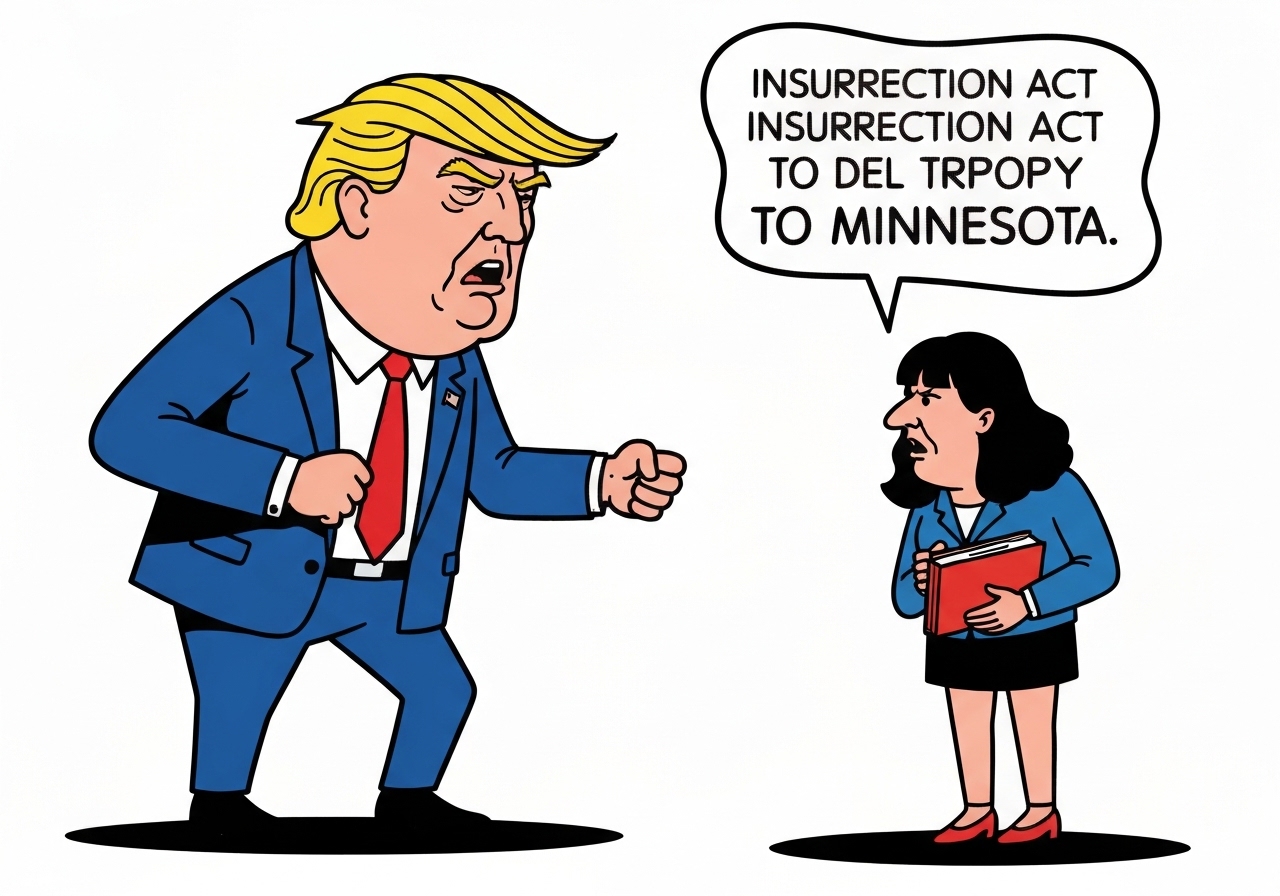
- President Trump publicly threatened to invoke the Insurrection Act on January 15, 2026, saying he would “institute the INSURRECTION ACT” to end unrest in Minnesota.
- The Department of Homeland Security reports roughly 2,500 arrests tied to “Operation Metro Surge” and has said nearly 3,000 ICE/CBP agents are deployed in the area.
- An ICE agent shot a Venezuelan national in north Minneapolis on January 14; the man was reported to be expected to survive.
- One week earlier an ICE officer fatally shot Renee Good in south Minneapolis; that death has spurred sustained protests and legal action.
- Minnesota officials have filed lawsuits seeking to halt federal operations; a judge denied a temporary restraining order on January 14, 2026, pending further evidence.
- The Minnesota Bureau of Criminal Apprehension (BCA) launched an independent force investigation into the January 14 shooting; the FBI collected evidence at the scene.
- The ACLU of Minnesota announced a class-action suit alleging constitutional violations by federal agents; Minnesota Attorney General Keith Ellison said he would challenge a federal military deployment in court.
- The FBI offered up to $100,000 for tips after protesters smashed into unmarked FBI vehicles; law enforcement reported sensitive items were stolen.
Background
The immediate escalation stems from “Operation Metro Surge,” a DHS-directed deployment to the Minneapolis–Saint Paul area that federal officials say has led to about 2,500 arrests and the presence of thousands of agents. The operation intensified after the fatal January shooting of Renee Good, which protesters and community leaders cite as evidence of unchecked federal force in Minneapolis neighborhoods. Federal officials defend the enforcement as targeting dangerous offenders and protecting communities.
President Trump and Homeland Security Secretary Kristi Noem have publicly backed the surge; local and state officials, including Gov. Tim Walz and Attorney General Keith Ellison, say the federal response is unlawful and harmful. The legal and political clash follows a long history of tension over federal use-of-force authority on U.S. soil and revived debate over the Insurrection Act, a statute with roots in the 1790s and infrequent modern use.
Main Event
On the evening of January 14, 2026, an ICE arrest operation in north Minneapolis culminated in an agent shooting a Venezuelan man in the leg after local officials and federal statements said the agent was attacked with a shovel and broom handle. A crowd gathered and clashes with law enforcement continued into the night, with police reporting thrown objects and use of crowd-control tactics. Minneapolis leaders called for calm; Gov. Walz issued a primetime appeal asking federal authorities to “end this occupation.”
The next day, President Trump posted on social media that he would invoke the Insurrection Act if Minnesota leaders did not “stop the professional agitators and insurrectionists,” promising to “quickly put an end” to the unrest. DHS Secretary Noem characterized the incident as an attempted murder of a federal officer and said DHS had no plans to withdraw agents. Minnesota officials, including Sen. Tina Smith, called the president’s threat tantamount to “declaring war on Minnesota.”
Legal responses multiplied: Minnesota’s AG and the mayors of Minneapolis and St. Paul filed a lawsuit alleging unconstitutional federal actions, while the ACLU of Minnesota announced a class-action suit on behalf of residents who say federal agents violated their rights. A federal judge denied an immediate restraining order on January 14, leaving litigation and investigative processes ongoing. Separately, the Minnesota BCA opened an independent force investigation and the FBI also collected evidence at the scene.
Analysis & Implications
Invoking the Insurrection Act would be legally and politically fraught. Historically used sparingly and most recently in 1992 during the Los Angeles unrest, the statute gives the president authority to deploy troops domestically but is constrained by constitutional checks and by courts when state-federal disputes arise. Legal experts say courts are likely to scrutinize any unilateral federal military deployment for violations of the Posse Comitatus principle and the Tenth Amendment if governors object.
Even a threatened invocation alters local dynamics. The prospect of federal troops on city streets can deepen community fear, undermine trust in law enforcement, and escalate confrontations between residents and federal officers. Local officials have emphasized civil liberties and public-health impacts—schools moving to remote learning, workers staying home, and calls for eviction moratoria—while law enforcement leaders warn of increased risk to officers and agents.
Politically, the president’s threat shifts the dispute from courtroom to national debate, energizing both supporters of strict immigration enforcement and critics alarmed by perceived federal overreach. Litigation over the Denver/Chicago deployments and the Supreme Court’s recent rejection of some federal deployment plans suggest judges could limit a future invocation; at the same time, rapid operational deployments and public-safety arguments can produce de facto effects on the ground before litigation resolves.
Comparison & Data
| Item | Reported Figure |
|---|---|
| Arrests tied to Operation Metro Surge | ≈ 2,500 (DHS) |
| ICE/CBP agents reported deployed | Nearly 3,000 (DHS statements) |
| Notable recent invocation of Insurrection Act | 1992 (President George H.W. Bush, Los Angeles) |
The table places current force levels and arrests in context: DHS describes the Minnesota operation as among the largest in its history, while legal precedent for the Insurrection Act is rare and typically tied to domestic unrest with local consent. These numbers frame the scale of enforcement and the potential scope of any federal response that includes troops.
Reactions & Quotes
The president’s post drew swift pushback from Minnesota officials and civil-rights advocates, and support from federal law-enforcement leaders. Below are representative remarks and their contexts.
“If the corrupt politicians of Minnesota don’t obey the law… I will institute the INSURRECTION ACT… and quickly put an end to the travesty that is taking place in that once great State.”
President Donald Trump (social media post, Jan. 15, 2026)
This post followed the January 14 shooting and framed the administration’s posture as one of law-and-order enforcement; it also prompted immediate legal threats from state officials.
“This is akin to declaring war on Minnesota.”
Sen. Tina Smith (off-camera interview)
Sen. Smith used strong language to describe the political and social consequences she fears from federal militarized deployment and signaled intent to use all available powers to protect state residents.
“What we saw last night… was an attempted murder of federal law enforcement.”
Homeland Security Secretary Kristi Noem (statement)
Noem framed the same events as justification for continued federal presence and for robust enforcement actions, asserting agents were under violent attack.
Unconfirmed
- Video circulated by some officials and social media users of the January 14 incident has not been independently verified to confirm sequence and provenance of events.
- Claims that specific individuals or groups organized the attacks on federal vehicles remain under investigation and have not been fully substantiated in public filings.
- Some on-scene accounts that ICE agents operated without badges or wore unmarked clothing are reported by witnesses but have not been comprehensively corroborated by agency disclosures.
- Public statements about the level of community support for the ICE operation (for example, a 90–95% support claim) lack contemporaneous, representative polling data focused on Minnesota to validate the figure.
Bottom Line
The presidential threat to use the Insurrection Act has elevated a local law-enforcement conflict into a national constitutional and political standoff. Key near-term developments to watch include the Minnesota BCA’s independent force investigation, court challenges led by state officials and the ACLU, and whether federal agencies alter tactics in response to legal pressure and public reaction.
Any actual invocation of the Insurrection Act would almost certainly face immediate legal challenges and deepen community tensions. For residents, workers and institutions in Minneapolis–Saint Paul, the practical consequences—school closures, staffing shortages, and daily fear around enforcement—are already material and likely to persist while litigation and investigations proceed.
Sources
- CBS News — Live updates on Minnesota ICE operations and protests (news organization)
- U.S. Department of Homeland Security — Press releases and statements (federal agency)
- Minnesota Bureau of Criminal Apprehension — Force Investigation Unit (state law-enforcement agency)
- ACLU of Minnesota — Press releases and litigation notices (civil-rights organization)
- Office of the Minnesota Attorney General — Filings and statements (state government)