
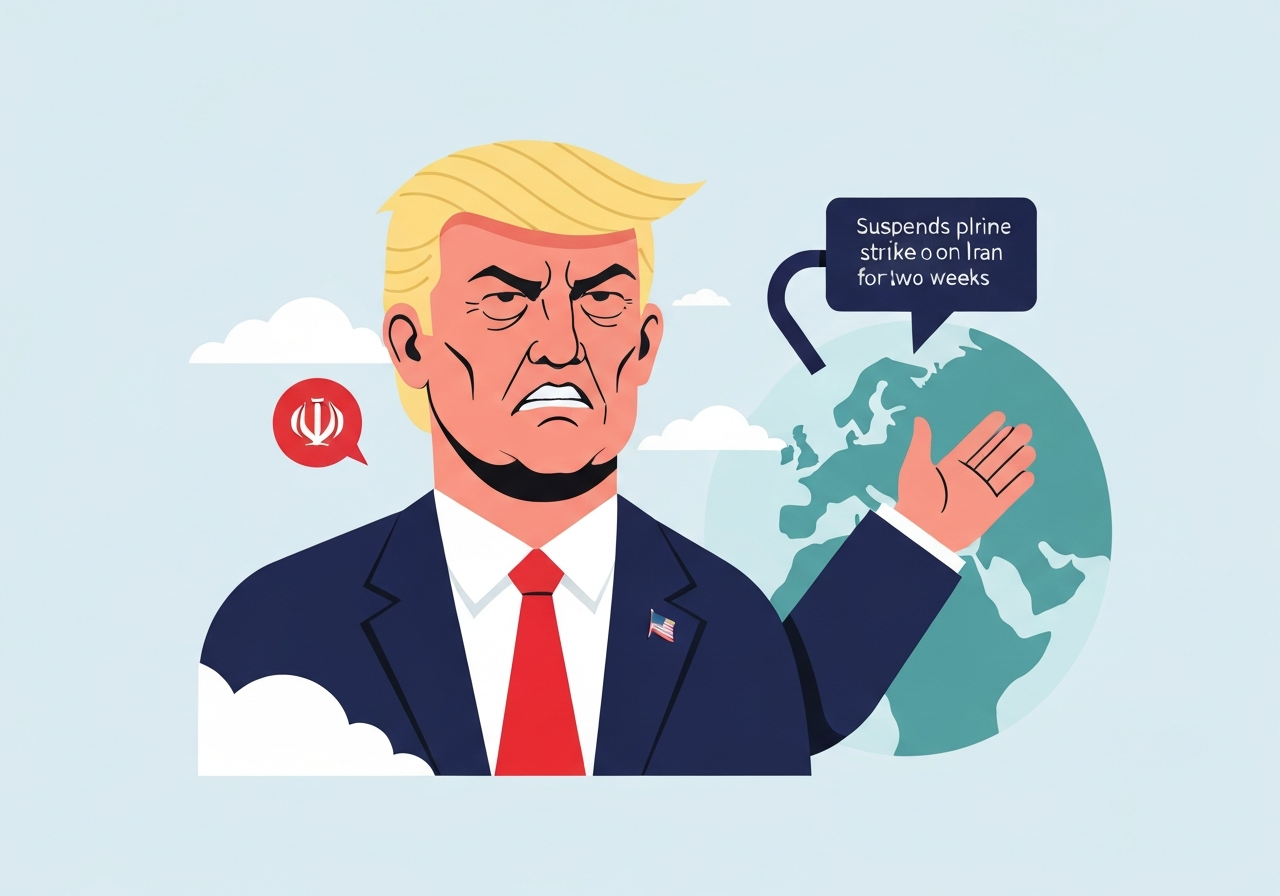
Lead: United States President Donald Trump announced on the evening of 7 April 2026 that he will suspend a planned bombing campaign against Iran for 14 days after a last‑minute mediation effort and a high‑stakes ultimatum. The pause follows a morning social‑media message from Trump that warned a “whole civilization” could be destroyed if Tehran did not comply. Tehran, through Foreign Ministry spokesman Abbas Araghchi, confirmed tentative coordination to allow safe passage through the Strait of Hormuz during the two‑week window. Pakistan’s leadership was credited with mediating the temporary agreement and further negotiations have been scheduled in Islamabad.
Key Takeaways
- President Trump posted the suspension at 6:32pm US Eastern (22:32 GMT) on 7 April 2026, about 90 minutes before his original 8:00pm (00:00 GMT) deadline.
- The pause is explicitly time‑bound: a two‑week suspension contingent on Iran reopening the Strait of Hormuz for safe passage.
- Iran’s Foreign Ministry said its armed forces would halt defensive operations and coordinate safe passage for two weeks if attacks are halted.
- Pakistan’s Prime Minister Shehbaz Sharif and Army Chief Field Marshal Asim Munir were named by Trump as mediators in the last‑minute settlement.
- The conflict has been active since 28 February 2026; reported fatalities include nearly 2,076 in Iran, 28 in neighbouring Gulf states, 26 in Israel and 13 US military personnel.
- The Strait of Hormuz carries nearly 20% of the world’s oil and gas shipments; its closure has been linked to recent global fuel price spikes.
- U.S. and Israeli officials say military objectives have been met; legal experts continue to debate the lawfulness of the initial offensive.
Background
Hostilities began on 28 February 2026 when U.S. and Israeli forces initiated a joint military operation targeting Iranian capabilities they described as a regional threat. The campaign rapidly expanded into a wider confrontation involving strikes across multiple theatres and prompted substantial civilian and military casualties. International concern increased as Tehran responded by restricting traffic through the Strait of Hormuz, a chokepoint for roughly one‑fifth of global oil and gas shipments, driving energy prices up worldwide.
Over recent weeks President Trump set a series of hard deadlines tied to demands that Iran reopen the strait, repeatedly postponing planned strikes as diplomacy and pressure continued simultaneously. Legal scholars and some governments characterized parts of the offensive as potentially unlawful, citing attacks on infrastructure and civilian targets, while U.S. and Israeli officials argued the operations were necessary to degrade perceived threats and prevent nuclear proliferation.
Main Event
On the evening of 7 April 2026, Trump used his Truth Social account to announce that, following talks with Pakistan’s leaders, he would delay bombing Iran for two weeks provided Tehran agreed to fully and immediately reopen the Strait of Hormuz. The post came at 6:32pm Eastern, about an hour and a half before the president’s self‑imposed 8pm deadline for strikes.
Shortly afterwards, Iran’s Foreign Ministry official Abbas Araghchi said that a tentative agreement had been reached: if U.S. attacks were halted, Iran’s armed forces would suspend defensive operations and allow coordinated, technically constrained passage through the strait for a two‑week period. Iran’s Supreme National Security Council signalled that an extension would be possible if negotiations progressed positively.
Trump framed the move as the result of having met military objectives and receiving a “ten‑point” ceasefire proposal from Iran that he described as a workable basis for a long‑term peace deal. He said the next 14 days would be used to finalise the agreement, while warning that the pause was conditional on Iran’s compliance and opening of the waterway.
Analysis & Implications
The immediate implication is a reduction in the likelihood of wide‑scale air strikes and the acute risk of retaliatory escalation in the coming fortnight, giving regional actors and global markets a brief window of relative calm. Economically, even a temporary reopening of the Strait of Hormuz could ease upward pressure on energy prices, though markets will watch for proof of sustained maritime access rather than promises alone.
Strategically, the United States’ ability to translate its military advantages into a negotiated settlement will depend on enforcement mechanisms and the willingness of other key actors—especially Israel—to align with Washington’s terms. Analysts note that Israel has previously acted with operational autonomy, and differing national thresholds for escalation could complicate implementation.
Politically, Trump’s announcement reflects a blend of coercion and diplomacy: threats of force followed by conditional suspension framed as leverage for a broader bargain. That posture may produce short‑term gains but risks undermining long‑term trust among local partners if promises or limits are perceived as reversible or ambiguous.
Comparison & Data
| Category | Reported Toll / Date |
|---|---|
| Fatalities in Iran | Nearly 2,076 (since 28 Feb 2026) |
| Fatalities in nearby Gulf states | 28 |
| Israeli fatalities | 26 |
| U.S. military fatalities | 13 |
| Strait of Hormuz share of global oil/gas | ~20% |
The table highlights the human costs reported since the start of the campaign on 28 February 2026 and the strategic significance of the Strait of Hormuz. Even with a two‑week pause, the humanitarian toll and infrastructure damage will shape reconstruction needs and diplomatic bargaining chips in any follow‑on talks.
Reactions & Quotes
“A whole civilization will die tonight, never to be brought back again.”
Donald Trump (Truth Social post, morning of 7 April 2026)
This stark warning from Trump earlier on 7 April raised regional alarm and framed the urgency he said necessitated immediate action; the later suspension followed hours after that message.
“If attacks against Iran are halted, our Powerful Armed Forces will cease their defensive operations.”
Abbas Araghchi, Iran Foreign Ministry spokesperson
Araghchi’s statement signalled Tehran’s conditional willingness to coordinate limited maritime passage for two weeks, while stressing technical limitations and the tentative nature of the agreement.
“That is going to be a big sigh of relief … because the alternative was so horrific.”
Osama Bin Javaid, Al Jazeera correspondent
Field reporting emphasised regional relief at the pause but also scepticism about durability and scope, with commentators noting ambiguity over which operations are fully included in the suspension.
Unconfirmed
- It is unclear whether the two‑week suspension covers all ongoing military operations or only prospective new strikes; official texts of the arrangement have not been published.
- No public, independently verifiable document detailing Iran’s alleged “10‑point” proposal has been released; reporting relies on statements from involved parties.
- The extent to which Israel will halt its own strikes—especially against Hezbollah and other regional actors—remains uncertain and unverified.
Bottom Line
The two‑week suspension announced on 7 April 2026 reduces the immediate risk of a large‑scale U.S. bombing campaign and creates a narrow window for diplomacy, conditional on Iran reopening the Strait of Hormuz and on compliance by regional partners. The pause shifts the conflict from imminent bombardment to intensive negotiation, but does not resolve underlying strategic disputes that precipitated the crisis.
Observers should watch for concrete verification that maritime traffic is being restored, whether independent monitors are granted access, and whether allied actors—particularly Israel—adjust their operations to match the U.S. commitment. The durability of the pause will hinge on implemented safeguards, transparency of any agreement, and whether the two weeks yield substantive, verifiable steps toward a longer‑term settlement.