
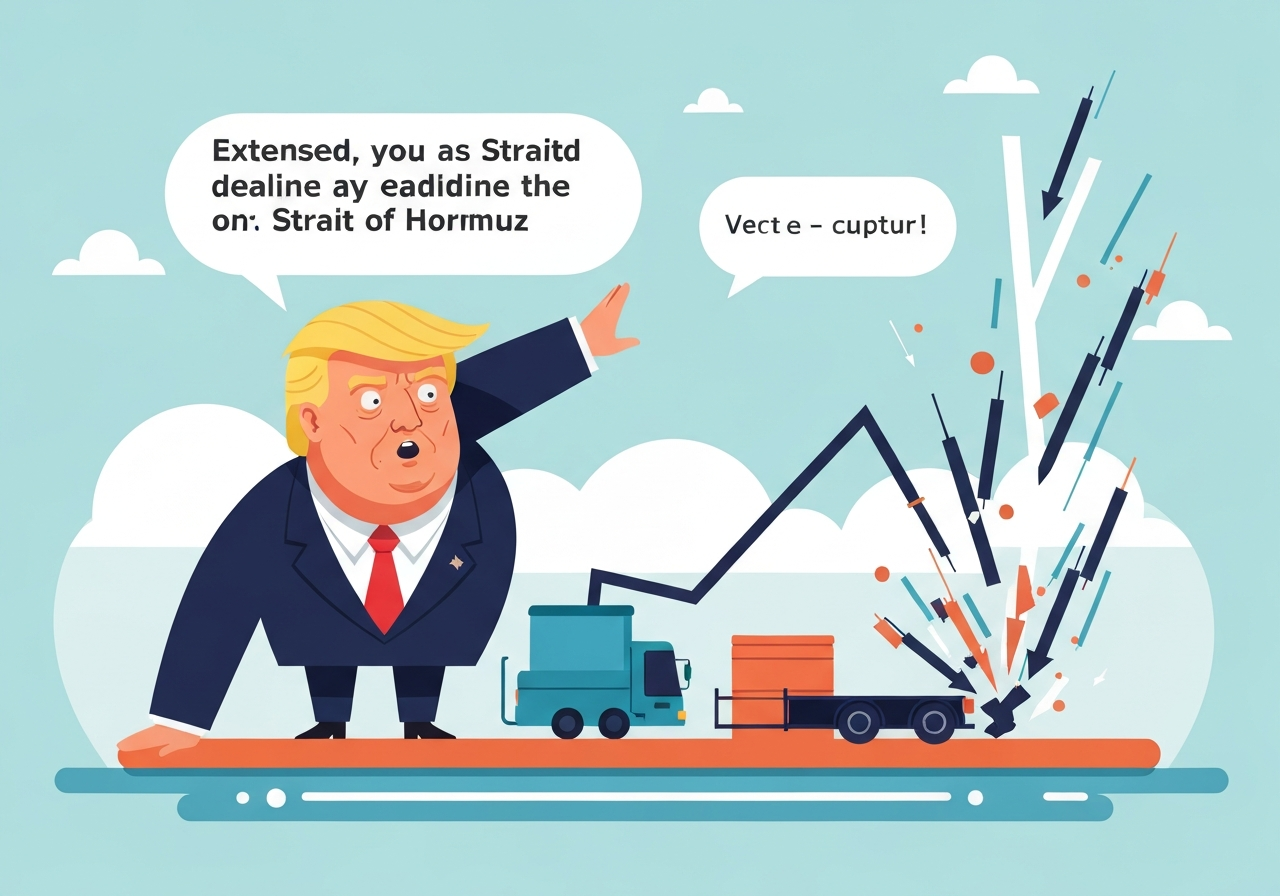
Lead: On March 26, 2026, President Trump announced a 10-day extension to his demand that Iran reopen the Strait of Hormuz, moving the new deadline to April 6 at 8 p.m. ET after saying talks with Tehran were progressing. The shift in tone came the same day Israel said it had killed an Iranian naval commander tied to efforts to close the strait. U.S. markets reacted sharply: the S&P 500 closed down 1.7 percent and Brent crude jumped to about $108.01 a barrel.
Key Takeaways
- President Trump extended the deadline for Iran to reopen the Strait of Hormuz by 10 days to April 6 at 8 p.m. ET; he said the extension followed an “Iranian Government request.”
- Israel announced it had killed an Iranian naval commander who played a key role in efforts to block traffic through the strait.
- Mr. Trump had earlier threatened to destroy Iranian power plants if Tehran did not comply within 48 hours and had previously pushed the timeline forward to a Friday deadline.
- Financial markets reacted: the S&P 500 fell 1.7 percent at Thursday’s close — the steepest daily decline since the war began — while Brent crude rose about 5.7 percent to $108.01 a barrel.
- Special envoy Steve Witkoff and Jared Kushner reported receiving “strong signs” from Iran after sending a 15-point action list via Pakistani intermediaries.
- Iran had not issued an immediate public response to the latest extension as of the update on March 27, 2026.
Background
The Strait of Hormuz, a strategic chokepoint through which a significant portion of global oil exports transit, has become a flashpoint in the wider conflict between Iran and opposing coalitions since hostilities escalated earlier in 2026. Disruptions there have outsized consequences for global energy markets and for nations dependent on Gulf oil shipments. In recent weeks, Iranian-backed operations and naval maneuvers have tightened shipping routes and raised insurance and freight costs across the region.
President Trump issued an initial ultimatum demanding Iran reopen the strait within 48 hours, warning of strikes on Iranian power infrastructure if Tehran did not comply — a step that analysts warned could dramatically widen the war and invite retaliatory attacks on oil facilities. The administration later moved that deadline and then, on March 26, announced a further 10-day extension. Parallel diplomatic channels, including mediators in Pakistan, have been reported as active in attempting to defuse the standoff.
Main Event
On March 26, Mr. Trump addressed the nation and senior cabinet members, at times using robust language about forcing Iran to negotiate. Early remarks at a cabinet meeting included a hardline warning that Tehran must negotiate or face continuing strikes. By late afternoon the president posted that talks were “going very well” and said the extension reflected an Iranian request to delay compliance until April 6 at 8 p.m. ET.
That same day Israel publicly announced it had killed an Iranian naval commander whom it described as central to efforts that effectively disrupted traffic through the Strait of Hormuz. Israeli officials framed the strike as targeting a figure responsible for coordinating actions that endangered commercial shipping; Tehran’s immediate public response was not reported. The killing adds a kinetic element to what had been a tense diplomatic exchange.
Markets moved quickly to price the heightened uncertainty. At the close of trading, the S&P 500 dropped 1.7 percent, marking the largest single-day decline since the start of the war. Oil prices rose: Brent crude climbed roughly 5.7 percent to $108.01 per barrel, reflecting traders’ concerns about supply disruption from Persian Gulf shipping channels.
Analysis & Implications
The president’s decision to extend the deadline suggests a tactical pivot: using the threat of force as leverage while keeping open a window for negotiation. Extending the timeline by 10 days reduces the immediate risk of a new strike but keeps pressure on Tehran, maintaining the option of escalation if diplomacy stalls. This blended posture — simultaneous coercion and talks — is likely intended to extract concessions without triggering a broader conflict.
For global markets, the episode underscores the sensitivity of energy and equity markets to geopolitical signals. A nearly 6 percent jump in Brent crude translates into higher fuel costs worldwide and can feed through to inflationary pressures, complicating central-bank policy choices. The S&P’s one-day fall reflects investor re-pricing of geopolitical risk and the potential for supply-side shocks to corporate earnings and consumer spending.
Regionally, Israel’s strike and the killing of an Iranian commander raise the risk of retaliatory moves by Tehran or its proxies. Even if Iran refrains from immediate state-to-state escalation, asymmetric tactics — attacks on shipping, maritime harassment, or strikes on energy infrastructure — could become more likely. That prospect will keep military and insurance costs elevated for vessels operating in or near the Gulf.
Comparison & Data
| Metric | Prior Close | Close on Mar 26, 2026 | Change |
|---|---|---|---|
| S&P 500 | — | Down 1.7% | Largest daily fall since war began |
| Brent crude | ~$102.30 | $108.01 | +~5.7% |
The table above places the market moves from March 26 in context: equities suffered notable losses while oil rallied sharply. Rising oil prices reflect traders pricing in potential supply constraints tied to the Strait of Hormuz; the equity sell-off signals broader risk aversion among investors. Analysts will watch whether oil remains elevated and if equity volatility persists as diplomatic exchanges continue.
Reactions & Quotes
White House and administration officials framed the extension as a mix of pressure and engagement. Below are representative remarks and their context.
“If Iran did not negotiate, we’ll just keep blowing them away.”
President Donald Trump, cabinet meeting remark (reported)
The president’s blunt phrasing at a cabinet meeting illustrated the administration’s readiness to use military force as leverage. The statement preceded the later, more conciliatory social-media posts describing talks as “going very well.”
“We received strong signs that peace was possible after sending a 15-point action list through Pakistani mediators.”
Steve Witkoff, special envoy (reported)
Mr. Witkoff’s comment, reported by administration briefings, was cited as rationale for optimism and for the decision to extend the deadline. The claim rests on diplomatic communications routed through intermediaries and has not been independently verified.
“The targeted strike removed a commander associated with efforts to hamper commercial navigation in the strait.”
Israeli official statement (reported)
Israeli authorities described the operation as aimed at degrading capabilities that threatened maritime traffic; the killing adds a kinetic development to the diplomatic sequence and may alter Tehran’s calculations.
Unconfirmed
- Iran’s internal deliberations and whether the government formally requested the extension have not been publicly confirmed by Tehran as of March 27, 2026.
- Claims that the 15-point action list transmitted by U.S. envoys guarantees a roadmap to de-escalation remain unverified; independent corroboration of Iranian acceptance has not been reported.
- Details about the identity and operational role of the Iranian naval commander killed—beyond official Israeli descriptions—have not been independently authenticated in open sources.
Bottom Line
The administration’s extension of the Hormuz deadline to April 6 temporarily reduces the immediate threat of a U.S. strike, but it leaves a potent mix of coercion and diplomacy in place. Markets signaled anxiety: equities fell while oil spiked, reflecting the persistent premium for geopolitical risk tied to Gulf shipping lanes.
Watch the next ten days for three key indicators: any public Iranian response, evidence that the 15-point list yields concrete concessions, and further kinetic actions in the Gulf region. Each could materially change the risk calculus for markets and for regional security.
Sources
- The New York Times (news report) — original reporting on the March 26–27 developments, market movement, and official statements.