
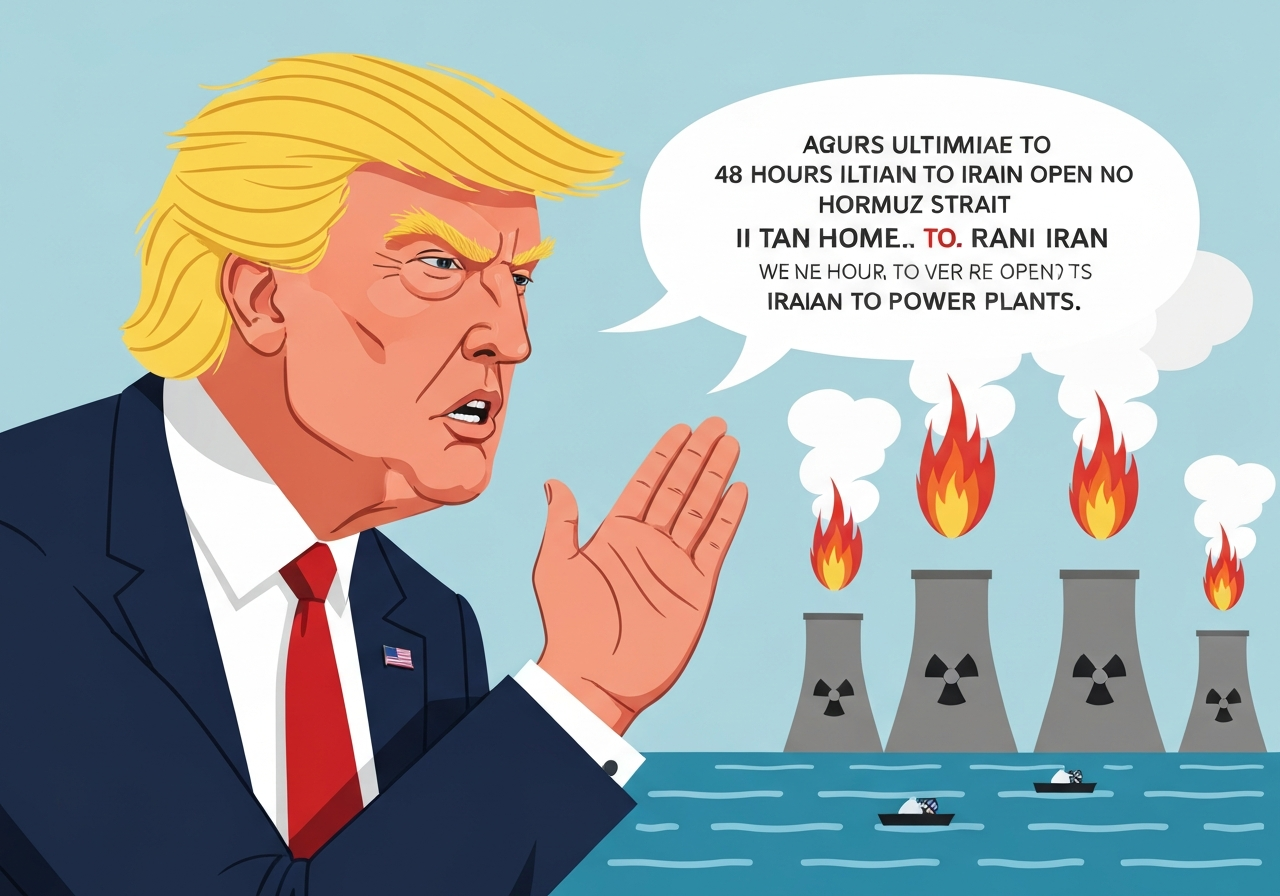
Lead: On March 22, 2026, U.S. President Donald Trump posted a 48-hour ultimatum demanding that Iran reopen the Strait of Hormuz to commercial shipping, after reports said the transit of oil and gas cargoes had been paralyzed. In the post, Trump warned he would strike Iranian power plants — beginning with the country’s largest — if the waterway was not reopened within the deadline. The statement marked a sharp escalation in rhetoric over a chokepoint that is vital to global energy flows. The warning prompted immediate international concern about potential military confrontation and energy-market disruption.
Key Takeaways
- President Donald Trump issued a social-media ultimatum on March 22, 2026, giving Iran 48 hours to reopen the Strait of Hormuz to commercial shipping.
- The post said the U.S. would “hit and obliterate” Iran’s power plants beginning with its largest facility if the strait remained closed; the phrase is reported verbatim by Bloomberg.
- Bloomberg reported the action followed a paralysis in the passage of oil and gas cargoes through the strait, a key artery for seaborne energy exports.
- The deadline introduces an immediate window for diplomatic de-escalation or rapid escalation with potential regional military consequences.
- Global energy markets and insurance costs for tankers could react quickly if the strait remains disrupted, given its role in seaborne oil transport.
- No independently verified government report of damage or planned strikes was available at the time of reporting.
Background
The Strait of Hormuz is a narrow maritime channel between the Persian Gulf and the Gulf of Oman that has been central to geopolitical friction for decades. Historically, roughly one-fifth of globally traded seaborne oil has transited the strait, making any disruption a catalyst for rapid market responses and international diplomatic activity. Tensions between the United States and Iran have flared repeatedly in the region, with periodic incidents involving naval confrontations, seizures of tankers and sanctions-driven pressure since 2018.
Control or denial of access to Hormuz has long been among the most consequential leverage points Tehran possesses, while the United States and its partners maintain naval forces in nearby waters to protect commercial shipping. Previous flare-ups have prompted multinational escort operations and emergency diplomatic interventions; they have also driven up insurance premiums and prompted ships to reroute at higher cost when possible. Domestic political considerations in both Tehran and Washington often shape public rhetoric and the choice of responses.
Main Event
According to Bloomberg’s report, President Trump used a late-night social-media post on March 22 to issue a 48-hour ultimatum to Iran to reopen the strait. The post tied the demand directly to a reported paralysis in the passage of oil and gas cargoes and added a timeline for punitive action. The president singled out Iran’s power-generation infrastructure as a target, saying he would begin with the largest plant should the strait remain closed after the deadline.
The timing and manner of the message — an explicit short-term deadline delivered via social media — marked a departure from more measured, formal diplomatic notes and increased the sense of urgency. Bloomberg’s account did not include an immediate, separate operational order from the U.S. government beyond the public post, and there was no independent confirmation in the first hours after the message of any military moves tied to that timeline.
Iran’s official response was not recorded in the primary report used for this article at the time of writing. Regional states and commercial shipping operators were reported to be monitoring developments closely, given the possible downstream effects on tanker routing, cargo schedules and maritime security arrangements.
Analysis & Implications
A direct threat to civilian power infrastructure raises both legal and strategic concerns. Striking power plants risks civilian harm and broader infrastructure damage that can ripple beyond a narrow military objective; such attacks would also raise complex questions under international humanitarian law and could provoke reciprocal or asymmetric responses. The choice to name electricity-generation facilities as targets signals intent to affect civilian utilities rather than strictly military assets.
Economically, even a short-term closure or credible threat to the Strait of Hormuz can push oil and gas markets higher and raise freight and insurance costs for maritime operators. Energy-importing nations may rush strategic fuel purchases, while shipping lines could re-route around the Cape of Good Hope or use alternative pipelines, both costly and time-consuming options. Market volatility could be amplified if major suppliers or consumers announce stockpile releases or emergency measures.
Politically, the ultimatum could be intended to project strength domestically and to signal to allies and adversaries that the U.S. remains willing to use force to keep key trade arteries open. However, it complicates diplomatic options: allies typically prefer de-escalatory channels and coordinated responses through multilateral frameworks, while unilateral threats heighten the risk of miscalculation. Long-term, sustained pressure on maritime chokepoints can encourage new diplomatic initiatives or, conversely, drive regional arms postures and alignment shifts.
Comparison & Data
| Item | Detail |
|---|---|
| Date of ultimatum | March 22, 2026 |
| Deadline length | 48 hours |
| Stated target | Iranian power plants (largest plant first) |
| Immediate reported impact | Passage of oil and gas cargoes paralyzed (per Bloomberg) |
The table above summarizes the timeline and immediate claims reported. The Strait of Hormuz’s economic significance — carrying a substantial share of seaborne oil flows — means even short disruptions are consequential. Market, insurance and naval posture indicators should be monitored in the coming 48–72 hours for concrete shifts.
Reactions & Quotes
U.S. public messaging in the form of the president’s social-media post drove the initial international response and prompted emergency monitoring by maritime stakeholders. Observers warned that such short deadlines increase the chance of rapid, unintended escalation unless back-channel diplomacy is activated.
“If Iran does not open the strait within 48 hours, I will hit and obliterate their power plants, starting with the biggest one.”
Donald J. Trump (social-media post, reported by Bloomberg)
Bloomberg’s reporting framed the post as a direct linkage between the paralysis of oil and gas shipments and the threatened kinetic response, an association that elevates the economic rationale for force in the president’s messaging.
“The passage of oil and gas cargoes was paralyzed, prompting the president’s hardline deadline.”
Bloomberg (news outlet)
Unconfirmed
- No independent verification was available at the time of reporting that Iran intentionally closed the strait as a coordinated action against commercial shipping.
- There was no publicly confirmed U.S. military order tied to the 48-hour deadline beyond the president’s social-media post.
- Any planned Iranian operational response or specific countermeasures were not independently corroborated in primary reporting used for this article.
Bottom Line
The March 22, 2026 ultimatum sharply increases short-term risk in an already tense theatre: a 48-hour public deadline combined with a threat against civilian power infrastructure compresses the window for diplomatic de-escalation. Immediate priorities for policymakers and companies include clarifying on-the-record positions, assessing the status of transiting cargoes, and preparing contingency measures for shipping and energy markets.
Unless followed quickly by verified diplomatic engagement or by unilateral steps to ease shipping constraints, the rhetoric carries real potential to trigger military responses, market disruption and wider regional instability. Close, transparent reporting and multilateral channels will be central to preventing miscalculation in the coming days.
Sources
- Bloomberg (news outlet – primary reporting on the president’s social-media post and the reported paralysis of oil and gas cargoes)