
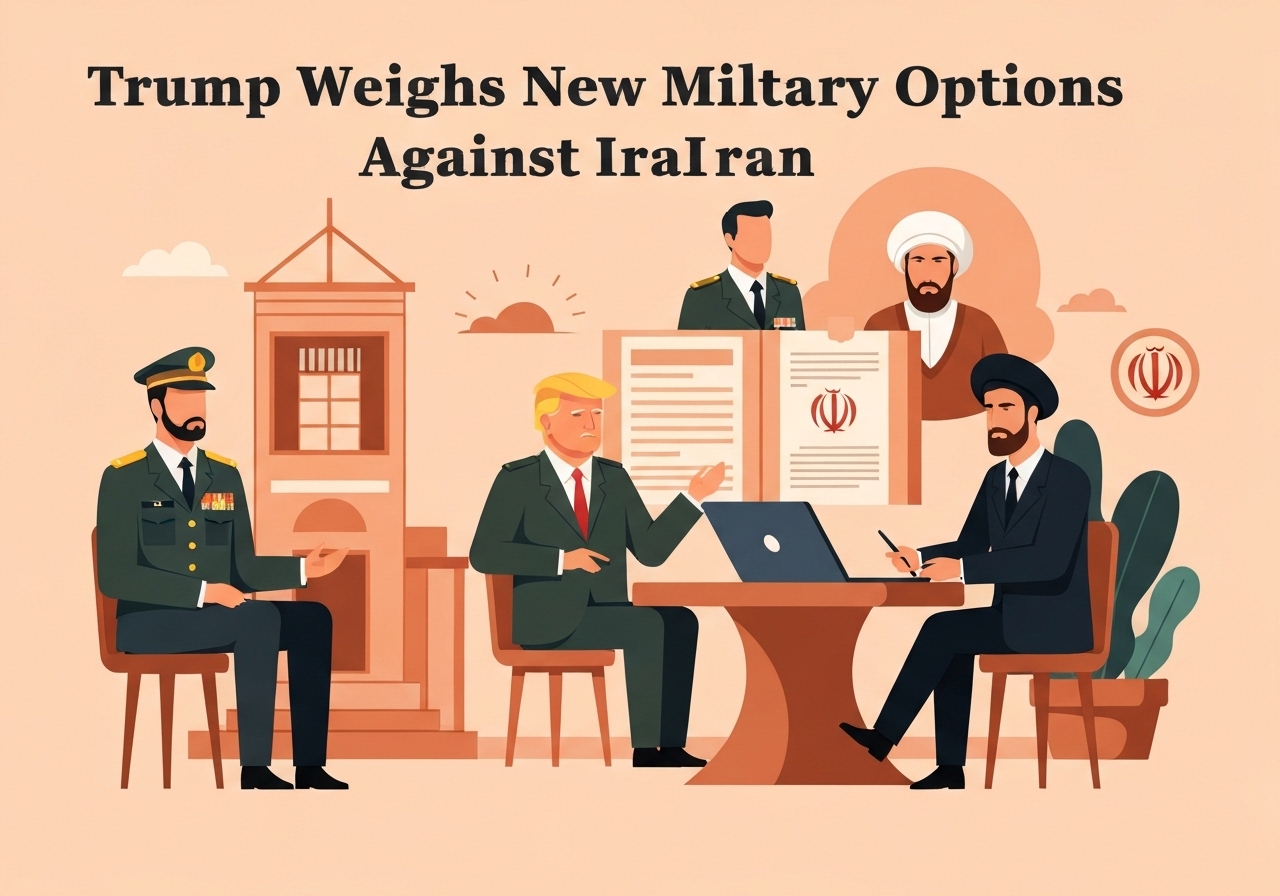
Lead: On Jan. 29, 2026, President Donald J. Trump reviewed an expanded slate of military options aimed at Iran, officials said, ranging from strikes on nuclear and missile sites to potential raids inside Iranian territory. The proposals were presented to the White House by Pentagon planners amid the aftermath of widespread protests in Iran that have been largely suppressed. Administration aides said the measures are intended to pressure Tehran to curb its nuclear ambitions and its backing for regional proxy forces, but Mr. Trump has not authorized any kinetic action and has kept diplomatic channels open.
Key Takeaways
- On Jan. 29, 2026, senior U.S. officials presented President Trump with a broader set of military options targeting Iran’s nuclear, missile and leadership infrastructure.
- The package now under review includes, for the first time in this cycle, the possibility of U.S. forces conducting raids on sites inside Iran, according to officials speaking on background.
- Options expand on proposals discussed two weeks earlier and reflect a shift after large-scale protests in Iran were forcibly quelled.
- Officials say the goals include degrading Iran’s nuclear and missile capabilities and applying pressure on the supreme leader’s network; no strikes have been ordered.
- The White House is simultaneously signalling openness to diplomacy; some aides said publicizing threats is aimed at forcing Tehran to the negotiating table.
- Administration debate is active: planners weigh military effectiveness, legal authorities, risks of regional escalation and potential costs for U.S. personnel.
- Officials cautioned that regime change is under informal consideration by some advisers but remains politically and operationally uncertain.
Background
For years U.S. administrations have focused on Iran’s nuclear program and its support for proxy groups in the region that have repeatedly clashed with Israel and U.S. partners. The current discussion follows renewed domestic unrest inside Iran earlier in January, where nationwide protests over social and political grievances were met with a forceful security response. American policymakers framed the demonstrations and their suppression as part of a broader set of concerns about Tehran’s behavior at home and abroad.
Two weeks before Jan. 29, Mr. Trump had been shown more limited measures intended to signal consequences for Iranian security forces that killed protesters and for militias operating with Tehran’s backing. The new options represent an enlargement of the toolkit under consideration by the White House and the Pentagon, adding options designed to damage specific military-industrial and leadership targets. U.S. officials say the shift reflects both the urgency felt in Washington and the search for means that could produce rapid operational effects.
Main Event
Senior Pentagon planners presented the expanded list of options to the president in recent days, laying out scenarios that range from precision strikes on facilities to raids by American forces inside Iran. Officials speaking on the condition of anonymity described the plans as designed to set back Iran’s ability to advance nuclear work or field longer-range missile systems, and to impose costs on lines of authority connected to the supreme leader. The options are described as more aggressive than those debated earlier in January but stop short of any presidential authorization.
According to officials, the inclusion of raids marks a distinct escalation in potential U.S. activity, because they could require on-the-ground operations inside Iran’s borders rather than stand-off strikes. Planners have also assessed the intelligence and force posture needed for such missions, and the likely Iranian responses, which range from conventional counterattacks to asymmetric retaliation through proxies. The White House has not selected or approved any option; aides emphasized that the president remains open to diplomatic solutions.
Administration messaging appears to combine deterrent signalling with a hope that publicizing stronger options will compel Iran to negotiate on nuclear limits and proxy behavior. Some U.S. officials said they believe telegraphing possible U.S. actions could be intended to produce bargaining leverage without immediate use of force. Others warned that overt threats can narrow the room for de-escalation if Tehran concludes its survival is threatened.
Analysis & Implications
An expansion of military options raises immediate strategic and legal questions. Operational planners must weigh achievable military effects against the risk of drawing regional actors into a broader conflict. Raids inside Iran, if undertaken, would be especially provocative: they carry high intelligence and force-protection requirements and present a greater chance of direct confrontation with Iranian security forces. Any kinetic campaign focused on nuclear or missile infrastructure also risks accelerating Tehran’s efforts to disperse or harden sensitive programs.
Diplomatically, tougher U.S. options could either push Tehran toward talks or provoke reciprocal escalations by Iran and its proxy networks in Iraq, Syria, Lebanon and Yemen. For Israel and Gulf partners, a credible U.S. threat could be reassuring in the short term; for other regional governments, the prospect of instability raises economic and security costs. The calculus for allied coordination is thus complicated: military plans that rely on shared basing, intelligence or logistics require partner buy-in that cannot be assumed.
Domestically, any move toward strikes or raids would prompt legal and political scrutiny in Washington. Congressional oversight, potential War Powers resolutions and public opinion could shape the administration’s freedom of action. Additionally, the prospect of regime change—a notion reportedly considered by some advisers—would require a sustained political and material commitment with uncertain outcomes and long-term regional repercussions.
Comparison & Data
| Category | Two Weeks Earlier | Options Presented Jan. 29, 2026 |
|---|---|---|
| Scope | Limited punitive strikes, sanctions, targeted messaging | Expanded strikes, potential raids, broader leadership pressure |
| Targets | Security forces, affiliated militias | Nuclear & missile sites, leadership networks, military infrastructure |
| Direct action inside Iran | Not included | Possible raids by U.S. forces under consideration |
The table above contrasts the narrower set of options discussed earlier in January with the broader package described to the president on Jan. 29, 2026. While the earlier approach emphasized punitive or deterrent measures aimed at specific security units and militia supporters, the newer briefing incorporates options intended to inflict operational damage on nuclear and missile capabilities or to disrupt the command networks tied to Iran’s leadership.
Reactions & Quotes
Officials and analysts offered immediate reactions that framed the debate in Washington.
Context: A senior U.S. official summarized the administration’s status and cautions ahead of any action.
“The president has not approved military strikes; these remain options under review,”
Senior U.S. official (anonymous)
Context: A national security scholar warned of the strategic trade-offs any kinetic campaign would entail.
“Direct operations inside Iran would raise the bar for both intelligence requirements and regional risk,”
National security analyst
Unconfirmed
- Whether the White House will authorize any of the raids presented to the president remains undecided and unannounced.
- Specific target lists, timetables and force packages for any proposed raids or strikes have not been publicly released.
- Claims that regime change is an official administration objective remain unverified and appear to reflect internal debate rather than settled policy.
Bottom Line
The Jan. 29, 2026 briefing shows the Trump administration is weighing a wider set of military tools against Iran than it considered earlier in the month. Those options—including the possible use of U.S. forces inside Iran—represent a sharper posture intended to impose costs on Tehran’s nuclear and missile programs and on leadership networks, but they also carry significant operational and geopolitical risks.
For now, no action has been authorized; the administration appears to be balancing deterrence and leverage against the need to avoid unintended escalation. Observers should watch for two immediate signals: whether any force posture changes are paired with allied consultation and whether the White House moves to seek congressional backing or a clear legal rationale before any kinetic step.
Sources
- The New York Times — media report based on interviews with unnamed U.S. officials (reporting)