
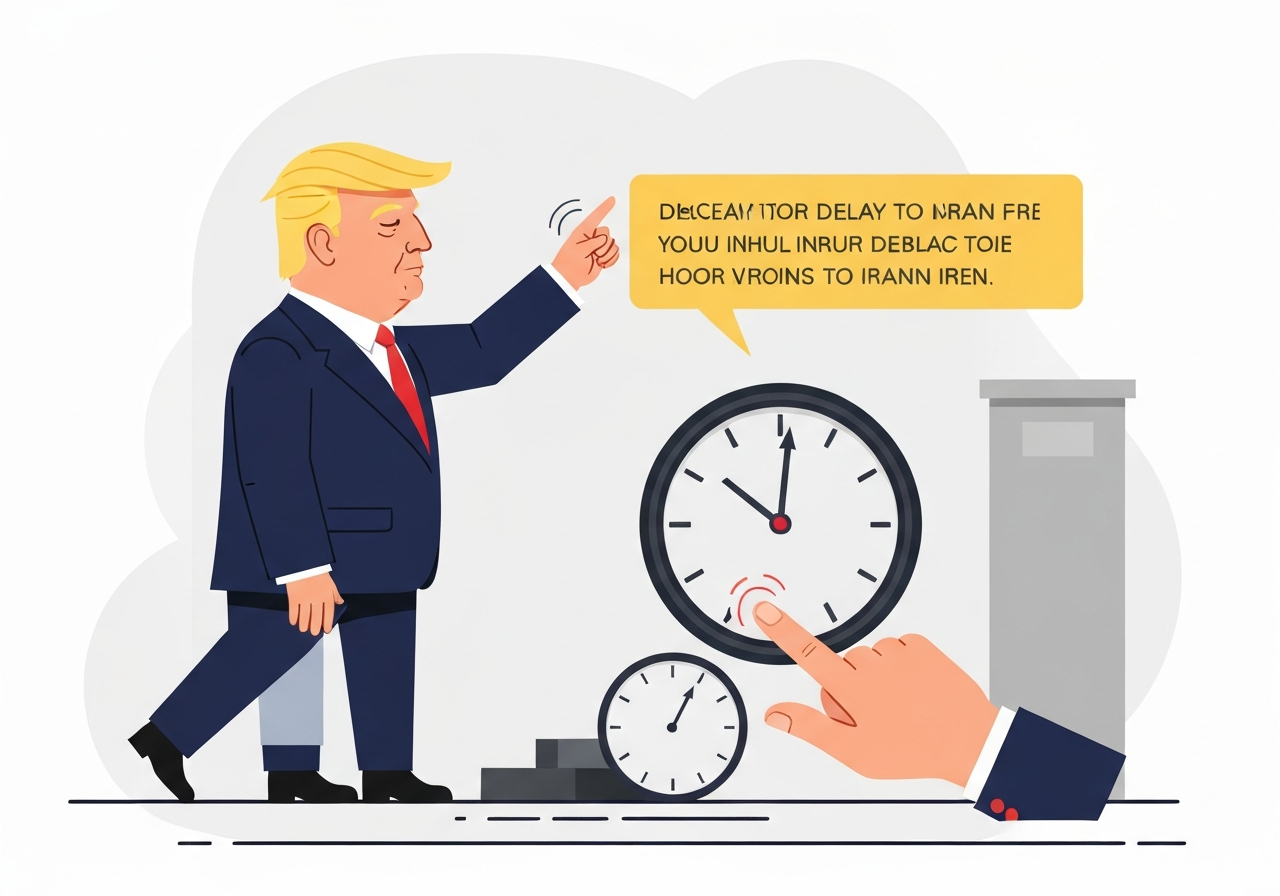
— President Donald Trump paused a threatened strike on Iranian power plants on Monday after limited contacts between U.S. and Iranian officials, calling the exchanges “productive conversations.” The administration said it would extend a prior 48-hour deadline through the coming Friday to allow diplomacy to proceed, even as U.S. and allied strikes and additional military deployments continued in the region. Iranian representatives publicly denied that formal negotiations to end the war were underway. U.S. officials described the contacts as preliminary and non-substantive.
Key Takeaways
- On March 23, 2026, President Trump delayed a planned strike on Iranian power plants and extended a 48-hour deadline to a five-day pause ending Friday.
- The pause followed initial U.S.–Iran contacts described by the president as “productive conversations,” though U.S. officials called them early and limited.
- Iran publicly denied that talks to end the war had started; Tehran reportedly seeks sanctions relief and security guarantees according to intermediaries.
- The threatened targets — power plants — are typically protected under international humanitarian law except in narrow circumstances, raising legal concerns.
- Meanwhile, U.S. and Israeli forces continued operations in the region and additional American military assets were dispatched to the area.
- U.S. planning reportedly includes contingency options such as seizing Kharg Island and operations to secure highly enriched uranium, steps that would mark a major escalation if executed.
Background
The military confrontation between the United States and Iran intensified over several weeks after attacks and counterattacks around Gulf shipping lanes and energy infrastructure. The dispute accelerated when Iran-backed forces and Iranian vessels moved to close the Strait of Hormuz, a vital global chokepoint for oil and gas shipments, prompting threats of retaliation from Washington. President Trump set a 48-hour ultimatum on Saturday to punish Iran for the closure, naming power plants among potential targets as punishment for disrupting shipping.
Targeting civilian energy infrastructure is constrained under the Geneva Conventions and customary international humanitarian law, which generally prohibit attacks expected to cause disproportionate civilian harm. Past exchanges of strikes and maritime harassment have already drawn regional powers and allies into shuttle diplomacy. Iranian officials have repeatedly said they will not accept foreign coercion, while intermediaries have signaled Tehran would want sanctions relief and guarantees against future attacks as part of any deal.
Main Event
On Monday, Mr. Trump announced a temporary halt to the most dramatic of his stated options after describing a narrow opening in contacts with Iranian interlocutors. He framed the move as a chance to see whether diplomacy could yield a settlement, saying the pause would last five days and that the administration would reassess at the end of that interval. The 48-hour window he had set on Saturday would otherwise have lapsed on Monday.
U.S. officials cautioned that the exchanges were at an early stage and lacked substantive terms. Iranian spokespeople denied there were negotiations to end the war, while reports indicated intermediaries such as lower-level diplomats and envoys had been used to test whether bridging language was possible. Despite the pause on strikes against power plants, U.S. military officials signaled that other kinetic actions were continuing and that additional assets were being moved into the region.
According to senior U.S. and allied planning documents described to reporters, options under consideration ranged from limited strikes to more ambitious operations, including a potential seizure of Kharg Island — Iran’s principal oil export platform — and missions to secure stores of highly enriched uranium. Officials emphasized those contingencies remained under review and had not been authorized; their mention underscored the breadth of military planning accompanying diplomatic outreach.
Analysis & Implications
The president’s decision to pause a strike on civilian energy infrastructure changes the immediate risk calculus but does not eliminate it. Using an early-stage dialogue as an “offramp” reduces the likelihood of near-term, dramatic escalation against power plants, yet the administration’s retention of other military options keeps pressure on Tehran and preserves a pathway to renewed strikes. The dual track of diplomacy-plus-force is intended to extract concessions quickly, but it also raises the risk that miscommunication could spiral back into wider conflict.
Legally, deliberate attacks on power-generation facilities carry substantial constraints. Under most interpretations of the Geneva Conventions and customary international law, such strikes are unlawful if they are expected to cause excessive civilian harm relative to their military advantage. Military planners’ discussion of seizing Kharg Island or targeting nuclear materials would represent a further escalation with direct consequences for global energy flows and could draw additional regional actors into the conflict.
Politically, an announced pause gives diplomats a narrow window to translate initial contacts into tangible steps, but the chances of rapid, comprehensive agreements are slim given Tehran’s publicly stated red lines. Any deal that included sanctions relief or security guarantees would require coordination with allied governments and would face domestic political scrutiny in Washington and elsewhere. Conversely, failure to reach terms within the five-day period would likely prompt a rapid resumption of force options already under consideration.
Comparison & Data
| Event | Date / Timeline |
|---|---|
| President’s 48-hour ultimatum announced | Saturday, March 21, 2026 (expires March 23) |
| Public pause announced / five-day window begins | Monday, March 23, 2026 (now through March 27) |
| Duration of conflict so far | More than three weeks as of March 23, 2026 |
The table highlights how the administration moved from a short ultimatum to a slightly longer diplomatic interval; the shift buys time but not certainty. The reported planning options — from limited strikes to a seizure of Kharg Island or securing enriched uranium — differ greatly in scale and consequence, and each would have distinct operational requirements and international reactions.
Reactions & Quotes
“We’re doing a five-day period. We’ll see how that goes,”
President Donald Trump (March 23, 2026)
Mr. Trump framed the pause as a test of whether preliminary contacts could produce a settlement, and he warned that military options remained on the table if talks failed.
“There are no negotiations underway to end the war,”
Iranian official (public statement)
Iran’s public denial underscored Tehran’s reluctance to be seen as yielding, even as intermediaries reportedly conveyed conditions Tehran would seek if formal talks began.
“Attacking civilian energy infrastructure is highly constrained under international law,”
International humanitarian law experts (legal commentary)
Legal specialists highlighted that strikes on power plants would face strict legal scrutiny and could be unlawful if expected to cause disproportionate civilian harm.
Unconfirmed
- Whether Iranian interlocutors have implicitly agreed to specific terms such as sanctions relief — there is no independent confirmation of any deal.
- Whether the White House will authorize large-scale operations such as seizing Kharg Island or deploying ground forces into Iran; these remain contingency options under review.
- The exact content and participants of the early contacts described as “productive” have not been publicly disclosed and remain unclear.
Bottom Line
President Trump’s decision to delay an attack on Iranian power plants and allow a five-day window for talks reduces the immediate risk of a major strike, but it does not signify a conclusive de-escalation. The contacts between U.S. and Iranian representatives are preliminary, and both sides continue actions that could quickly reverse any fragile diplomatic opening.
Diplomacy now has only a narrow timeframe to produce concrete steps or at least credible confidence-building measures; absent that, military plans that remain under consideration could be executed, with unpredictable regional and global consequences. Observers should watch for whether intermediaries can convert initial exchanges into verifiable commitments on sanctions, guarantees and operational restraints.
Sources
- The New York Times — news organization; main reporting on the pause, statements and reported planning options.
- International Committee of the Red Cross (ICRC) — international organization; overview of Geneva Conventions and protections for civilian infrastructure.