
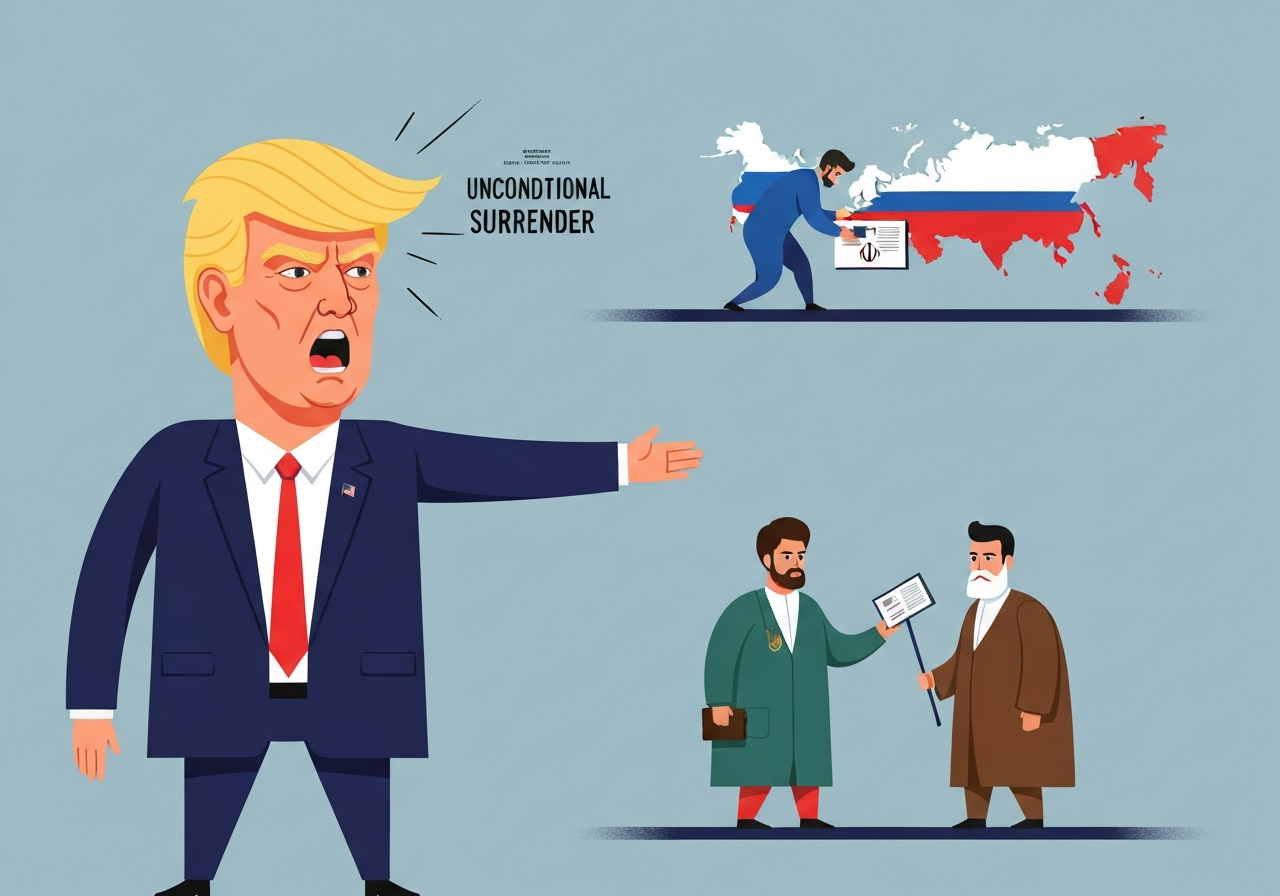
President Donald Trump on March 6, 2026, publicly demanded Iran’s “unconditional surrender” as the weeklong U.S.-Israeli campaign intensified and reports emerged that Russia has been passing intelligence on U.S. positions to Tehran. Israeli forces launched fresh strikes on Tehran — involving more than 80 fighter jets, the IDF said — while Iran responded with missile and drone salvos aimed at Israel and U.S. partners across the Gulf. U.S. Central Command reported more than 3,000 targets struck in the first seven days of Operation Epic Fury and said 43 Iranian ships were damaged or destroyed; independent tallies and international agencies report large civilian displacements and mounting casualties. The developments add new strain to diplomacy, energy markets and regional security with unclear prospects for de-escalation.
Key Takeaways
- President Trump publicly insisted on “unconditional surrender” from Iran and later clarified it could mean Iran is no longer able to fight, not necessarily a formal declaration (March 6, 2026).
- Multiple sources, including a senior U.S. official, told reporters that Russia has provided Iran with intelligence on U.S. positions in the Middle East, marking the first known indication of Russian operational support to Tehran in this phase of the conflict.
- Israel said more than 80 fighter jets took part in a new wave of strikes on Tehran and other western and central Iranian sites, targeting military facilities, missile storage and an alleged underground command center.
- U.S. Central Command reported that over the first seven days of Operation Epic Fury the U.S. struck more than 3,000 targets and that 43 Iranian ships were damaged or destroyed.
- The Islamic Republic’s health ministry reported over 1,200 people killed in Iran during the first seven days of fighting; UNICEF reported about 180 children killed across the conflict so far.
- Regional airspace disruptions prompted airlines to suspend flights; United canceled U.S.-Tel Aviv and U.S.-Dubai services through at least March 21, 2026, and Qatar, UAE and others partially closed or limited airspace.
- Humanitarian displacement is large: aid groups report at least 300,000 displaced in Lebanon alone following strikes and evacuation orders, with risk of a wider humanitarian crisis.
- Investigations are ongoing into a Feb. 28 strike on a girls’ primary school in Iran that sources say U.S. investigators now believe may have involved U.S. operations in the area; no final conclusions have been reached.
Background
The U.S.-Israeli campaign against Iran began with synchronized strikes on Feb. 28, 2026, after which the Islamic Republic launched retaliatory missile and drone attacks on U.S. forces and regional partners. Washington and Tel Aviv say the operation—named Operation Epic Fury—aims to degrade Iran’s missile, drone and naval capabilities; President Trump has described objectives in stark terms, including removing senior elements of Iran’s leadership. Longstanding ties between Tehran and Moscow, plus prior transfers of dual-use materiel between the two countries, mean any Russian involvement carries wider geopolitical consequences.
Iran’s political order has been under exceptional strain since the death of Supreme Leader Ayatollah Ali Khamenei on Feb. 28; Iran’s Assembly of Experts is formally responsible for selecting a successor, but uncertainty about leadership and lines of authority persists. Regional states — from Gulf monarchies to Lebanon and Syria — now face direct and indirect effects of the fighting, including missile and drone strikes, disruption of shipping through the Strait of Hormuz, and fears of broader escalation involving proxies and conventional forces.
Main Event
On March 6, Israeli forces said they carried out a fresh wave of strikes on Tehran and other Iranian locations using more than 80 fighter jets, striking what the IDF described as missile storage sites, an underground command center and military academies. Video and official statements posted by Israel and corroborated by some visual reporting show explosions in central Tehran; Iran reported missile and drone counterattacks targeting Israel and U.S. positions in the Gulf.
The U.S. military released imagery it said showed a strike on an Iranian drone carrier at sea and said American forces have damaged or destroyed dozens of Iranian naval vessels. CENTCOM told reporters and posted updates that, in the first seven days of the campaign, more than 3,000 targets were struck and 43 Iranian ships were damaged or destroyed. Independent data teams and think tanks have tracked strikes and infrastructure damage, while Iranian authorities report large civilian casualties.
Diplomatically, Russia’s president spoke by phone with Iran’s president on March 6; the Kremlin said Vladimir Putin urged an immediate cessation of hostilities and a return to diplomacy. U.S. sources told reporters that Russia has been providing Tehran with intelligence about U.S. positions — a development the White House acknowledged publicly as a serious concern while saying it had not yet altered operational outcomes on the battlefield.
Analysis & Implications
The reported handoff of intelligence from Russia to Iran risks widening the conflict’s international footprint and complicates U.S. operational security. If confirmed at scale, Moscow’s assistance could blunt some U.S. tactical advantages by making basing and movement transparent to Tehran, forcing changes in force posture and coalition planning. Even so, U.S. officials assert that observed operations and strike effects have not been substantially reversed by any such disclosures.
Economically, the conflict is already routing through global markets: oil benchmarks climbed sharply, with West Texas Intermediate and Brent approaching multi-month highs on fears of supply disruptions through the Strait of Hormuz. The surge in crude has immediate knock-on effects on fuel prices, shipping insurance costs and inflationary pressures in import-dependent economies. Firms and states face tougher logistical and fiscal choices if hostilities persist.
Militarily, senior analysts caution that airpower and sea control alone rarely produce durable regime change. Historical studies and experts consulted by news organizations note that degrading an adversary’s infrastructure may reduce capabilities but often yields only temporary quiet unless matched by political solutions and effective governance alternatives. In Iran’s case, even severe attrition of missile and air defenses could leave subterranean networks, proxy structures and political resilience that prolong instability for years.
Comparison & Data
| Metric | Reported Figure | Source |
|---|---|---|
| Targets struck (first 7 days) | More than 3,000 | CENTCOM / U.S. military |
| Iranian naval vessels damaged/destroyed | 43 | CENTCOM |
| Iranian casualties (7 days) | 1,200+ (Iranian health ministry) | Iranian government |
| Children reported killed | ~180 (UNICEF) | UNICEF |
| U.S. strikes on Iranian bases | 27 bases (CBS data) | CBS News data team |
The table aggregates official and media tallies available as of March 6, 2026. Numbers reflect different collection methods: military claims, national health counts, NGO estimates and independent verification by media analysts. Discrepancies between sources are common in active conflicts and are noted in investigations and situational reports.
Reactions & Quotes
“There will be no deal with Iran except UNCONDITIONAL SURRENDER!”
President Donald Trump (Truth Social, March 6, 2026)
White House officials later clarified that “unconditional surrender” could mean Iran is no longer able to conduct military operations, not necessarily a formal capitulation. Senior aides framed the phrase as a political ceiling for negotiations rather than a legal requirement.
“We are in dialogue with representatives of the Iranian leadership, and we will certainly continue this dialogue.”
Kremlin press secretary Dmitry Peskov
The Kremlin characterized its ties to Tehran as diplomatic engagement and said Moscow seeks de-escalation; that statement came after U.S. officials told reporters Russia had supplied Tehran with intelligence on U.S. positions, a claim Moscow did not explicitly confirm.
“The stakes could not be higher… the situation could spiral beyond anyone’s control.”
UN Secretary-General António Guterres
The U.N. chief urged all parties to stop the fighting and begin serious diplomatic negotiations, highlighting civilian suffering and risks to the global economy.
Unconfirmed
- Claims that Russia is supplying detailed, real-time targeting feeds to Iran are reported by multiple sources but lack public, independently verified operational logs; U.S. officials describe the disclosures as a concern under active review.
- Investigators’ preliminary statements that the U.S. may have been responsible for the Feb. 28 strike on a girls’ primary school in Iran remain unfinalized; official inquiries continue and no conclusive attribution has been published.
- Precise tallies of senior Iranian leaders killed vary between sources; some official statements reference “more than 50” leaders while independent verification of identities and roles is incomplete.
Bottom Line
The conflict that began on Feb. 28 has escalated into a region-wide crisis with immediate military, humanitarian and economic consequences. Public demands from President Trump for “unconditional surrender,” combined with reports of Russian intelligence assistance to Iran, risk hardening positions and narrowing diplomatic openings. Markets and neutral states are already reacting; oil prices surged and airlines suspended routes, while humanitarian organizations warn of mounting civilian harm.
Short of a negotiated pause or third-party mediation, military operations are likely to continue to shape the next phase. Analysts note that air and naval strikes may impose severe short-term costs on Iran’s capabilities but historically have limited success in producing lasting political change without coherent post-conflict governance plans. For policymakers and the public, the immediate priorities are clear: verify disputed claims, protect noncombatants, sustain channels for diplomacy, and calibrate responses to prevent wider escalation.
Sources
- CBS News live updates — (U.S. national media live reporting and aggregated data)
- U.S. Central Command (CENTCOM) — (Official military statements on targets and naval actions)
- Kremlin press releases — (Official Russian government statements)
- United Nations — (Statements by the Secretary-General and U.N. human rights office)
- UNICEF — (Child casualty and humanitarian impact reporting)
- Institute for the Study of War — (Independent analysis and strike monitoring)