
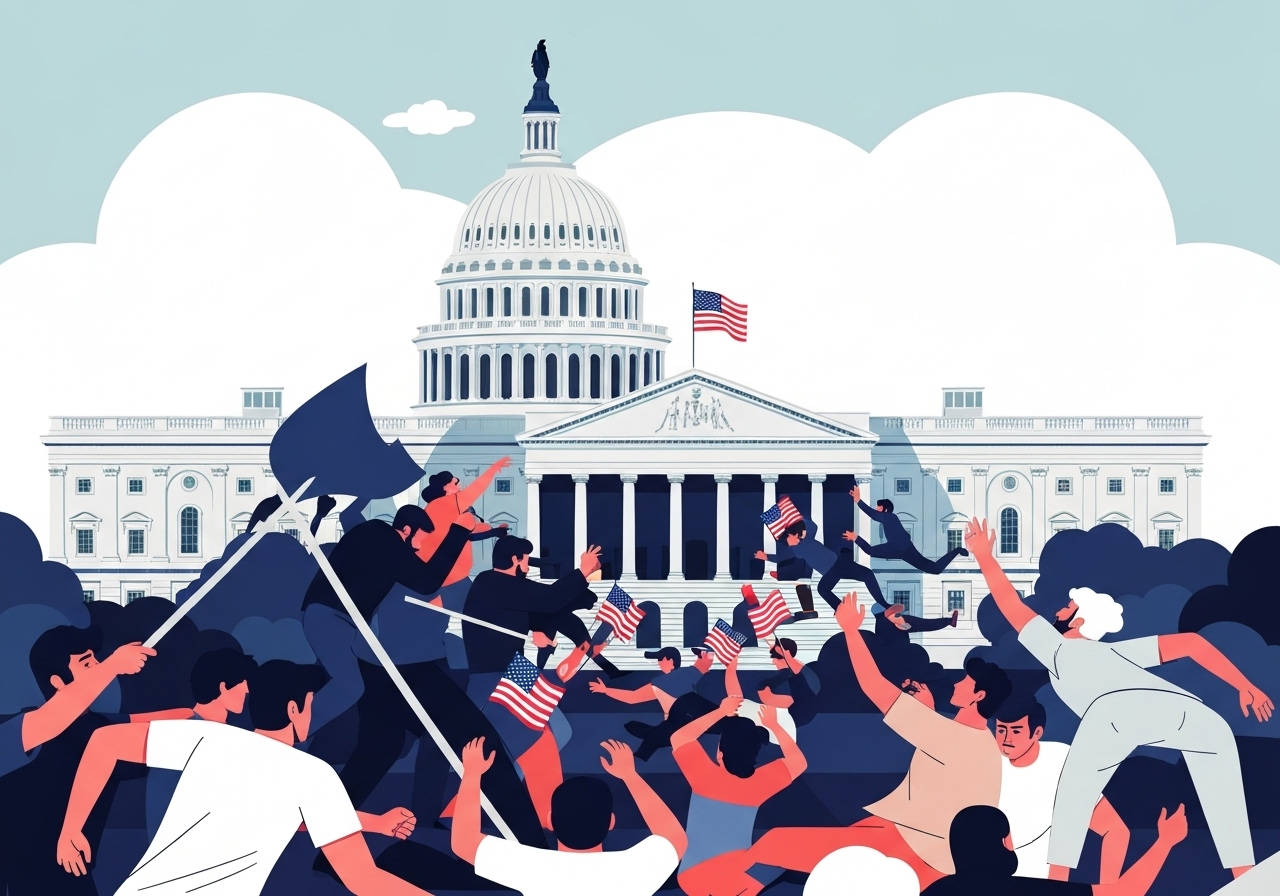
Lead: On Jan. 6, 2026 — the fifth anniversary of the Jan. 6, 2021, attack on the U.S. Capitol in Washington — the White House published a new timeline that described that day’s pro-Trump marchers as “peaceful” and blamed Capitol Police for escalating violence. The administration’s page downplayed President Donald Trump’s pre-riot rhetoric, repeated a false claim the 2020 election was stolen, and challenged widely reported accounts of how the riot unfolded. The move prompted immediate bipartisan criticism and renewed debate about accountability for the events that left multiple dead and more than 100 officers injured. The dispute comes as roughly 1,583 people have been charged in connection with the attack and hundreds remain subject to criminal proceedings or pardons issued on the first day of Trump’s second term.
Key Takeaways
- The White House on Jan. 6, 2026, posted a timeline describing January 6, 2021, attendees as “orderly and spirited” and saying police escalation turned the day violent.
- About 1,583 people have been charged related to the attack; roughly 608 faced charges for assaulting, resisting, or interfering with law enforcement, and about 174 of those were charged with using a deadly or dangerous weapon, per the U.S. Attorney’s Office.
- More than 100 law enforcement officers were reported injured during the attack; several rioters and some officers later died, including Capitol Police Officer Brian Sicknick.
- The White House timeline repeats the claim that the 2020 election was stolen, a conclusion contradicted by official investigations and court rulings.
- House Democratic leaders called the administration’s update a whitewash; they organized hearings and public statements on the fifth anniversary to counter the new account.
- The White House cited video excerpts and a clip involving then-House Speaker Nancy Pelosi in arguing security lapses were mischaracterized; Pelosi’s team called those excerpts cherry-picked and out of context.
Background
On Jan. 6, 2021, thousands of supporters of then-President Donald Trump gathered in Washington after a rally near the White House. A large contingent marched to the U.S. Capitol, where a joint session of Congress was certifying the Electoral College results of the 2020 presidential election. The assembled crowd included many who believed, contrary to extensive evidence and multiple court rulings, that the election had been stolen; those claims were a central part of the rhetoric preceding the breach.
The breach of the Capitol resulted in violent confrontations with law enforcement, the evacuation and lockdown of the Capitol complex, and interruptions to the congressional certification process. Official investigations, prosecutions and a House select committee examined those events; the U.S. Attorney’s Office has brought roughly 1,583 prosecutions tied to the attack, including hundreds of charges related to assaults on officers.
Over five years, the narrative of Jan. 6 has been highly contested in political discourse. Some former and current administration officials, participants, and supporters have offered alternative accounts of what happened and who bore responsibility. At the same time, law-enforcement accounts, video evidence assembled by prosecutors, and congressional findings have established a widely accepted timeline of the day’s escalation and violence.
Main Event
On Jan. 6, 2026, the White House published a webpage that lays out a timeline and narrative asserting that many attendees were peaceful and that certain Capitol Police actions escalated tensions. The page accused officers of using tear gas, flash-bang devices and rubber munitions against peaceful crowds and suggested some officers removed barricades or opened doors in ways that facilitated entry. The administration also highlighted footage and a clip involving Speaker Nancy Pelosi to argue security responsibility had been misattributed.
Many survivors of the attack, former officers who were on the scene and investigators rebutted that account. Former and current Capitol Police members — and the House select committee’s published materials — have described sustained, targeted violence against officers, including direct assaults and the use of chemical irritants and projectiles against police. Several officers were seriously injured in those confrontations, and later reports confirmed deaths connected to the events, directly or subsequently.
President Trump, addressing House Republicans on the anniversary, reiterated his criticisms of the House select committee that investigated the attack and emphasized his claim that he told supporters to march “peacefully and patriotically.” Democrats and some commentators countered that his speech and prior rhetoric contributed to the crowd’s mobilization and that pardons issued on the first day of his second term undercut accountability for violent participants.
The White House’s release prompted immediate reactions across the political spectrum. House Democrats organized an unofficial hearing and public events on the anniversary to emphasize the experiences of law enforcement and survivors and to challenge the administration’s portrayal. Congressional leaders including Minority Leader Hakeem Jeffries and Senator Chuck Schumer publicly condemned the effort as a factual revisionism that dishonors victims and undermines the rule of law.
Analysis & Implications
The administration’s attempt to recast Jan. 6 on an official government page is politically consequential because it represents a formal, accessible record that may shape public understanding, educational materials and media citations. When the executive branch publishes a contested narrative on an official platform, it can confer legitimacy on disputed claims and complicate efforts by law enforcement and courts to present an authoritative account. That dynamic matters for how institutions, citizens and historians will interpret the event over time.
Legally, the White House narrative does not change the status of criminal cases or the factual findings reached by courts and prosecutors. The U.S. Attorney’s Office’s prosecutions and the evidence introduced in trials remain public records and legal precedent; pardons, however, can limit consequences for individuals and affect how justice is perceived. The early pardons issued on the first day of Trump’s second term have already narrowed immediate legal remedies for many convicted participants.
Politically, the move deepens partisan polarization around Jan. 6. Republican supporters who accept the administration’s framing may view prior investigations as politically motivated, while Democrats and many independents may see the rewrite as an attempt to erode institutional norms and displace accountability. That polarization could influence committee oversight, election rhetoric, and public trust in federal institutions in the run-up to future campaigns and policymaking debates.
Internationally, efforts to revise an official account of a democracy-challenging event can reverberate with allies and adversaries alike. Foreign governments and commentators monitor how a democracy responds to internal attacks and whether institutions uphold transparent, evidence-based inquiry. A contested historical record can weaken U.S. credibility on issues of democratic resilience and rule-of-law promotion abroad.
Comparison & Data
| Metric | Reported Figure |
|---|---|
| Defendants charged in Jan. 6 cases | ~1,583 |
| Defendants charged with assaulting/resisting officers | ~608 |
| Of those, charged with using deadly/dangerous weapon | ~174 |
| Law-enforcement officers injured | 100+ |
| Fatalities linked to the day | Several (including Ashli Babbitt; later deaths among officers such as Brian Sicknick) |
The table above draws on data cited by prosecutors and reporting compiled since 2021. Numbers reflect the scale of prosecutions and the degree to which violence targeted law enforcement. While prosecutions continue to evolve — with appeals, additional charges or case dismissals possible — these figures indicate the substantial criminal response and the costs borne by officers and staff at the Capitol complex.
Reactions & Quotes
Republican and Democratic leaders offered sharply different readings of the White House move, focusing either on procedural errors or on efforts to absolve political actors. Lawmakers organized events and issued statements on the anniversary to reaffirm their positions and honor victims.
“We will not let history be rewritten to excuse those who attacked our democracy,”
House Minority Leader Hakeem Jeffries (statement)
Jeffries and other Democrats used anniversary events to stress accountability and the scale of violence directed at officers and lawmakers.
“These pardons are among the most sickening things… His betrayal of law enforcement, of democracy, makes a mockery of the rule of law,”
Senate Minority Leader Chuck Schumer (floor speech)
Senator Schumer framed the pardons and the new timeline as further undermining legal and civic norms. Meanwhile, the White House pointed to an X post promoting the new timeline as the administration’s public explanation.
“Cherry-picked, out-of-context clips do not change the fact that the Speaker of the House is not in charge of the security of the Capitol Complex,”
Ian Krager, spokesperson for Rep. Nancy Pelosi
Pelosi’s office disputed White House use of a clip attributed to Pelosi’s daughter and called the excerpt an incomplete presentation of her remarks on security planning.
Unconfirmed
- The White House’s assertion that video clearly shows officers “inexplicably removing barricades, opening Capitol doors, and even waving attendees inside” is disputed and has not been independently verified in all instances; available footage is contested and context-dependent.
- Claims on the White House page that Speaker Pelosi was responsible for ‘‘security lapses’’ rely on selected clips and have been described by Pelosi’s office as cherry-picked; full context and responsibility for Capitol security involve multiple agencies and officials.
- Some characterizations that most attendees were uniformly “peaceful” contradict prosecutorial records showing widespread, documented assaults on officers; the scale and pattern of violence remain established by court filings, but individual behavior varied.
Bottom Line
The White House’s publication of an alternate Jan. 6 timeline on the fifth anniversary represents a deliberate effort to offer a competing official narrative. That effort has immediate political effects — shaping public conversation, fueling partisan responses and influencing how institutions defend or reassess their roles that day. It does not, however, alter prosecutorial findings, court records or the documented injuries and fatalities tied to the attack.
Going forward, the dispute over the official account will affect congressional oversight, legal debates and civic memory. Scholars, journalists and courts will continue to examine primary evidence — video, testimony and official records — to construct a durable public history. Readers should weigh the new White House page alongside public records and court documents, and watch for independent verification of the administration’s specific claims.
Sources
- ABC News — national news reporting and synthesis of White House timeline and reactions.
- U.S. Attorney’s Office, District of Columbia — official summary of Jan. 6 prosecutions and charges (official source).
- The White House — official administration statements and the published timeline (official source).