
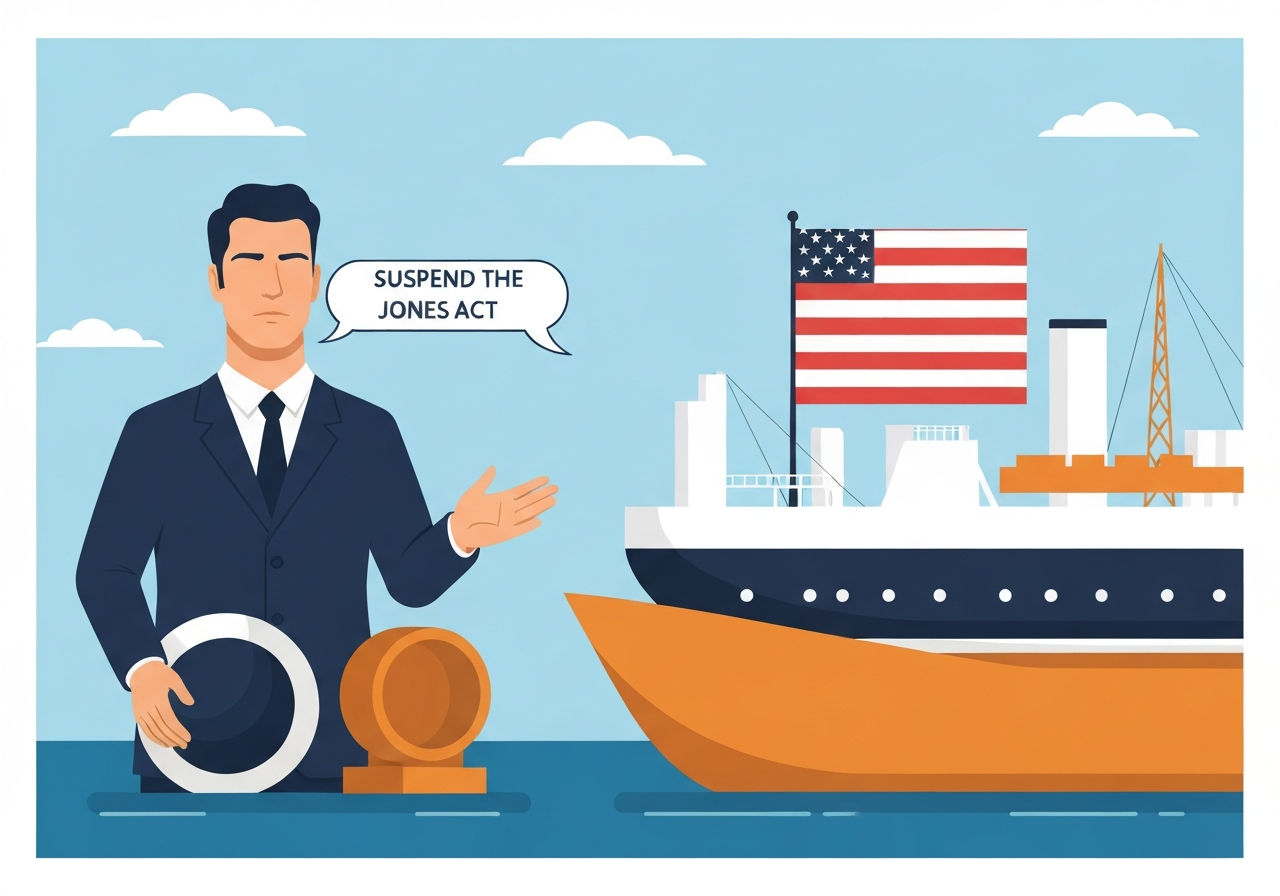
Lead: The White House on March 18 issued a 60-day waiver of the Jones Act to ease domestic shipping of oil, natural gas, fertilizer and coal as the war with Iran has driven U.S. energy prices higher. The move, announced by White House press secretary Karoline Leavitt, is intended to speed deliveries to U.S. ports and reduce costs at the pump. Gasoline prices rose about $0.92 per gallon compared with a month earlier amid supply concerns tied to Iran and disruptions in the Strait of Hormuz. Experts and industry groups say the short-term waiver is unlikely to produce large downward pressure on retail fuel prices.
Key Takeaways
- The administration issued a 60-day waiver of the Jones Act on March 18 to allow foreign-flagged vessels to move goods between U.S. ports.
- The Jones Act, enacted in 1920, requires domestic shipments to use U.S.-built, -owned and -crewed ships that fly the U.S. flag.
- U.S. gasoline prices rose roughly $0.92 per gallon in the past month, a spike the White House links to the Iran conflict and related market disruption.
- Former Federal Maritime Commissioner William Doyle and several analysts say the waiver’s effect on pump prices will be minimal — at most fractions of a cent per gallon.
- The American Maritime Partnership warned the waiver risks displacing American mariners and companies and estimated potential savings at under one cent per gallon.
- Critics argue the real price pressure comes from global oil markets; about 40–50% of retail gasoline price reflects global per-barrel costs, and roughly 20% of world oil transits the Strait of Hormuz.
Background
The Merchant Marine Act of 1920, commonly called the Jones Act, was designed to sustain the U.S. domestic maritime industry by requiring coastwise cargo to move on American-built, owned and crewed vessels. Over a century it has become both a protection for U.S. shipbuilding and a recurring target for critics who say it raises costs and limits capacity. Supporters view the law as vital to national security and to preserving jobs in U.S. shipyards and among mariners.
The waiver authority exists to address immediate threats to military operations and national interests; in this instance the White House tied the temporary exemption to ongoing military actions described as Operation Epic Fury. The current waiver is explicitly limited to 60 days and covers energy-related cargoes that the administration says are critical to sustaining U.S. supply chains. Debate over the statute has intensified whenever energy prices spike or when domestic logistics bottlenecks become acute.
Main Event
On March 18 the White House publicly announced a temporary rollback of Jones Act restrictions for a 60-day window. In a social-media statement, press secretary Karoline Leavitt said the step would let oil, natural gas, fertilizer and coal move more freely to U.S. ports while the military pursues operations tied to regional security. The administration framed the waiver as a tactical measure to mitigate short-term market disruptions rather than a permanent policy change.
Industry and policy experts immediately assessed likely effects. William Doyle, a former commissioner of the Federal Maritime Commission, said any cost reduction passing to consumers would be negligible — at best fractions of a cent per gallon — because the largest drivers of gasoline cost are crude-oil prices and refining margins, not coastal shipping fees. The American Maritime Partnership, representing domestic maritime interests, warned the waiver could displace U.S. mariners and companies and insisted it would not meaningfully lower gas prices.
Opponents of the Jones Act argue the law contributes to higher long-term costs by protecting an expensive domestic shipbuilding base and a small pool of U.S. domestic vessels. Colin Grabow of the Cato Institute pointed to higher construction and operating costs for U.S.-built ships — figures he cited as roughly five times the construction cost and four times higher operating costs compared with many overseas yards — as a structural factor that inflates domestic shipping rates over time.
Analysis & Implications
Technically, a Jones Act waiver increases the pool of vessels eligible for domestic moves, which can ease short-term logistical constraints in supply chains. If U.S. refineries or terminals face immediate vessel shortages, allowing foreign-flagged ships could speed deliveries and reduce regional bottlenecks. However, transportation costs typically account for a small share of the retail gasoline price, so those operational improvements translate into limited consumer savings.
Most of what consumers pay at the pump is tied to the global crude-oil price and refining dynamics; analysts commonly point to the world-market per-barrel cost as generating 40–50% of the retail gasoline price. Because the March spike in U.S. pump prices followed disruptions associated with the Iran conflict and higher global crude prices, a domestic shipping fix does not address the core supply-price driver: global oil market risk and geopolitics.
Politically, the waiver allows the administration to signal action to voters anxious about gasoline costs without altering the underlying statute. Labor groups and maritime businesses opposed to frequent waivers will likely press for stricter legal tests and oversight, arguing that broad short-term exemptions undermine domestic maritime employment. Conversely, free-trade advocates may use the temporary measure to press for longer-term reform or repeal, framing the Jones Act as an inefficient protection that raises consumer costs.
Comparison & Data
| Metric | Reported Figure | Source |
|---|---|---|
| Waiver length | 60 days | NPR / White House statement |
| Recent gasoline increase | ~$0.92 per gallon month-over-month | NPR report |
| Strait of Hormuz share | ~20% of global oil shipments | NPR report |
| Estimated maximum pass-through to pump price | <$0.01 per gallon (AMP); fractions of a cent (Doyle) | American Maritime Partnership; William Doyle (NPR) |
The table shows the narrow numerical window in which a temporary waiver operates: a limited duration (60 days), a large global oil-price influence on retail gasoline, and small estimated savings from changing coastal shipping rules. That math explains why many analysts expect little immediate relief at the pump even if logistics improve.
Reactions & Quotes
White House officials framed the waiver as a short-term logistical fix tied to military operations and supply-chain resilience.
“President Trump’s decision to issue a 60-day Jones Act waiver is just another step to mitigate the short-term disruptions to the oil market as the U.S. military continues meeting the objectives of Operation Epic Fury.”
Karoline Leavitt, White House press secretary (social-media statement)
Maritime policy experts emphasized the limited nature of potential savings.
“The impact will be minimal.”
William Doyle, former U.S. Federal Maritime Commissioner
Industry groups warned about domestic labor and capacity consequences and downplayed price effects.
“We are deeply concerned about this 60-day, broad waiver being abused and unnecessarily displacing American workers and American companies. We also reiterate that this waiver will not reduce gas prices.”
American Maritime Partnership (industry group statement)
Unconfirmed
- Claims that the 60-day waiver will be widely “abused” and displace large numbers of U.S. mariners are asserted by industry groups but lack comprehensive, publicly available labor-displacement data for this specific waiver.
- Precise savings per gallon from the waiver are disputed; estimates range from fractions of a cent to under one cent per gallon, but a rigorous, transaction-level pass-through analysis for this waiver period has not been published.
- Whether the waiver will materially change regional logistics bottlenecks at specific terminals depends on real-time vessel availability and contractual arrangements and remains to be seen.
Bottom Line
The 60-day Jones Act waiver is a targeted, short-term administrative step aimed at easing coastal movement of energy-related cargo amid Iran-linked market disruption. Because retail gasoline prices are driven principally by global crude prices, refining margins and taxes, most analysts expect only marginal relief at the pump from this measure alone.
Longer-term consumer savings would likely require structural changes — such as adjustments to U.S. shipbuilding policies, broader market reforms, or shifts in global crude supply — each of which carries political and economic trade-offs. For now, the waiver buys time to address immediate logistical stresses but is unlikely to alter the trajectory of pump prices unless global supply risks ease.