
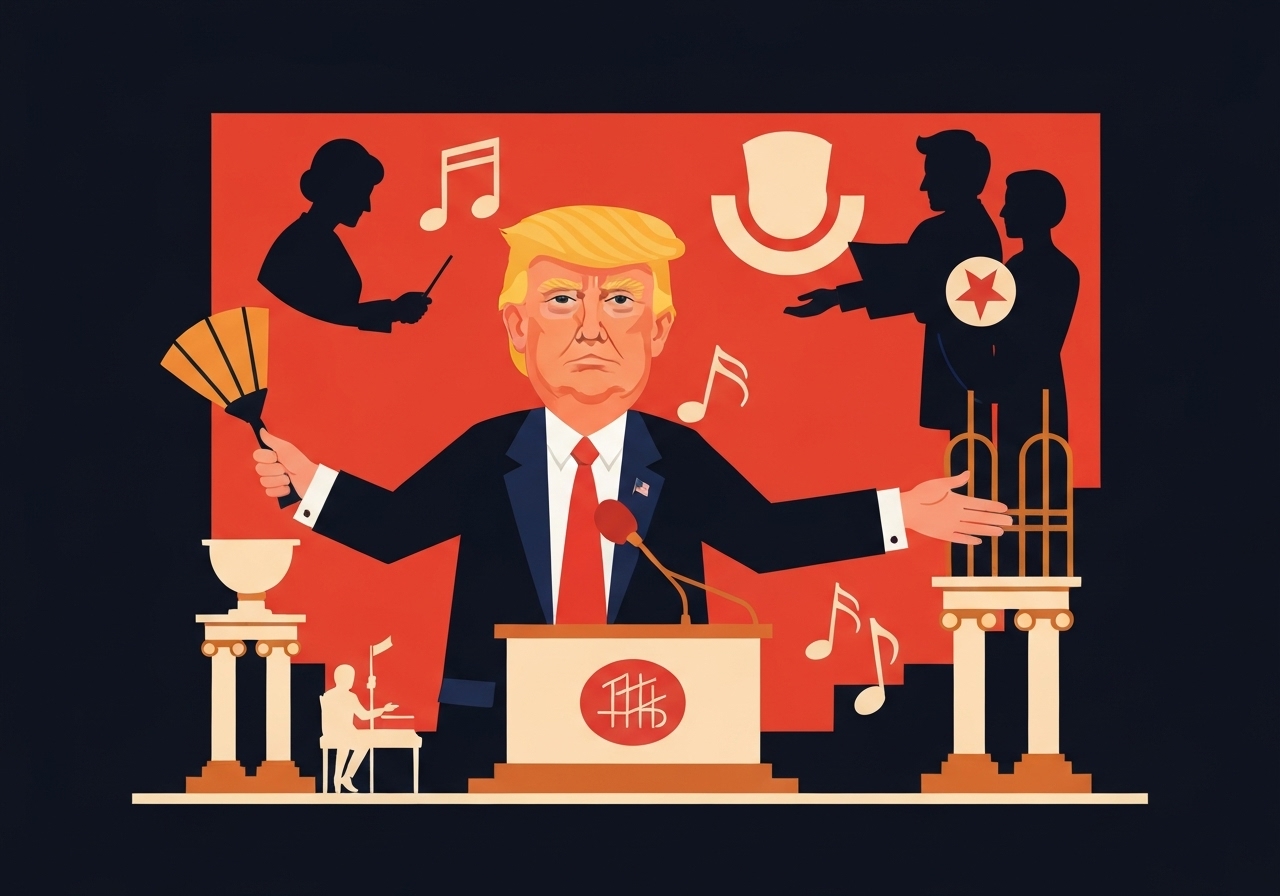
— President Donald J. Trump stepped onto the stage at the John F. Kennedy Center for the Performing Arts on Sunday as the host of the Kennedy Center Honors, a role no sitting president has previously assumed. Speaking from a lectern bearing the presidential seal, Mr. Trump paid tribute to honorees including Sylvester Stallone, Gloria Gaynor, George Strait, the band Kiss and actor Michael Crawford. The appearance — after Mr. Trump declined to participate during his first term — underscored a widening presidential footprint in cultural institutions and sparked debate about the politicization of national arts ceremonies.
Key Takeaways
- On , President Trump hosted the Kennedy Center Honors, the first sitting president to do so in the award’s history.
- The 2025 honorees were Sylvester Stallone, Gloria Gaynor, George Strait, Kiss and Michael Crawford, representing prominent figures from film, disco, country, glam rock and musical theatre.
- Mr. Trump said he would “try to act like Johnny Carson” while addressing the audience from the presidential lectern.
- He had boycotted the Honors during his first term amid objections from some artists but returned to a more conciliatory posture after regaining the presidency.
- Officials and observers described the move as part of a broader effort by the administration to assert influence over cultural institutions in Washington.
- The event highlighted tensions between artistic communities and the White House, with responses split between praise for the honorees and concerns about politicization.
Background
The Kennedy Center Honors, established in 1978, are intended to recognize lifetime contributions to American culture through the performing arts. Traditionally, presidents have attended the ceremony to show national recognition of artists, but they have not taken on a formal hosting role. Attendance and involvement have varied by administration, reflecting broader relationships between the White House and cultural leaders.
Mr. Trump’s first term was marked by contentious interactions with several prominent artists; he did not participate in the Honors during that period following public objections by some honorees or their peers. Since returning to office, the president and his team have signaled a different approach, seeking more cooperative engagements with institutions that had previously been at odds with his administration.
Main Event
The ceremony at the Kennedy Center unfolded with Mr. Trump at the podium, framed by the presidential seal and a formal program of tributes and filmed retrospectives. He commended the assembled honorees, noting their wide-reaching audiences over decades of work and describing them as among the greatest performers and creators in their fields. The president’s remarks mixed personal anecdotes with broad praise for popular entertainment figures.
Honorees reflected a distinctly commercial-popular music and entertainment profile: Stallone, known for the Rocky and Rambo franchises; Gloria Gaynor, whose recording of “I Will Survive” became an international disco anthem; George Strait, a longstanding country music star; Kiss, the theatrical rock group famed for makeup and pyrotechnics; and Michael Crawford, the original Phantom in The Phantom of the Opera. Presenters and video packages highlighted career milestones and cultural influence.
Notably, Mr. Trump’s visible role at a high-profile arts ceremony marked a departure from precedent and drew attention to how presidential participation can reshape public perception of cultural institutions. After declining to attend in his first term, his return to the Kennedy Center stage signaled both reconciliation with some artists and a reassertion of White House presence in ceremonial life.
Analysis & Implications
The decision to host the Honors elevates questions about the boundary between ceremonial presidential duties and active cultural stewardship. When a sitting president not only attends but hosts an arts event, it concentrates symbolic authority in the executive branch and can alter how institutions and audiences gauge independence. For the Kennedy Center, the moment provides visibility and potential access to presidential support, but it also raises concerns among artists who have previously criticized political influence.
Politically, the move may be calculated: honoring widely recognizable entertainers—figures with cross-demographic appeal—can bolster a president’s cultural credentials without requiring alignment on policy. Yet this strategy risks deepening polarization around cultural recognition; artists who oppose an administration may see such honors as co-option, while supporters view presidential involvement as rightful national endorsement.
From an institutional standpoint, the event may set a precedent for future administrations. Other cultural organizations will be watching whether increased White House hosting becomes normalized, and whether that trend affects programming, donor behavior and institutional autonomy. International observers may interpret the development as an example of the U.S. executive asserting cultural soft power through symbolic gestures.
Comparison & Data
| Administration | Kennedy Center Role |
|---|---|
| Clinton | Attended; presidential presentation customary |
| George W. Bush | Attended |
| Obama | Attended |
| Trump (first term) | Did not participate |
| Trump (2025) | Hosted ceremony (first sitting president to host) |
The table contrasts recent presidential involvement: attendance has been the norm, while direct hosting by a sitting president is unprecedented. That shift is meaningful because hosting implies a proactive role in ceremony pacing and the optics of national recognition, rather than a brief presidential appearance.
Reactions & Quotes
Officials and attendees offered measured responses, balancing praise for the honorees against unease about the changing relationship between the White House and cultural institutions.
“I will try to act like Johnny Carson,”
President Donald J. Trump
The president used humor and an entertainment reference to frame his role, signaling a performance-oriented approach to hosting. His other remarks emphasized the popularity and commercial reach of the honorees.
“These are incredible people — among the greatest artists and actors, performers, musicians, singers and songwriters ever to walk the face of the Earth,”
President Donald J. Trump
That praise foregrounded the president’s intent to celebrate mainstream cultural figures with mass audiences. Observers noted the emphasis on market success and broad recognition as a throughline in the selections.
“To honor lifetime achievement in the performing arts is central to the Kennedy Center’s mission,”
John F. Kennedy Center for the Performing Arts (official)
The Kennedy Center framed the evening as recognition of sustained artistic contribution, even as commentators debated the implications of presidential hosting.
Unconfirmed
- Whether the White House had direct influence over the Kennedy Center’s choice of honorees for 2025 has not been independently verified.
- The long-term effect of a sitting president hosting the Honors on future selection processes and institutional independence remains uncertain.
Bottom Line
President Trump’s decision to host the Kennedy Center Honors on December 7, 2025, represents a notable shift in presidential engagement with national cultural ceremonies. By taking the helm, he reinforced a more hands-on executive posture toward arts institutions after a period of estrangement in his first term.
The immediate outcome is heightened attention on the Kennedy Center and the honorees—Sylvester Stallone, Gloria Gaynor, George Strait, Kiss and Michael Crawford—while the longer-term consequences hinge on whether future administrations replicate or reverse this precedent. Observers should watch subsequent ceremonies, statements from cultural leaders, and any institutional responses that clarify the evolving boundary between politics and cultural recognition.
Sources
- The New York Times (news)
- John F. Kennedy Center for the Performing Arts (official)