
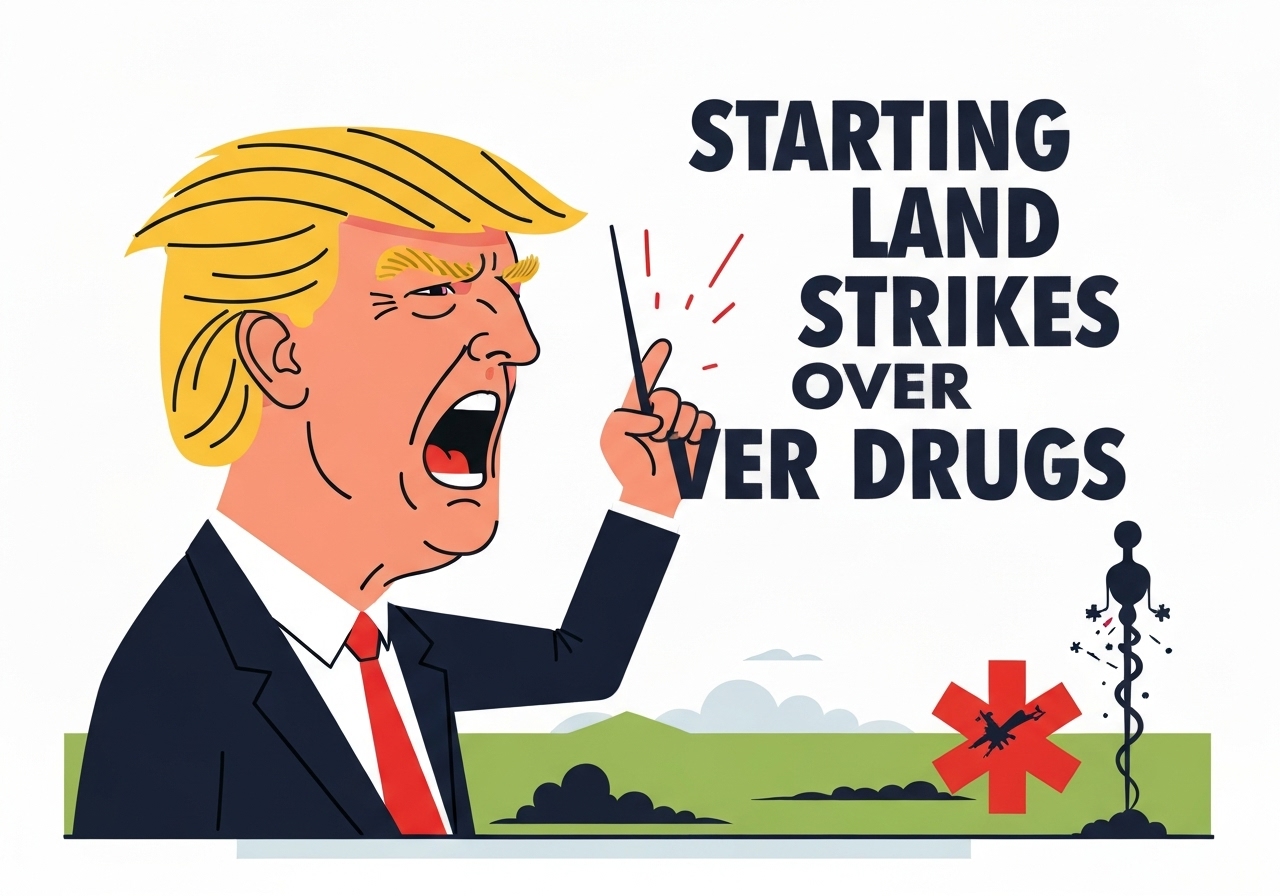
Lead: President Donald Trump told reporters Friday in the Oval Office that the United States would be “starting” land strikes against drug operations in Latin America, while declining to specify timing or locations. He repeated a claim that the U.S. had already “knocked out 96%” of drugs arriving by sea and said land operations would follow. The Pentagon has recently conducted strikes on vessels it identified as drug-smuggling boats in international waters off the coast of South America. Venezuelan President Nicolás Maduro warned this week that foreign attack would prompt wide domestic resistance.
Key Takeaways
- Trump announced on Friday in the Oval Office that U.S. operations will expand to land, after maritime actions; he declined to provide dates or target locations.
- The president said U.S. efforts have removed “96%” of drugs entering by water, a specific claim he used to justify a land campaign.
- The Pentagon has conducted strikes against suspected drug-smuggling boats in international waters off South America in recent days, according to U.S. officials.
- Trump stated land strikes “do not necessarily have to be in Venezuela,” broadening the possible geographic scope of operations.
- Venezuelan President Nicolás Maduro warned of a “general insurrectionary strike” and urged radical resistance if his country is attacked.
- Key operational details — precise targets, host-nation consent, timeline and legal authorities — remain undisclosed by U.S. officials.
- Striking targets on sovereign soil would mark a major escalation with potential diplomatic and legal consequences across the hemisphere.
Background
For months the U.S. has framed parts of its counter-drug strategy in military terms, citing the harm of fentanyl and other trafficking to American communities. In late 2025 the Pentagon escalated operations at sea, saying it had engaged vessels off the South American coast it identified as moving illicit shipments. The White House has tied those operations to both drug interdiction goals and pressure on regimes it sees as complicit or unable to stop flows.
Venezuela has been a focal point of U.S. criticism for years, and relations between Washington and Caracas have been routinely antagonistic. President Nicolás Maduro has repeatedly denounced U.S. policies as hostile and has rallied domestic supporters in response. Regional capitals and international law experts have warned that strikes on land—if carried out without host-country consent or U.N. authorization—could breach sovereignty norms and provoke wider confrontation.
Main Event
On Friday in the Oval Office, Mr. Trump told reporters the U.S. was moving from maritime interdiction to operations “by land,” asserting land-based action would be easier to execute. He repeated the 96% figure for drugs interdicted via water routes and said those gains would be followed by a new phase focused on terrestrial networks. Reporters pressed for specifics about timing and geography; the president declined to provide them, leaving key operational questions open.
The Pentagon, which has publicly described recent strikes on suspected drug-smuggling boats in international waters off South America, has not issued parallel public details about any planned land operations. U.S. officials have framed maritime strikes as targeting traffickers and transport nodes, not sovereign governments, but they have not clarified whether land strikes would require partner-state permission or be unilateral. Trump also emphasized that people and groups bringing drugs into the United States would be “targets,” a broad formulation that raises questions about how targets would be identified and validated.
Venezuelan authorities responded strongly this week after U.S. rhetoric and maritime activity intensified. Mr. Maduro urged supporters to undertake a “general insurrectionary strike” and to pursue deeper revolutionary measures if Caracas were attacked. The standoff highlights how anti-trafficking operations can intersect with regional politics, turning law-enforcement aims into potential catalysts for diplomatic crisis.
Analysis & Implications
Operationally, shifting to land strikes introduces substantial complexity. Maritime interdiction can rely on naval interdiction and international-water rules; land operations typically require intelligence on fixed facilities, secure insertion of forces or proxy actions, and reliable rules of engagement to limit civilian harm. Absent host-nation consent, any U.S. kinetic action on land risks violating sovereignty and prompting diplomatic fallout or military responses.
Legally, the United States would need to invoke a clear justification for strikes on foreign soil—such as consent, invitation by the host government, self-defense against imminent threats, or U.N. authorization. Publicly available statements so far do not specify the legal predicate for land operations, creating uncertainty among allies and international legal observers. That ambiguity could complicate cooperation with regional partners and undermine support from governments concerned about precedent and territorial integrity.
Politically, the president’s remarks serve both domestic and international signaling purposes. Domestically, framing the overdose crisis in combat terms aims to show decisive action on drugs to voters; internationally, it exerts pressure on regimes accused of enabling trafficking. But escalation risks entangling the U.S. in protracted counter-narcotics campaigns with limited ability to address the social and economic drivers of trafficking, and could increase retaliatory or asymmetric responses from affected states or nonstate actors.
Comparison & Data
| Operation Type | Status (public) | Reported impact |
|---|---|---|
| Maritime interdictions | Ongoing — Pentagon strikes in international waters | President stated 96% of waterborne drugs “knocked out” (claim by administration) |
| Land strikes | Announced intent — no public timeline or locations | Operational details and measured impact not publicly reported |
The table contrasts what the administration has described as maritime results with the announced intention to commence land-based operations; the latter lacks publicly reported metrics. Independent verification of the 96% figure and any future land strike outcomes will be essential for assessing effectiveness and collateral effects.
Reactions & Quotes
“We knocked out 96% of the drugs coming in by water, and now we’re starting by land, and by land is a lot easier, and that’s going to start happening.”
President Donald Trump (Oval Office)
This quote framed the administration’s justification for expanding operations, but left unanswered questions about targets and legal authority.
“If our nation comes under foreign attack, the working class should mount a general insurrectionary strike and push for an even more radical revolution.”
Nicolás Maduro (President of Venezuela)
Maduro’s remarks signal a readiness to mobilize domestic opposition if Caracas perceives an external military threat, raising the risk of escalation on the ground.
Unconfirmed
- Exact timing and locations for any U.S. land strikes remain undisclosed and unverified by independent sources.
- Whether Venezuela will be directly targeted is unclear; the president said strikes “do not necessarily have to be in Venezuela,” but provided no specifics.
- Public documentation of legal authorization, partner-nation consent or U.N. endorsement for land operations has not been released.
- Reports of casualty estimates, expected scale of operations, and mechanisms for post-strike accountability are not available.
Bottom Line
The administration’s announcement marks a rhetorical and potential operational escalation in the U.S. counter-drug campaign: maritime actions have been publicly reported and now the White House says land strikes will follow. Yet crucial details—when, where, under what legal authority and with what consequences—are missing, leaving a substantial gap between intent and verifiable policy.
Absent transparent legal justification and partner cooperation, land-based strikes risk provoking diplomatic and security backlash across the region while offering uncertain returns against entrenched trafficking networks. Observers should watch for formal statements from the Pentagon or State Department, any requests for host-nation consent, and independent verification of both targets and outcomes.
Sources
- Fortune — news report (press coverage of presidential remarks and regional responses)