
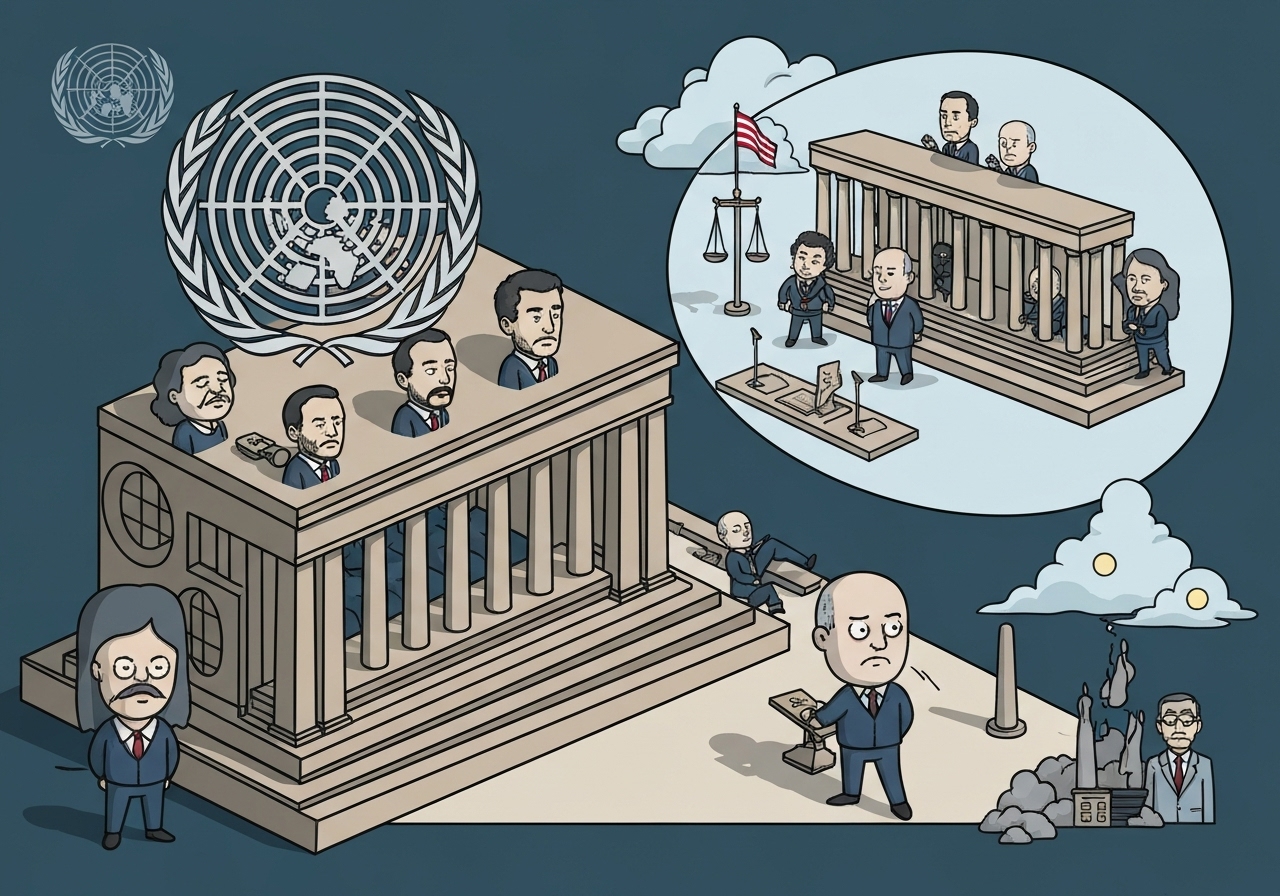
Lead: The U.S. seizure and extradition of Nicolás Maduro to The Hague this week, after his removal from power in Venezuela, has reignited global debate over the durability of post‑World War II legal norms. The Trump administration says the operation targeted narco‑terrorist networks and was lawful; Maduro faces narco‑terrorism charges in an international court following his arraignment on Monday. Senior U.N. officials and multiple governments warned the move risks eroding the U.N. Charter’s prohibition on the use of force. The episode has prompted diplomats and analysts to ask whether a new precedent for extraterritorial action by powerful states has been set.
Key Takeaways
- The Maduro operation resulted in his removal from power in Venezuela and his arraignment in The Hague on narco‑terrorism conspiracy charges on Monday.
- The Trump administration characterizes the action as part of an ongoing armed conflict with Venezuelan drug networks and cites its recently released National Security Strategy as policy context.
- U.N. Under‑Secretary‑General Rosemary A. DiCarlo urged all U.N. members to adhere to the U.N. Charter, warning against unilateral uses of force.
- More than a dozen states and international figures — including officials from China, France and the EU — criticized the operation as contravening the non‑use‑of‑force principle.
- Analysts warn the incident could affect conflicts and flashpoints from Ukraine to Taiwan and Greenland by changing how states assess the risks and legitimacy of direct action.
- The U.S. has previously sanctioned leaders and officials in the region; in October the administration imposed sanctions on Colombian President Gustavo Petro and associates for alleged drug‑trade links.
- Responses vary: some U.N. Security Council members called for a unified rebuke, while aligned leaders defended or downplayed the legal ramifications.
Background
The post‑1945 international order rests on treaties and institutions designed to constrain interstate violence and resolve disputes through law and diplomacy. The U.N. Charter’s prohibition on the use of force — save for self‑defense or Security Council authorization — is a central pillar of that order. Since World War II, states have repeatedly debated where law ends and expediency begins, especially in cases involving cross‑border criminal networks or threats to national security.
In recent years, tensions over extraterritorial action have grown. Russia’s full‑scale invasion of Ukraine has already strained norms against aggression, and powerful countries have at times used covert or deniable means to pursue strategic objectives. The U.S. government under President Trump has framed its second‑term National Security Strategy around restoring U.S. influence in the Western Hemisphere, and it has treated some Venezuelan actors as unlawful combatants tied to narcotics and terrorism.
Main Event
According to official U.S. statements and court filings, a coordinated operation on a Caracas military base removed President Nicolás Maduro and his wife, Cilia Flores, and transported them to The Hague, where Maduro was arraigned Monday on charges of participating in a narco‑terrorism conspiracy. The U.S. administration describes the mission as a precise law‑enforcement operation against transnational drug networks based in Venezuela.
U.S. representatives at the United Nations, including Ambassador Mike Waltz, defended the action as lawful and targeted, arguing it addressed an immediate criminal threat to U.S. citizens and partners. The administration has also classified the Venezuelan drug cartels as participants in an armed conflict, which it says alters the legal framework for use of force against them.
International reaction was swift and polarized. The European Union and some member states reiterated adherence to international law and the U.N. Charter, while China, Russia and others publicly condemned the operation as a violation of sovereignty. French Foreign Minister Jean‑Noël Barrot warned that repeated breaches of non‑use‑of‑force norms by powerful states would have severe global consequences.
Analysis & Implications
Legal scholars note that the U.S. claim hinges on two linked arguments: first, that Venezuelan leadership was complicit with narcotics trafficking amounting to a transnational armed criminal threat; second, that classifying those networks as participants in an ‘armed conflict’ permits a broader use‑of‑force calculus. If accepted as precedent, that framing could widen the scope of extraterritorial operations against non‑state and state‑linked actors.
Diplomatically, the operation complicates U.S. relations with allies who prioritize multilateral legal processes. The EU’s call to uphold the U.N. Charter signals a desire among many states to preserve collective checks on force. At the same time, some U.N. Security Council members with closer ties to Washington offered muted responses or defended U.S. national security prerogatives, underscoring fractures in global governance.
Strategically, the capture raises questions about deterrence and escalation. States facing domestic instability or transnational criminal threats may feel emboldened to authorize cross‑border operations; rival powers may respond asymmetrically or accelerate military posturing in contested regions such as the Indo‑Pacific or Europe. The move therefore risks creating new collision points between counter‑criminal and geopolitical logic.
Comparison & Data
| Scenario | Potential effect on international norms |
|---|---|
| Ukraine | Could harden positions on sovereignty violations and complicate support coalitions that rely on legal justifications. |
| Taiwan | May increase worries about sudden, coercive moves against political leaders, though China prefers gradual pressure over direct seizures. |
| Greenland | Raises rhetorical claims about strategic territories and fuels concerns about territorial ambitions among major powers. |
The table summarizes likely directional effects on norms across several flashpoints. While the Maduro operation is singular, its perceived legality or illegality will inform state calculations in crises where legal cover and rapid action are both attractive.
Reactions & Quotes
U.N. officials and diplomats offered immediate critiques and calls for adherence to charter obligations, arguing that the stability of international law depends on consistent practice.
“The maintenance of international peace and security depends on the continued commitment of all member states to adhere to all the provisions of the Charter.”
Rosemary A. DiCarlo, U.N. Under‑Secretary‑General
U.S. envoys defended the operation as lawful and narrowly tailored to disrupt narcotics‑linked violence, linking it to declared national security priorities.
“This was a surgical law enforcement operation against unlawful actors who pose a global drug threat.”
U.S. Ambassador to the U.N., Mike Waltz
European and other state officials expressed alarm about precedent‑setting uses of force, while some allied leaders questioned whether established legal processes were bypassed.
Unconfirmed
- Whether the legal rationale the U.S. has advanced will be accepted by international courts as sufficient precedent for similar extraterritorial operations is unresolved.
- Any follow‑on moves by other states motivated by this incident — for example, direct actions against political leaders in rival countries — remain speculative and unverified.
- Precise operational details about how Maduro was removed from power and transferred to The Hague beyond official U.S. summaries have not been independently confirmed.
Bottom Line
The Maduro seizure and arraignment crystallize a broader contest over the reach of international law and the willingness of powerful states to act unilaterally against perceived security threats. While the U.S. frames the operation as a targeted effort against narcotics networks, many states view it as a dangerous expansion of the circumstances that justify force. The dispute now centers on whether international institutions and courts will uphold or reject the legal claims made in this case.
For policymakers and observers, the immediate focus should be on preserving transparent legal review and multilateral dialogue to limit escalation. Over the medium term, how courts, the U.N. and major powers respond will shape whether this episode becomes an isolated outlier or a new model for decisive, extraterritorial state action.
Sources
- Associated Press (news report) — original coverage of the Maduro capture and international reactions.