
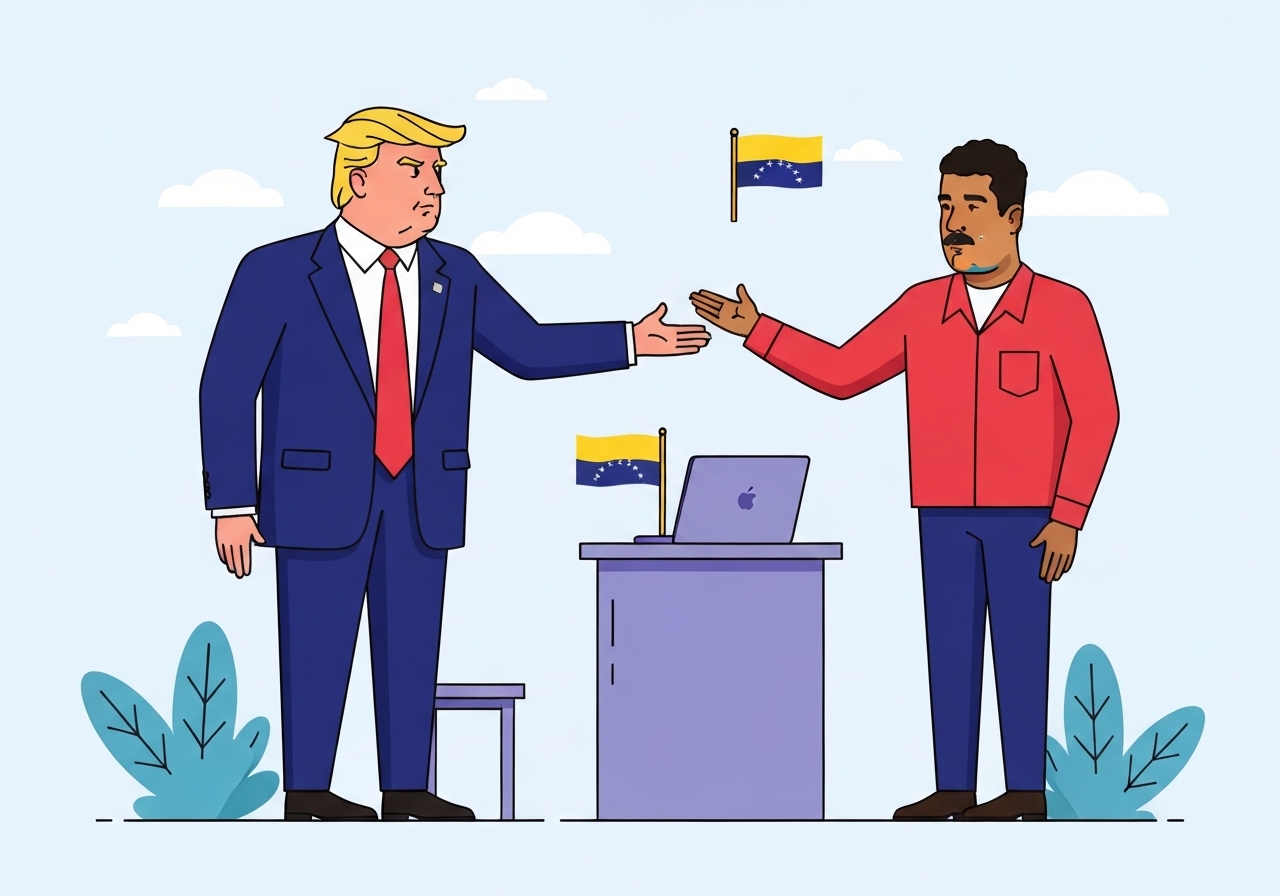
U.S. President Donald Trump reportedly told Venezuela’s Nicolás Maduro in a phone call on 21 November that he must leave office immediately and offered safe passage for Maduro and close family — a demand Maduro declined, according to multiple U.S. and regional media sources. Trump confirmed on , that the call took place but gave few details, saying only that “I wouldn’t say it went well or badly, it was a phone call.” Neither Washington nor Caracas has published full records of the exchange; the account of an ultimatum and subsequent counter-demands comes primarily from reporting by the Miami Herald and was discussed in U.S. outlets. The episode adds a new, tense chapter to a four-month U.S. pressure campaign that has included a major naval deployment off Venezuela’s northern coast.
- Phone call reportedly occurred on 21 November; Trump publicly confirmed the call on 1 December 2025.
- Sources told the Miami Herald Trump offered safe passage for Maduro, his wife and son only if Maduro resigned immediately.
- Maduro is said to have refused and demanded what was described as a “global amnesty” and retention of military control while ceding political power.
- The discussion was reportedly brokered by Brazil, Qatar and Turkey; follow-up calls were reportedly requested but not answered.
- The episode coincides with a four-month U.S. pressure campaign and a large naval deployment off Venezuela’s northern coast ordered by Trump.
- Analysts and Venezuelan officials told outlets some in Caracas view U.S. military threats as a bluff, raising doubts about immediate military action.
- Maduro published a letter to OPEC accusing the U.S. of seeking control of Venezuela’s oil reserves through force.
Background
Nicolás Maduro has led Venezuela since 2013 and has weathered repeated crises: a protracted economic collapse, mass protests, a reported assassination attempt in 2018 and contested national elections. International pressure on his government has waxed and waned; the U.S. pushed a “maximum pressure” strategy during Trump’s earlier term and has re-intensified actions in recent months. The current episode follows months of diplomatic and military signaling, including sanctions, public threats and deployment of naval assets in the Caribbean.
Maduro’s domestic position has been resilient despite external pressure and internal dissent; he continues to command loyalty within portions of the armed forces and state institutions. Opposition actors and several regional governments have sought negotiations at various times, while other international actors have backed Maduro or called for inclusive talks. The competing incentives — domestic survival, international isolation, and control of oil revenue — shape Caracas’s responses to external demands.
Main Event
According to reporting by the Miami Herald, the 21 November call featured a blunt message from President Trump: leave power immediately and accept safe passage. The Herald reported Trump framed the offer as a narrow window for Maduro and his immediate family to depart under protection in exchange for an immediate resignation. The White House and presidential spokespeople have not released an official transcript or detailed summary of the conversation.
Venezuela’s government reportedly refused the ultimatum and presented a set of counter-conditions. Those demands were described in U.S. reporting as requests for a sweeping amnesty from prosecution for Maduro and close associates, and negotiated arrangements over control of armed forces versus political office. State media in Caracas published a letter in which Maduro accused the U.S. of aiming to seize Venezuela’s oil resources by force.
Sources told U.S. outlets that Brazil, Qatar and Turkey helped to arrange the initial contact, though those countries have not issued detailed official accounts of mediation. The Miami Herald also reported that Maduro sought a second conversation after Trump publicly declared Venezuela’s airspace “closed in its entirety,” but that follow-up contact received no reply. Both capitals have signaled a preference for a negotiated settlement even as pressure intensified.
The reported exchange amplified international debate over Washington’s options: whether diplomacy, increased sanctions, covert pressure or military measures could dislodge Maduro without triggering wider regional instability. Publicly, senior U.S. officials have emphasized a range of tools short of direct regime change, while domestic political outlets in the U.S. have urged stronger action, intensifying the debate over credibility and consequence.
Analysis & Implications
The episode illustrates the persistent gap between public threats and credible military action. Many analysts argue that the U.S. retains significant leverage — financial sanctions, diplomatic isolation and naval presence — but that the costs of direct military intervention remain high both regionally and domestically. Caracas’s ability to cling to power is linked to loyalty within parts of the military and to networks that control resources and information.
Regionally, an overt U.S. push to remove Maduro could strain ties with countries that oppose foreign intervention and prompt new alignments with external actors such as Russia, Iran or Turkey. Conversely, a negotiated transition that preserves security guarantees for senior officials could reduce the risk of armed conflict but risk perceptions of impunity. The reported Maduro demand for immunity and continued military control illustrates the transactional nature of any possible deal.
For global energy markets, uncertainty around Venezuela’s leadership raises questions about production restoration and investment, though immediate effects on oil prices have been muted by broader market dynamics. Long-term change in Caracas would likely require substantial institutional reform and international guarantees to unlock investment and production capacity.
Domestically in the U.S., the incident sharpens political debate over the administration’s foreign-policy posture. Editorial voices in major U.S. outlets have argued both for escalation and caution; policymakers must weigh credibility against the risk of entanglement in a complex, protracted crisis with uncertain outcomes.
Comparison & Data
| Year | Event | Significance |
|---|---|---|
| 2013 | Maduro assumes presidency | Start of Maduro’s rule |
| 2018 | Reported assassination attempt | Heightened internal security measures |
| 2024 | Contested election outcome | Opposition claims of defeat |
| 2025 | Nov–Dec: reported ultimatum and naval deployment | Renewed international pressure |
The table places the November call in a broader sequence of crises that have marked Maduro’s time in office. While past episodes have produced sanctions and diplomatic isolation, none produced a swift change of leadership. That pattern helps explain both Washington’s use of pressure and Caracas’s reluctance to yield.
Reactions & Quotes
U.S. officials and regional leaders offered measured public statements while media reports supplied detailed accounts. Analysts caution that reported threats may outstrip immediate U.S. willingness to use force.
“I wouldn’t say it went well or badly, it was a phone call.”
Donald Trump (public remark, 1 December 2025)
“Maduro and most of his cohorts view the US military threats as a bluff.”
Source in contact with Venezuelan officials (as reported to the Wall Street Journal)
“The United States seeks to appropriate Venezuela’s vast oil reserves — the largest on the planet — through the lethal use of military force.”
Nicolás Maduro (letter published in Venezuelan state media)
Unconfirmed
- Precise wording and legal terms of the alleged ultimatum remain unverified beyond media sourcing.
- Details of any mediation role played by Brazil, Qatar and Turkey have not been publicly confirmed by those governments.
- The scope and legal basis of the reported “global amnesty” demanded by Maduro are not documented in official texts.
- Whether a formal second call was requested by Maduro and declined by U.S. officials is reported but not substantiated by official records.
Bottom Line
The reported ultimatum, if accurate, is an extraordinary instance of direct presidential contact aimed at regime change in a strategically important country. Yet the balance between public threats and credible means of enforcement remains uncertain; Caracas’s survival to date rests on security-sector loyalties and institutional controls that are hard to overturn quickly. Observers should expect a mix of continued diplomatic maneuvering, targeted sanctions and public signaling rather than immediate regime collapse.
For policymakers and markets, the key questions are whether Washington will broaden its coercive toolkit and whether regional actors can broker a transition that avoids violence while delivering accountability. In the coming weeks, verified statements, diplomatic communiqués and any movement in Venezuelan military alignments will be the most reliable indicators of whether the crisis escalates or moves toward negotiated settlement.
Sources
- The Guardian (international news outlet reporting on the call and confirmations)
- Miami Herald (U.S. regional newspaper; primary source for the reported ultimatum details)
- Wall Street Journal (U.S. national newspaper; commentary and sourcing on regional reactions)
- Agencia Venezolana de Noticias (AVN) (Venezuelan state media; published Maduro’s letter to OPEC)
- Office of the President of Colombia (official; referenced for Cartagena mediation offer)