
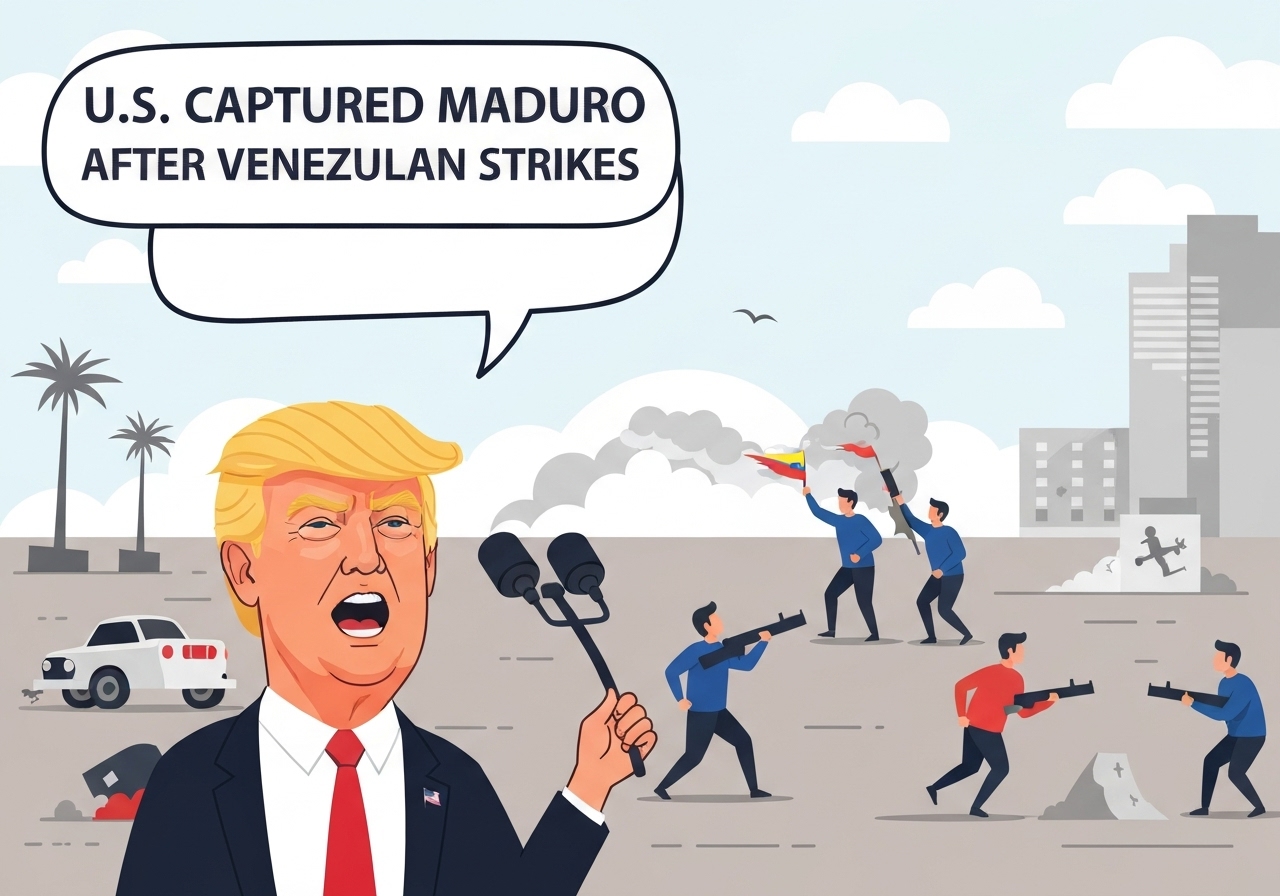
Updated Jan. 3, 2026, 1:30 PM EST — President Donald Trump announced from Mar-a-Lago that U.S. forces carried out overnight strikes in Venezuela that resulted in the capture of President Nicolás Maduro. Trump described the operation as an “assault like people have not seen since World War II,” said no U.S. service members were killed, and confirmed Maduro was being transferred to the United States after an indictment in the Southern District of New York. He framed a continued U.S. presence in Venezuela as necessary to secure oil resources and said the country would be run “until such time as we can do a safe, proper and judicious transition.”
Key takeaways
- The announcement came Jan. 3, 2026; the president briefed reporters from Mar-a-Lago following an overnight operation that he said captured Nicolás Maduro.
- Trump called the strikes “large scale” and said no U.S. service members were killed, though he acknowledged a small number were wounded and expected to recover.
- The administration says Maduro has been indicted in the Southern District of New York on narco-terrorism charges; Trump said Maduro will be taken to New York to face those charges.
- Trump asserted the United States will maintain a military presence in Venezuela tied to oil security and said U.S. control or oversight of Venezuelan operations would not cost U.S. taxpayers because revenue would reimburse reconstruction and operations.
- The U.S. Energy Information Administration notes Venezuela produced 0.8% of global crude in 2023 despite holding one of the world’s largest known oil reserves, a detail the administration cited when explaining economic aims.
- Defense Secretary Pete Hegseth described the action as a “massive joint military and law enforcement raid” he said was executed without loss of U.S. life.
Background
Venezuela has long been a major oil-bearing nation and a founding member of OPEC, but its petroleum sector has been weakened over years by mismanagement, corruption and sanctions. U.S. policymakers and regional actors have debated pressure, sanctions and support for opposition movements for much of the last decade, making Venezuela a focal point of hemispheric policy. The United States previously indicted Nicolás Maduro and other Venezuelan officials in 2020 on narcotics-related charges; those legal actions have been part of broader U.S. efforts to hold senior Venezuelan officials accountable.
The Trump administration has repeatedly framed Venezuelan policy around both human rights and energy security, arguing that restoring production would benefit global markets and undermine revenue streams that support illicit networks. Any sustained U.S. presence or administration role in Venezuela would raise questions about sovereignty, logistics and international law, and would require coordination with allied states and international institutions. Domestic U.S. politics also shapes messaging: Trump addressed the operation from his Florida resort, reiterating campaign-style rhetoric about strength, resources and rapid action.
Main event
According to President Trump and senior administration spokespeople, U.S. forces executed an overnight operation in which Maduro was captured at a fortified residence. Trump described the location as “more like a fortress than a house,” saying steel doors and a reinforced safe space were present but that Maduro’s movement was intercepted before he reached it. The administration released a photo Trump said showed Maduro aboard the USS Iowa Jima; officials characterized the mission as joint military and law-enforcement action.
Defense Secretary Hegseth called the operation “flawlessly executed,” and the president repeatedly emphasized that no U.S. service members were killed, though he acknowledged some were wounded and expected to recover. Trump said the administration had delayed the operation due to weather and launched when conditions permitted; he also warned of readiness to escalate if necessary but expressed hope a second, larger attack would not be needed.
On legal matters, Attorney General Pam Bondi publicly stated that Maduro and his wife have been indicted in the Southern District of New York on narco-terrorism charges; Trump said they would be brought to New York to face those charges. The administration described plans for U.S. oversight or involvement in Venezuela’s governance for a transitional period, with an explicit link to restoring oil production and compensating reconstruction costs through oil revenue.
Analysis & implications
The capture of an incumbent head of state by foreign military forces is rare in modern international relations and carries immediate diplomatic, legal and security implications. If the U.S. intends to retain a presence in Venezuela to secure oil infrastructure, it must confront questions from international law, regional governments and multilateral institutions about sovereignty and occupation. Even if framed as temporary and justified on criminal charges and security grounds, prolonged presence risks backlash from regional governments and could complicate relations with countries that oppose U.S. unilateral actions.
Economically, restoring Venezuelan oil output could affect global markets, but rebuilding production will require substantial investment and time. Trump’s claim that reconstruction “won’t cost us anything” because oil revenues will reimburse costs simplifies a complex process: rehabilitating wells, pipelines and refineries after years of decline involves capital, skilled labor and legal arrangements with private firms and international banks. The administration’s ability to secure cooperative oil companies and clear legal ownership and sanction issues will determine how quickly production can rise.
Domestically for the United States, the operation may be presented as a law-enforcement and security success; it will also generate political debate over executive authority, the use of military force, and the precedent of detaining a foreign leader on U.S. soil. Allies and adversaries will watch responses closely: nations aligned with Maduro or critical of U.S. intervention may condemn the action, while others may welcome removal of a leader accused of narcotics trafficking. The legal process in New York will test the capacity to try an ex-head of state for transnational crimes and set a significant precedent.
Comparison & data
| Item | Noted figure or status |
|---|---|
| Venezuelan share of 2023 global crude production (EIA) | 0.8% |
| Petroleum resource status | One of the world’s largest known oil reserves (production reduced by mismanagement and sanctions) |
The table highlights the gap between Venezuela’s large known reserves and its small share of 2023 global crude output, a central factor behind the administration’s stated emphasis on oil infrastructure rehabilitation. Any forecast of how quickly Venezuelan output could increase must account for physical degradation of fields, the availability of investment, and the legal status of assets under existing sanctions and contracts.
Reactions & quotes
Officials and commentators offered immediate, often stark responses that reflect differing perspectives on legality, strategy and consequences.
“We had nobody killed—I think we had nobody killed, I have to say, because a couple of guys were hit, but they came back and they’re supposed to be in pretty good shape.”
President Donald Trump
This comment followed the president’s public briefing and was used to underscore the administration’s claim of operational success with limited U.S. casualties.
“A massive joint military and law enforcement raid that was flawlessly executed.”
Defense Secretary Pete Hegseth
Hegseth framed the operation as coordinated action by multiple U.S. agencies and emphasized execution and planning; that framing is central to the administration’s narrative that the mission was precise and controlled.
“They will soon face the full wrath of American justice on American soil in American courts.”
Attorney General Pam Bondi
Bondi’s statement connects the capture to existing legal cases and signals intent to prosecute Maduro under U.S. narcotics and related statutes in the Southern District of New York.
Unconfirmed
- Authenticity of the photograph released by the president purporting to show Maduro aboard the USS Iowa Jima has not been independently verified.
- Details about the broader chain of arrests or seizures inside Venezuela, including the fate of other senior officials or assets, remain unconfirmed.
- The exact legal and operational arrangements for a U.S. transitional presence or resource reimbursement through oil revenues are not yet documented publicly.
Bottom line
The capture of Nicolás Maduro, if confirmed as described by the White House, is an extraordinary development with wide-reaching legal, diplomatic and security consequences. It simultaneously advances the administration’s criminal prosecution narrative and raises immediate questions about sovereignty, precedent and regional stability.
Practical outcomes will depend on the transparency of evidence, the legal process in New York, and how regional actors and international institutions respond. Observers should watch for formal filings in U.S. courts, independent verification of on-the-ground facts in Venezuela, and diplomatic signals from neighboring countries that will shape the durability of any U.S. presence or transitional governance arrangement.
Sources
- CBS News — news report and presidential briefing (media)
- U.S. Energy Information Administration — country production and energy data (federal agency)
- U.S. Attorney’s Office, Southern District of New York — federal prosecutorial office (official)