
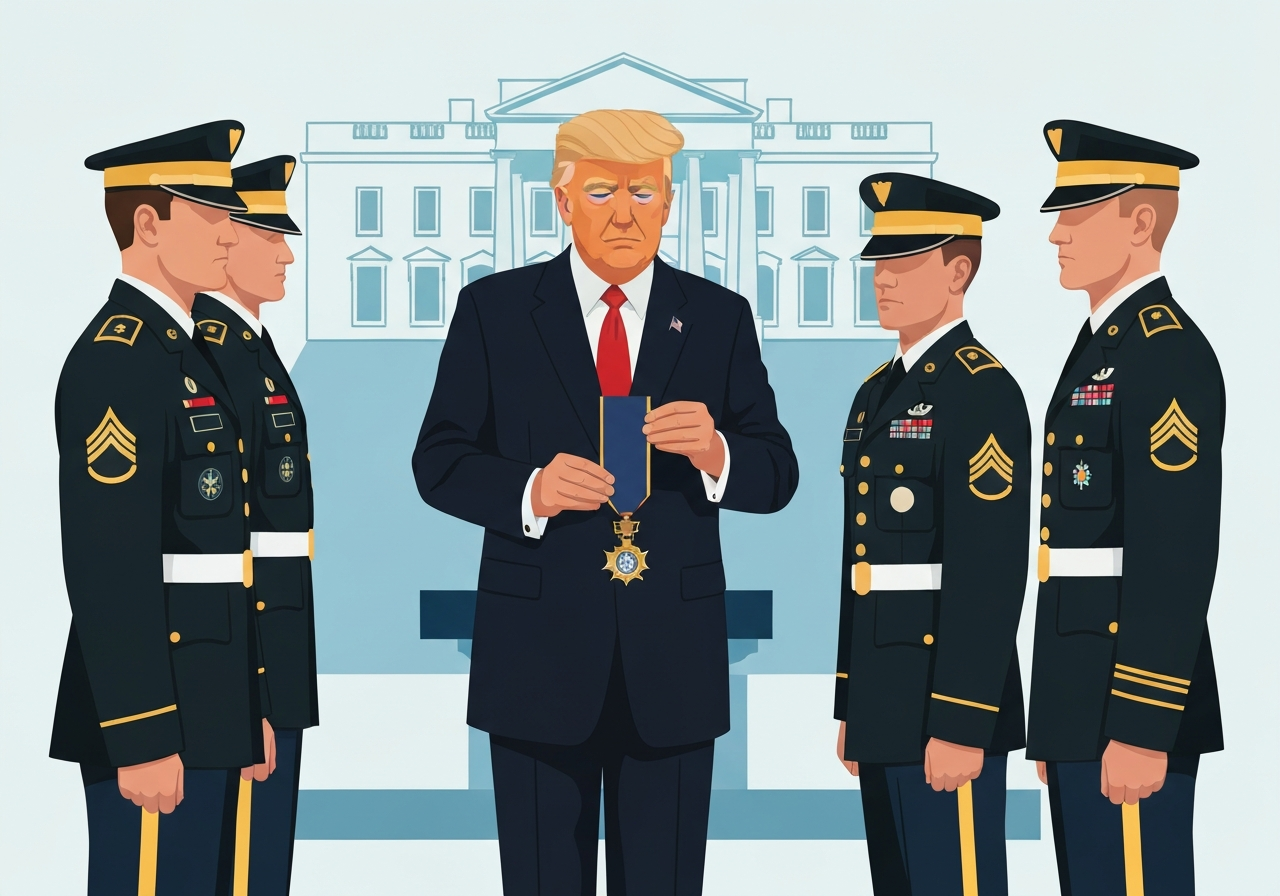
President Donald Trump on Monday presented the Medal of Honor to three U.S. Army service members at a White House ceremony in the East Room, honoring acts of extraordinary valor from World War II, the Vietnam War and the war in Afghanistan. The awards recognized Master Sgt. Roderick W. Edmonds for leadership and resistance as a prisoner of war in Germany in 1945, Retired Command Sgt. Maj. Terry P. Richardson for actions during a Sept. 14, 1968, Vietnam reconnaissance mission credited with saving 85 lives, and Staff Sgt. Michael H. Ollis, killed Aug. 28, 2013, in Afghanistan after shielding a Polish coalition officer. The event brought family members and allied guests to the White House while the president used part of his remarks to address policy matters, including Iran and immigration. The Medals of Honor were presented in the name of Congress for conduct above and beyond the call of duty that placed the recipients at extreme personal risk.
Key Takeaways
- Three Medals of Honor were presented at the White House on Monday to Edmonds (World War II), Richardson (Vietnam, Sept. 14, 1968) and Ollis (Afghanistan, Aug. 28, 2013).
- Richardson’s citation credits him with actions that ultimately spared an estimated 85 fellow U.S. soldiers during a reconnaissance mission near Loc Ninh, Vietnam.
- Staff Sgt. Michael H. Ollis was posthumously honored for blocking an insurgent and saving a Polish coalition officer at Forward Operating Base Ghazni; the incident cost Ollis his life.
- Master Sgt. Roderick W. Edmonds is recognized for ordering 1,200 American POWs to attend a roll call to prevent the identification and likely execution or torture of Jewish-American prisoners in January 1945.
- The president used his remarks to touch on unrelated policy issues, including Iran, immigration enforcement and an aside about White House decor and Polish politics.
- The Medal of Honor is awarded by the president, in the name of Congress, and recognizes acts that go beyond the call of duty and involve extreme personal risk.
Background
The Medal of Honor is the United States military’s highest award for combat valor; presidents present it on behalf of Congress to service members whose actions demonstrate conspicuous gallantry and risk of life. Award ceremonies often bring together surviving family members, fellow veterans and allied representatives to recognize both individual sacrifice and broader service traditions. In recent years, Congress and military branches have reviewed older cases and advanced some long-delayed recognitions as archival records and veteran advocacy clarified past events.
This White House ceremony occurred against a wider political backdrop: the president referenced current security concerns about Iran and domestic policy topics while speaking, illustrating how ceremonial honors sometimes intersect with ongoing policy narratives. Each recipient’s award spans a different conflict era—World War II, Vietnam and Afghanistan—highlighting the continuity of battlefield sacrifice across generations. Families and coalition partners have played visible roles in securing and accepting these honors, underlining diplomatic and personal ties that awards ceremonies can reaffirm.
Main Event
The East Room ceremony assembled the three honorees’ relatives and attendees who directly benefited from the recipients’ actions, including the Polish officer Staff Sgt. Ollis saved. President Trump introduced the awards by praising the recipients’ courage and reflecting on the importance of recognizing battlefield valor. Trump said the occasion was unmatched in its significance and spoke briefly about subjects beyond the awards themselves, including regional security concerns and domestic matters.
Terry P. Richardson’s citation recounts a Sept. 14, 1968 reconnaissance operation near Loc Ninh in the Republic of Vietnam, where, as a platoon leader, he rescued three wounded soldiers under heavy machine-gun fire, directed airstrikes from a seized hilltop for at least seven hours despite sniper wounds and declined immediate medical evacuation to remain with his unit. The White House summarized that Richardson’s conduct spared the lives of 85 fellow soldiers; Richardson attended with members of his former unit.
Staff Sgt. Michael H. Ollis, 24 when he died, served at Forward Operating Base Ghazni in Afghanistan. During an Aug. 28, 2013 attack, he directed troops to safety, returned to search for missing personnel, encountered Lt. Karol Cierpica of Poland, and positioned himself between an injured coalition officer and an insurgent. Ollis engaged the attacker, who detonated a suicide vest and mortally wounded Ollis; Cierpica spoke at the ceremony and has publicly honored Ollis’ memory.
Master Sgt. Roderick W. Edmonds served as the senior NCO among approximately 1,200 American prisoners at a German camp in early 1945. When German authorities threatened to single out Jewish-American prisoners for roll call on Jan. 26, 1945, Edmonds ordered all prisoners to present themselves, invoking prisoners’ rights under international law and reportedly stating ‘We are all Jews here.’ His actions, along with later preparations to resist camp evacuation as Allied forces advanced, are credited with preventing the segregation and likely execution of Jewish-American POWs.
Analysis & Implications
Ceremonies honoring historic acts of valor serve multiple functions: they recognize individual sacrifice, reaffirm institutional values in the armed forces and connect contemporary political leadership with military tradition. Presenting medals from three distinct conflicts underscores continuity in the military’s narrative of duty and courage across decades. That continuity can strengthen public appreciation for veterans and support for veteran services, but it also invites scrutiny when political leaders use such forums to address unrelated policy issues.
The president’s remarks about Iran and domestic policies at this event illustrate how medal presentations can become platforms for broader messaging. For some observers, linking valor awards to current policy reinforces the administration’s framing of threats; for others, it risks politicizing moments meant primarily for solemn recognition. The presence of allied figures like Lt. Cierpica also highlights the international dimensions of U.S. operational partnerships and the diplomatic goodwill that can accompany individual acts of heroism.
On a practical level, posthumous awards and belated recognitions reflect ongoing efforts by families, veterans’ groups and military review boards to ensure historical accuracy and proper acknowledgement. Edmonds’ medal, awarded decades after World War II, and Ollis’ posthumous recognition illustrate that the award process can evolve as records are reviewed and advocacy continues. These processes can bring closure to families and reinvigorate public discussion of historical episodes and their present-day lessons.
Comparison & Data
| Recipient | Conflict | Date of Action | Key Fact |
|---|---|---|---|
| Terry P. Richardson | Vietnam | Sept. 14, 1968 | Directed strikes; citation credits 85 lives saved |
| Michael H. Ollis | Afghanistan | Aug. 28, 2013 | Shielded Polish officer; killed by suicide vest |
| Roderick W. Edmonds | World War II | Jan. 26, 1945 | Blocked identification of Jewish POWs; led resistance |
The table summarizes the recipients, conflicts and the specific dates tied to the actions recognized. Presenting these cases side by side highlights the distinct operational contexts—reconnaissance and protracted firefight versus prisoner-of-war resistance—and the shared theme of placing others’ lives ahead of one’s own. The comparison also underlines how medal awards can address very different forms of courage: tactical battlefield action and moral leadership under captivity.
Reactions & Quotes
There’s no ceremony that can be more important than this.
President Donald Trump
Trump opened the event by framing the presentation as uniquely significant, setting a solemn tone before moving into broader policy commentary.
A soldier is not something you are from time to time. It is who you are forever.
Lt. Karol Cierpica
Cierpica, the Polish officer saved by Staff Sgt. Ollis, spoke emotionally about the lifelong identity of service and later described Ollis as family, underscoring the personal bonds forged in coalition operations.
We are all Jews here.
Master Sgt. Roderick W. Edmonds (as recounted in citation)
The line attributed to Edmonds, repeated during the ceremony, encapsulates the moral stand that his citation credits with preventing the separation and likely persecution of Jewish-American POWs.
Unconfirmed
- Detailed operational records beyond the official citations for Richardson’s seven-hour direction of airstrikes are not publicly available in full, limiting independent verification of every tactical claim.
- The precise extent to which the president’s policy comments were coordinated with families or military officials present at the ceremony is not documented publicly.
- Any classified after-action materials or intelligence that could provide fuller context for the events in Afghanistan or Vietnam remain restricted and were not released as part of the ceremony record.
Bottom Line
The White House ceremony recognized three distinct acts of valor spanning World War II, Vietnam and Afghanistan, honoring moral leadership, battlefield tactics and self-sacrifice that saved lives. While the awards reaffirm longstanding military values, the event also illustrated how official ceremonies can intersect with contemporary political messaging when leaders choose to broaden their remarks.
For families and surviving beneficiaries, the medals provide formal acknowledgement and public recognition that can have deep personal and symbolic meaning, sometimes arriving decades after the fact. Observers will watch whether such ceremonies influence public understanding of veteran affairs, military history reviews and the broader relationship between national commemoration and current policy debates.
Sources
- AP News (news organization)