
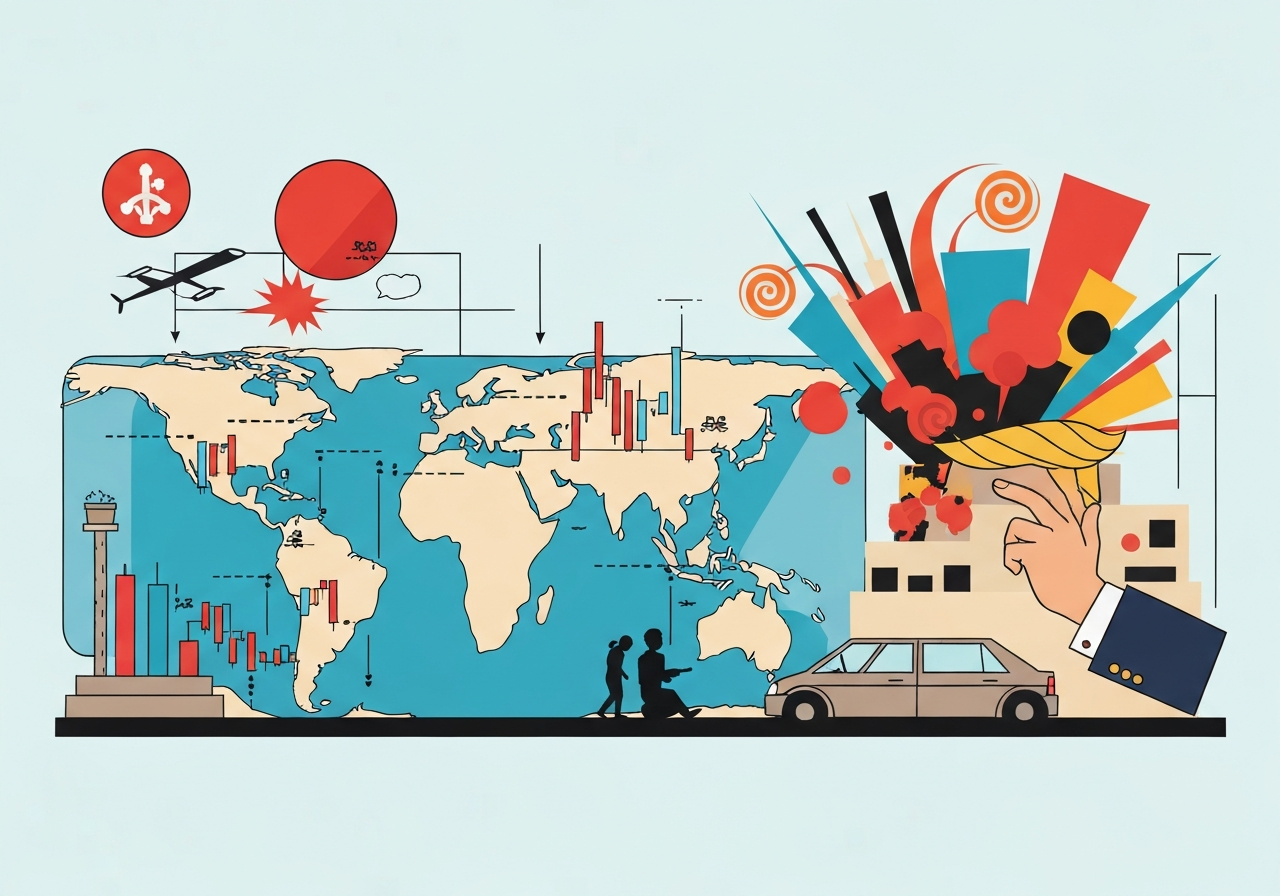
Global stock markets tumbled on Monday after strikes ordered by President Donald Trump on Feb. 28 escalated into open conflict across the Middle East, sending oil prices sharply higher and triggering fears of prolonged supply disruption. Asian trading opened with heavy losses: Japan’s Nikkei fell 7 percent and South Korea’s main index dropped 8.2 percent after steep declines the previous week. Brent crude surged 27 percent to $104.57 a barrel, its largest single-day gain since 1988 and the first time the benchmark topped $100 since early 2022. Investors and central bankers immediately raised the prospect of higher inflation and renewed interest-rate pressure worldwide.
Key Takeaways
- Global equities opened deeply negative on Monday: Japan’s Nikkei down 7.0% and South Korea’s main index down 8.2%, following prior weekly falls of 5.5% and more than 10% respectively.
- Brent crude jumped 27% to $104.57 per barrel, the biggest one-day rise since 1988 and the first return above $100 since Russia’s 2022 invasion of Ukraine.
- Analysts warn this is the most severe oil supply shock since the 1970s, raising odds of higher global inflation and further central-bank tightening.
- U.S. and allied strikes that began Feb. 28 have been followed by retaliatory attacks on oil infrastructure and shipping lanes, including the closure of the Strait of Hormuz.
- At least eight U.S. service members have been confirmed killed since Feb. 28; casualty figures and some high-profile target reports remain disputed or unverified.
- Markets are reacting to both the immediate supply shock and the political uncertainty around Washington’s strategy and exit options.
Background
The strikes ordered by President Trump on Feb. 28 marked a sharp escalation in U.S. involvement alongside Israeli operations against Iranian targets. That action came amid already heightened tensions dating back to the 2019–2022 regional proxy conflicts and after the 2022 Russian invasion of Ukraine reshaped energy and geopolitical trade patterns. Oil markets, already sensitive to supply interruptions, had limited spare capacity; a sudden disruption in Persian Gulf flows can rapidly lift prices globally.
Shipping through the Strait of Hormuz normally carries a sizeable share of seaborne crude — industry estimates put the figure at up to about one-fifth of global supply. The region hosts critical oil and gas infrastructure for multiple producing states, making any attack or chokepoint closure an immediate risk to delivered volumes. Traders and policymakers have little recent precedent for a simultaneous, high-intensity shock to both production sites and maritime transit in the Gulf outside the 1970s and the 1990–91 Gulf War.
Main Event
Markets opened the trading week with sharp losses after overnight reports of U.S. and Israeli strikes on Iranian sites and subsequent Iranian counterattacks on regional infrastructure and shipping. Equity indices in Asia led declines, with Nikkei and South Korean markets particularly hard hit; European and U.S. futures also reflected deepening risk aversion. The immediate market driver was the spike in oil prices as traders priced in potential weeks or months of disrupted flows.
Brent crude’s 27% jump to $104.57 was described by market participants as the single largest daily rise since 1988. That move pushed oil back into triple digits and forced commodity desks, pension funds and sovereign wealth managers to revalue risk across diverse asset classes. Energy stocks surged in some markets while broader indices fell, reflecting sector-specific gains amid systemic losses.
The conflict has produced military casualties: at least eight U.S. service members have been confirmed killed since Feb. 28. In parallel, reports circulated on social and traditional media about senior Iranian figures being struck; some of those reports remain unverified and are addressed below. U.S. officials and market analysts highlighted that clarity from Washington about objectives and an exit strategy was limited at publication time, amplifying investor anxiety.
Analysis & Implications
Economically, a sudden, sustained rise in oil prices raises near-term inflation across energy-importing countries, eroding real incomes and complicating central-bank decisions. Higher fuel costs feed into transport and production, and if sustained they can push headline inflation above targets already strained by rebound demand in many economies. Policymakers face a classic dilemma: tighten monetary policy to curb inflation and risk deepening economic slowing, or tolerate higher inflation to avoid immediate recessionary pressure.
For financial markets, the shock increases volatility and prompts reallocation from risk assets to perceived safe havens such as government bonds and the U.S. dollar. The scale of index falls in Japan and South Korea suggests concentrated investor deleveraging and portfolio rebalancing. If the conflict persists, corporate earnings forecasts, particularly for industries with tight margins or high energy intensity, will need downward revision.
Geopolitically, the strikes and ensuing retaliation expand the conflict footprint across the Gulf and adjacent sea lanes. Closure or intermittent disruption of the Strait of Hormuz would force longer shipping routes and higher insurance costs, compounding price transmission to global consumers. Diplomatically, the U.S. decision to join large-scale strikes raises questions among allies about strategy, burden-sharing and the political calculus ahead of U.S. midterm elections in November.
Comparison & Data
| Market/Item | Move (Most Recent) | Prior Week Move |
|---|---|---|
| Japan Nikkei | -7.0% | -5.5% |
| South Korea main index | -8.2% | > -10% |
| Brent crude | +27% to $104.57 | First triple-digit since 2022 |
The table highlights how acute the immediate market reaction was compared with recent weekly moves. Traders price in not only the physical disruption of supply but also secondary effects: higher shipping costs, insurance surcharges for Gulf transits and potential knock-on impacts to manufacturing supply chains. Central banks will monitor core inflation and wage dynamics to decide if a policy response is required beyond previously signaled paths.
Reactions & Quotes
Market strategists and risk analysts emphasized the scale of the oil shock and the uncertainty about conflict duration.
“Faced with the worst oil supply shock since the 1970s, all eyes will be on Washington’s response,”
Helima Croft, RBC Capital Markets (analyst quoted via Reuters)
Ms. Croft cautioned that without a clear definition of objectives, it is difficult to forecast whether the conflict will last weeks or months. That uncertainty has fed directly into risk premia on oil and equities, according to traders and institutional investors reached for comment.
“There will likely be more before it ends. That’s the way it is,”
President Donald Trump (public remark)
The president’s public remarks, widely reported, were interpreted by some voters as a blunt acknowledgment of escalating costs, while others viewed them as signaling a willingness to sustain military pressure. Political analysts note that economic fallout from rising energy costs could affect the Republican Party’s standing heading into November midterms.
Unconfirmed
- Reports that Iran’s supreme leader, Ayatollah Ali Khamenei, was killed in the strikes have circulated widely; these claims remain unverified and contradict established public records. Independent confirmation is required.
- Some locally sourced casualty counts and claims about exact damage to specific oil platforms or terminals are still being assessed by on-the-ground authorities and third-party inspectors.
Bottom Line
The immediate financial effect of the Feb. 28 strikes and ensuing regional escalation is severe: equity indices plunged, oil spiked above $100, and traders reweighted portfolios to reflect higher geopolitical risk. That combination raises the probability of higher inflation and forces central banks to reassess near-term policy paths if energy prices remain elevated.
Beyond economics, the episode underscores how rapid military escalation in the Gulf can transmit through global markets within hours. The speed and depth of the market reaction will keep pressure on Washington to explain objectives and to work with partners to stabilize shipping and energy flows. Investors and policymakers should prepare for persistent volatility until credible signals of de-escalation or secure alternative supply routes emerge.
Sources
- The Daily Beast — (news organization; original report referenced)
- Reuters — (news organization; market and analyst quotes)
- Axios — (news organization; market context)
- RBC Capital Markets — (financial firm; analyst commentary)
- The White House — (official; sought for comment)
- Agence France-Presse (AFP) — (news organization; regional reporting)