
Lead
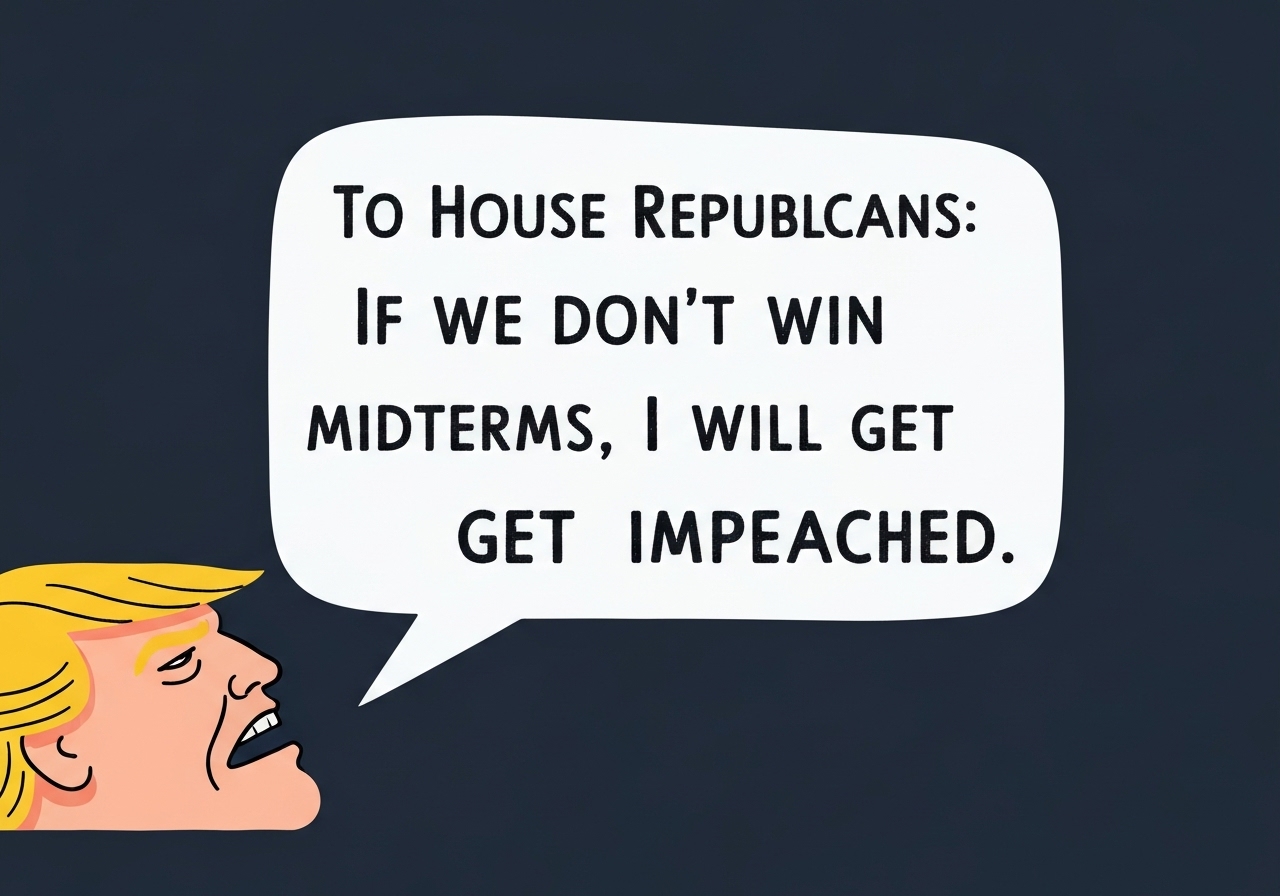
On Tuesday, Jan. 6 in Washington, President Donald Trump told a retreat of House Republican lawmakers that the GOP must prevail in the 2026 midterm elections or Democrats would find grounds to impeach him. Speaking at an event for House Republicans, he framed victory as necessary to protect his agenda and warned of political consequences if the party falters. He urged greater unity on issues including gender politics, healthcare and election reform while pressing colleagues to sell policies to voters worried about the cost of living. The remarks come as all House seats and one-third of Senate seats will be contested in November, making control of Congress central to his argument.
Key Takeaways
- President Donald Trump told House Republicans on Jan. 6 in Washington that losing the 2026 midterms would enable Democrats to pursue impeachment.
- The 2026 elections will contest all 435 House seats and roughly one-third of Senate seats, determining congressional control relevant to any impeachment effort.
- Trump urged a unified GOP message on gender politics, healthcare and election reforms and urged lawmakers to address voters’ cost-of-living concerns.
- He predicted a large Republican victory but also voiced concern about the historical trend that the president’s party often loses ground in midterms.
- House Republicans have largely deferred to the president on spending and policy, though recent maneuvering — including a potential veto override over cancelled water projects — shows some independence.
- Trump was impeached twice during his 2017–2021 term; the Republican-led Senate acquitted him on both occasions.
Background
The speech came amid ongoing tensions over congressional authority and intra-party strategy. Since returning to the White House, Trump has been the dominant figure in the GOP, and many House Republicans have aligned closely with his priorities on spending, nominations and legislative strategy. That alignment has at times included ceding decisions to the administration; nevertheless, some members of Congress have recently signaled a willingness to act independently, including on potential veto overrides. The larger political context is the November 2026 midterms, when control of the House and a portion of the Senate will be decided — outcomes that would directly affect any impeachment logistics and the capacity to pass or block the president’s agenda.
Impeachment is a political as well as a constitutional process, and history shapes how parties approach it. Trump was impeached twice by a Democratic-led House — once over Ukraine-related allegations and once in the aftermath of the Jan. 6, 2021, Capitol attack — and acquitted both times by a Senate controlled by Republicans. The president’s warning to House Republicans invoked that history to underscore the stakes of congressional control. At the same time, routine midterm dynamics often disadvantage the sitting president’s party, complicating any prediction about 2026 outcomes.
Main Event
At a retreat for House Republicans in Washington, Trump urged lawmakers to present a unified front to the electorate and to make his policy agenda central to their campaigns. He explicitly tied electoral performance to his personal political safety, warning that failure in the midterms would allow Democrats to target him with impeachment efforts. He framed his message around both policy issues — mentioning gender politics, healthcare and election reform — and voter grievances, especially concerns about the rising cost of living. The venue and tone were aimed at motivating rank-and-file members ahead of the long campaign season.
During his remarks, Trump predicted an ‘epic’ Republican victory but acknowledged the historical difficulty presidents face in midterms, asking rhetorically what was happening with public sentiment. That ambivalence reflected concern within the party about translating presidential popularity into down-ballot wins. The president also referenced recent congressional friction, as lawmakers consider whether to override his veto on cancelled water projects in Colorado and Utah — a vote that, if it occurs, would test GOP cohesion. The override would require a two-thirds majority in the House, a high threshold that illustrates how divided votes can be even inside the same party.
Lawmakers at the retreat heard a sustained push from the president to sell policy to voters rather than rely solely on partisan messaging. Trump emphasized campaigning on tangible issues affecting households, seeking to counteract the conventional midterm disadvantage for the party in power. He also appealed to lawmakers’ political self-interest, suggesting that a strong GOP performance would protect both legislative priorities and his personal legal and political standing. The speech combined tactical advice with stark warnings about political consequences.
Analysis & Implications
Politically, the president’s explicit linkage of midterm outcomes to the risk of impeachment serves multiple functions. It acts as a rallying cry intended to motivate turnout and discipline within the party, while simultaneously sending a signal to Democrats about the potential costs of pursuing impeachment without the appropriate electoral strength. The statement may sharpen Republican messaging in vulnerable districts where economic concerns are paramount, but it also risks being perceived as transactional or coercive by some voters.
From a constitutional standpoint, impeachment requires House action followed by a Senate trial; practical success therefore depends on which party controls each chamber after November. If Republicans maintain or gain the House, Democrats would face higher political hurdles to secure the majority vote in that chamber needed to impeach. Conversely, a Democratic House majority would increase the probability of formal proceedings. The president’s emphasis on the midterms reflects an understanding of these institutional mechanics.
For governance and legislative prospects, midterm results will determine the president’s ability to advance his priorities and to shield himself from oversight actions. Control of the House affects appropriations and investigations, while the Senate controls confirmations and trial outcomes. A fractured GOP, where some members break with the president on specific issues, could undermine the party’s electoral pitch and legislative cohesion, making both policy wins and legal defenses more difficult. The potential veto-override votes in this period illustrate how intra-party splits can play out in high-profile decisions.
Comparison & Data
| Item | Detail |
|---|---|
| 2026 midterms (November) | All 435 House seats; ~1/3 of Senate seats contested |
| Trump impeachments (2017–2021) | Two impeachments by the House; acquitted twice by the Senate |
| Recent congressional friction | Possible House vote to override a veto canceling water projects in Colorado and Utah (needs two-thirds) |
The table above places the day’s remarks against immediate procedural and historical facts: the scale of the upcoming midterm contests, the president’s past impeachment history, and a near-term vote that could reveal GOP unity. These data points help explain why the president framed the midterms as a direct test of both policy and political survival.
Reactions & Quotes
House members at the retreat heard the president’s comments as both a call to action and a reminder of the stakes. Some Republicans privately express concern about translating presidential-level rhetoric into wins in districts where local issues dominate, while others welcomed a clear, high-stakes message to motivate the base.
You gotta win the midterms ’cause, if we don’t win the midterms, it’s just gonna be – I mean, they’ll find a reason to impeach me.
President Donald Trump
The president’s blunt phrasing underscored his argument that electoral outcomes shape the feasibility of impeachment. Lawmakers must weigh the political utility of that argument against potential backlash among swing voters who dislike perceived threats.
I’ll get impeached.
President Donald Trump
That short, emphatic line was delivered to underscore urgency. For Republican strategists, the message is intended to drive turnout and party discipline ahead of the long campaign calendar leading up to November 2026.
Unconfirmed
- There is no public, detailed Democratic plan tied to a specific post-midterm impeachment timetable; any such strategy would depend on election outcomes and investigations.
- It is not yet confirmed whether the House will achieve the two-thirds majority needed to override the president’s veto on the water-project cancellations; that vote had not concluded at the time of reporting.
Bottom Line
President Trump framed the 2026 midterms as the decisive moment for both policy and personal risk, urging House Republicans to unify around a message aimed at voters’ economic concerns and a slate of policy priorities. His invocation of impeachment as a consequence of losing the midterms is intended to raise the political stakes and to encourage party discipline, but it also exposes the GOP to scrutiny about how that message will play in competitive districts. The interplay between electoral outcomes and congressional procedure means November’s results will materially affect both the administration’s legislative agenda and any future impeachment prospects.
For voters and lawmakers alike, the weeks and months before November will test the effectiveness of Republican messaging, the degree of intra-party cohesion, and the practical limits of congressional action. Control of the House and the Senate will determine not only policy outcomes but also the institutional capacity to pursue or to resist impeachment proceedings.
Sources
- Yahoo News (news aggregator — original Reuters dispatch available)
- Reuters (news agency reporting)