
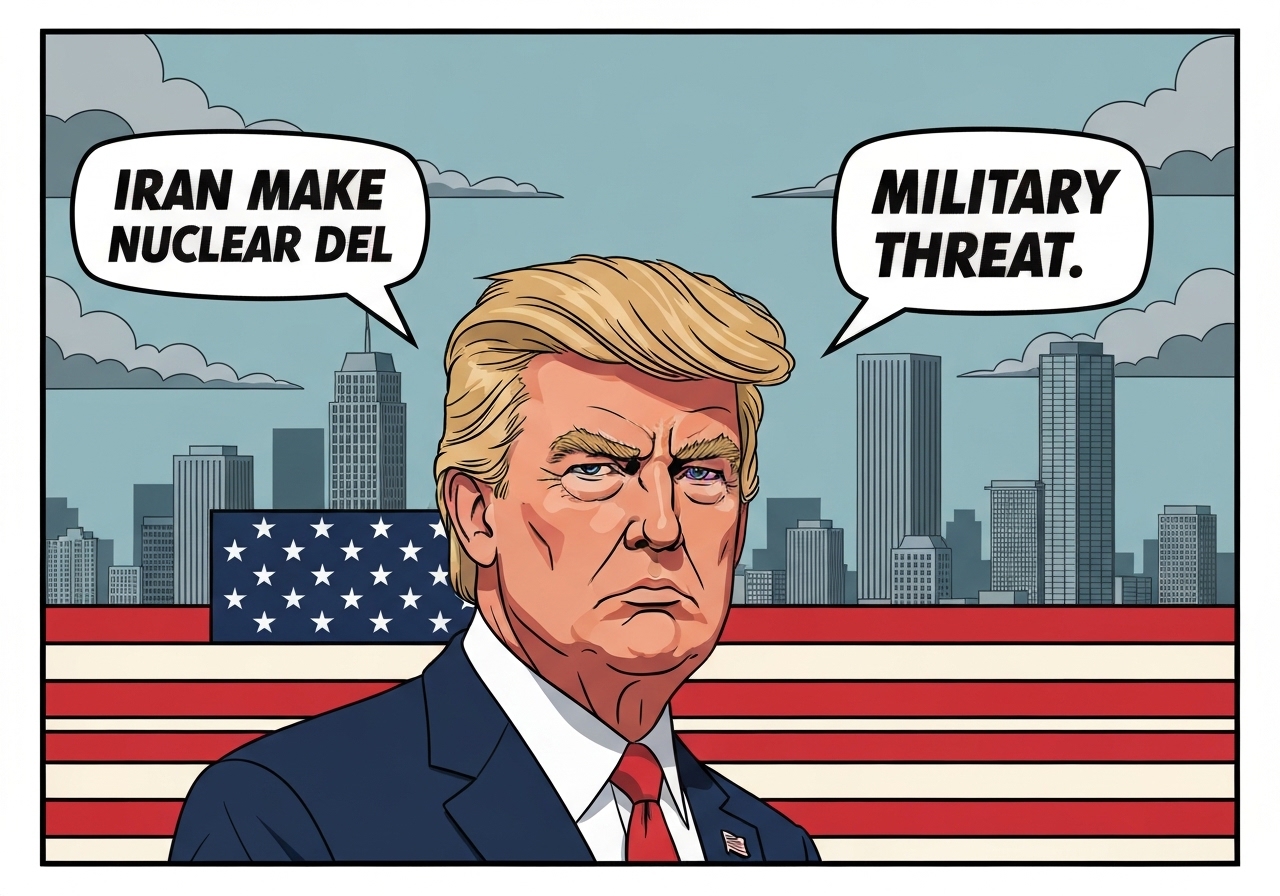
Lead: President Donald Trump renewed a direct threat of US military action against Iran on Wednesday, posting that a large naval force is en route and urging Tehran to accept a nuclear agreement. He framed the message as a last chance for a deal that prohibits nuclear weapons and warned a further attack would be “far worse” if Iran refuses. Tehran’s foreign minister immediately rejected talks while threats persist, and regional governments and rights groups warned the dispute could deepen instability across the Middle East.
Key Takeaways
- Trump posted on Truth Social on Jan 28, 2026 that “a massive armada” is heading to Iran and urged Tehran to “come to the table” for a no-nuclear-weapons deal.
- The president said he previously ordered strikes in June and warned any future attack on Iran would be “far worse” if Tehran declines to negotiate.
- Iranian Foreign Minister Abbas Araghchi told state media that negotiations cannot occur under threats and that Tehran did not request new talks.
- Human Rights Activists News Agency (HRANA) has confirmed at least 6,221 deaths linked to recent unrest, while Iran reports 3,117 and the UN rapporteur says the toll could be far higher.
- Alleged June strikes on three nuclear sites reportedly killed 430 people, and Iranian officials have vowed a comprehensive retaliation to any new strike.
- Regional actors including Turkey and Egypt have mixed signals: Turkey’s foreign minister suggested Iran may be open to talks, while Egypt sought separate discussions with US and Iranian envoys to calm tensions.
Background
The dispute follows months of intense domestic unrest inside Iran, where antigovernment protests prompted a harsh security response and heavy casualties. The US has repeatedly framed certain thresholds—such as mass killings of demonstrators or mass executions of detainees—as potential triggers for military action, and those red lines have been invoked by this administration. In June, US strikes on facilities central to Iran’s nuclear infrastructure were widely reported and are cited by both Washington and Tehran in their competing narratives about the program’s status. The nuclear file has long been an international flashpoint, involving indirect negotiations, regional security concerns, and competing claims about peaceful versus weapon intent.
Tehran insists its enrichment activities serve civilian aims and says it retains the right to enrich uranium. Western governments and international bodies remain worried about weapons-related potential, and the June attacks intensified those fears while damaging diplomatic channels. The protests and the government’s response have become intertwined with nuclear diplomacy: Washington links the human rights crisis to a tougher stance on Iran’s program, while Iran rejects negotiating under coercion. Neighboring states host US forces and face pressure over basing and airspace decisions, complicating any military planning.
Main Event
On Wednesday, Trump posted a long message on Truth Social asserting that a substantial naval force was moving toward Iran with “great power, enthusiasm, and purpose,” and urging Tehran to negotiate a fair deal that rules out nuclear weapons. He reiterated prior demands—”MAKE A DEAL”—and framed the approach as time-sensitive. He also referenced the June strikes, asserting those actions had significantly degraded Iran’s nuclear capabilities and warning that any subsequent attack would be worse if Iran refuses to negotiate.
Iran’s Foreign Minister Abbas Araghchi responded through state outlets that Tehran had not sought new negotiations and that dialogue cannot proceed while threats and excessive demands persist. Araghchi reiterated that talks must be free of coercion, signaling Tehran’s refusal to return to the negotiating table under current pressure. President Masoud Pezeshkian similarly criticized US threats as destabilizing for the region and unlikely to achieve constructive results.
The messaging from other capitals has been mixed. Turkey’s foreign minister Hakan Fidan told Al Jazeera that Iran appears ready to reengage on the nuclear file, a comment that contrasts with Tehran’s publicly stated refusal to negotiate while threats continue. Separately, Egypt’s foreign ministry said its foreign minister spoke with both Araghchi and the US envoy in efforts to defuse tensions and avoid escalation. Tehran has warned that any strike would draw a significant Iranian response against US forces or bases in the region.
Analysis & Implications
A renewed US threat raises immediate escalation risks. A US strike, even limited, would likely trigger military countermeasures from Iran, targeted attacks on regional facilities or bases hosting US forces, and potential disruption to shipping through the Strait of Hormuz. States that host US assets, including Qatar, Saudi Arabia, and the UAE, have already signaled constraints on allowing their territory or airspace to be used, complicating operational planning and increasing political costs for Washington.
Diplomatically, the public ultimatum approach narrows negotiating space. Tehran has repeatedly said it will not negotiate under threat, so an insistence on talks while posturing militarily is likely to produce stalemate rather than agreement. The pattern also strengthens hard-line narratives inside Iran that portray concessions as capitulation, reducing political room for Iranian officials who might consider compromise. Conversely, Western warnings about human rights abuses in Iran add moral and political pressure on US policymakers to act, limiting purely diplomatic options.
Economically, renewed hostilities would raise insurance and shipping costs and unsettle oil markets, with ripple effects for global energy prices. International institutions and allies may face pressure to either distance themselves from unilateral military actions or to support deterrent measures, producing potential strains in alliances. Legally and politically, a US strike absent broad international backing would prompt debates at the UN and among partners about proportionality, evidence, and post-strike responsibilities for civilian protection and reconstruction.
Comparison & Data
| Source | Death toll / figure | Notes |
|---|---|---|
| HRANA (NGO) | 6,221 confirmed | Includes at least 5,858 protesters; ongoing investigations into 12,904 others |
| UN special rapporteur (UN) | Up to 20,000 (possible) | Estimate based on emerging medical reports inside Iran |
| Iranian government (state) | 3,117 total | 2,427 described as civilians and security forces; remainder labelled as “terrorists” |
| June strikes (reported) | 430 killed | Strikes on three nuclear facilities reported in June; attribution and independent verification vary |
The figures above illustrate large discrepancies between independent monitoring groups, UN assessments, and official Iranian tallies. Al Jazeera noted it could not independently verify all claims. Such divergence underscores both the difficulty of on-the-ground verification inside Iran and the political stakes in how different parties present casualty figures to domestic and international audiences.
Reactions & Quotes
US presidential messaging and Tehran’s rebuttals have been strong and immediate, prompting responses from regional governments and rights monitors. Below are representative, brief statements with context.
Context: The US president framed the deployment as a final push for a negotiated settlement and sought to signal resolve to both domestic supporters and regional partners. He positioned the step as a mix of diplomatic pressure and credible military threat.
‘A massive armada is heading to Iran… COME TO THE TABLE’
Donald J. Trump (post on Truth Social)
Context: Iran’s foreign ministry emphasized that threats preclude negotiations and that contacts alleging requests for talks were incorrect. The response aimed to close off diplomatic avenues until hostile rhetoric subsides and to avoid domestic perception of capitulation.
‘Negotiations do not go along with threats; talks need conditions free of menaces’
Abbas Araghchi (Iranian Foreign Ministry, state media)
Context: Iran’s president characterized external threats as destabilizing the region and unlikely to produce constructive outcomes. This statement sought to frame Iran as defending regional stability and to warn of unpredictable consequences of military action.
‘Threats aimed at disrupting regional security will only produce instability’
Masoud Pezeshkian (President of Iran)
Unconfirmed
- Precise current location and composition of the US naval force referred to as an “armada” have not been independently verified.
- Independent confirmation of the reported 430 deaths from the June strikes is limited in open-source reporting.
- The exact whereabouts and status of Iran’s highly enriched uranium stockpiles remain publicly unclear and unverified.
- Whether private contacts occurred between US and Iranian envoys immediately prior to the public posts has not been confirmed outside state statements.
Bottom Line
The public standoff between the US and Iran this week raises the immediate prospect of military escalation, while diplomatic pathways appear narrowed by mutual public posturing. Tehran’s refusal to negotiate under overt threats and Washington’s reliance on a threat of force make an agreed, verifiable nuclear settlement less likely in the near term unless back-channel diplomacy resumes.
Regional actors face difficult choices: permitting use of facilities or airspace would implicate them in direct operations, while refusing complicates US military options and may push Washington toward more politically costly measures. For observers and policymakers, the coming days will be decisive: whether cooler heads can reopen discreet channels for negotiation, or whether a further strike and Iranian retaliation will reshape security dynamics across the Middle East.
Sources
- Al Jazeera (international news report)
- Human Rights Activists News Agency (HRANA) (NGO monitoring casualties)
- Office of the UN High Commissioner for Human Rights (UN special procedures)