
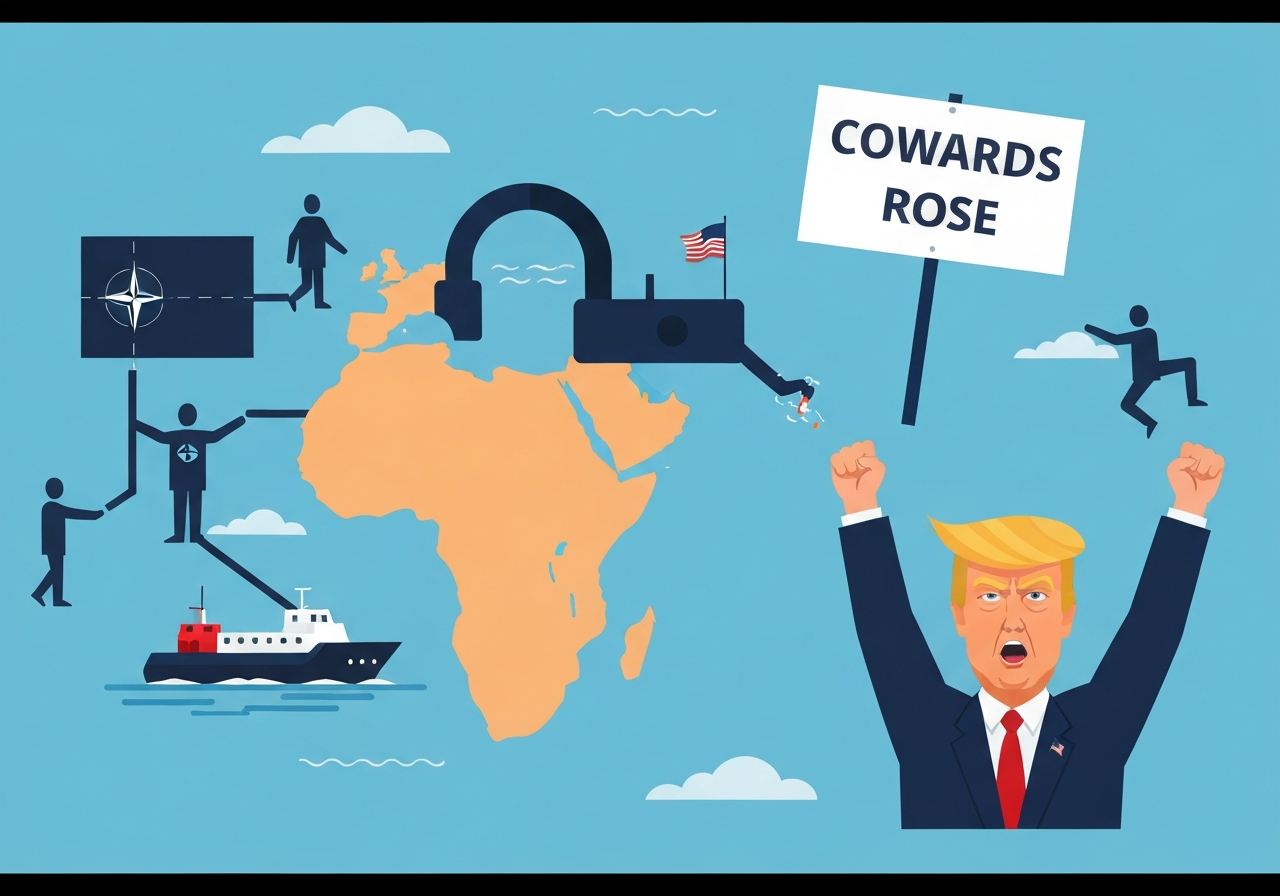
President Donald Trump on Friday publicly rebuked NATO allies for what he described as unwillingness to help secure shipping through the Strait of Hormuz as the US–Israel campaign against Iran continues and the waterway remains effectively closed. Speaking on his Truth Social platform, Trump argued that allied inaction was prolonging high oil prices and that a simple military maneuver could reopen the strait. His comments followed a day of shifting alignments: the United Kingdom said it would permit US use of UK bases for operations described as collective self-defence, while NATO announced an adjustment to its Iraq mission and the temporary relocation of personnel to Europe. The conflict, which began with US–Israeli strikes on February 28, has roiled markets, killed thousands and displaced millions.
- Trump posted on Truth Social calling NATO countries “COWARDS, and we will REMEMBER!”, accusing them of refusing to help reopen the Strait of Hormuz.
- The Strait of Hormuz remains effectively closed to routine shipping, a development that has been cited as a key driver of elevated global oil prices.
- US–Israeli strikes began on February 28, and the conflict has killed thousands and displaced millions, according to multiple reports cited in coverage.
- The United Kingdom announced on Friday it will allow US forces to use UK bases for what it described as operations in the collective self-defence of the region.
- NATO said on March 20 it was “adjusting” its mission in Iraq and relocating non-combat personnel to Europe amid security concerns.
- French President Emmanuel Macron told EU leaders that defending international law and pushing for de-escalation were priorities; no EU leaders volunteered to join direct military action.
Background
The crisis traces to a sharp escalation after US–Israeli strikes that began on February 28, 2026. Iran responded with measures that have sharply limited maritime operations through the Strait of Hormuz, a chokepoint that handles a significant share of seaborne oil shipments. Historically the strait has been a flashpoint for regional confrontation because closure or interference has an outsized effect on global energy markets and on economies heavily reliant on imported oil. NATO was conceived to provide collective defence among transatlantic partners, but its members have divergent threat perceptions and domestic political constraints that shape decisions about direct military involvement outside the Euro-Atlantic area.
Allied capitals are balancing competing priorities: demonstrating solidarity with long-standing US partners while avoiding entanglement in a wider war with Iran. The UK government framed its agreement to let US forces use British bases as a defensive step aimed at protecting international shipping, rather than an endorsement of offensive escalation. Meanwhile, NATO’s adjustment in Iraq has been framed as a precautionary measure to protect non-combat personnel rather than a withdrawal tied to a change in mission objectives. Energy and economic pressures—rising fuel costs, inflationary effects, and downbeat growth forecasts from institutions such as the European Central Bank—have intensified the political stakes for European leaders.
Main Event
On Friday, President Trump’s public rebuke of NATO focused on allied refusal to join efforts he described as necessary to reopen the Strait of Hormuz. He said allies were complaining about high oil prices while not taking the low-risk steps he proposed to secure maritime routes. The UK’s announcement that it would allow US use of its bases for “collective self-defence” marked a notable shift in London’s posture and was presented by Downing Street as aimed at degrading missile sites and other capabilities used to attack commercial shipping.
NATO officials said the alliance was “adjusting” its posture in Iraq and confirmed temporary relocation of mission personnel to Europe amid the fighting. Alliance representatives characterized the move as a safety and operational recalibration rather than an abandonment of commitments to Iraqi partners. NATO’s supreme allied commander for Europe thanked Iraq and participating allies for assisting in the relocation and emphasized that the alliance was monitoring the security environment closely. French President Emmanuel Macron and other EU leaders emphasized de-escalation and adherence to international law during summit discussions in Brussels, signaling reluctance to expand direct military engagement.
Operationally, US requests for allied assistance to protect shipping have run into diplomatic and legal complexities: allies weigh their obligations under collective defence frameworks, domestic parliamentary constraints, and the risks of expanding the war. Military planners on all sides must consider rules of engagement, basing authorizations, and the practicalities of escorting commercial vessels in a high-threat environment. Meanwhile, markets continue to price in the elevated risk to oil supply, complicating policymaking in Europe where inflation and growth forecasts have been revised downward.
Analysis & Implications
The president’s public admonishment of NATO highlights strains within the transatlantic security architecture. If allies resist kinetic measures to secure Hormuz, the US may face pressure to operate with fewer partners or to rely on coalitions of the willing, which can deepen strategic divergence with long-term partners. Politically, Trump’s messaging aims to pressure European capitals by linking allied inaction to direct economic pain—higher fuel costs affecting voters—while framing intervention as a low-risk, high-reward step. That framing may resonate in capitals under domestic pressure, but it underestimates legal constraints and the political appetite for escalation among some allies.
Allowing US forces to use UK bases for so-called collective self-defence raises legal and operational questions about the distinction between defensive and offensive strikes. London’s statement framed operations narrowly to degrade capabilities used against shipping, but translating that wording into practice requires precise targeting decisions and confidence that actions will not trigger broader retaliation. NATO’s posture change in Iraq underscores the alliance’s challenge: preserving support missions while adapting to a fast-changing threat environment. A prolonged campaign that continues to disrupt shipping risks sustained damage to trade flows and could prompt insurance and freight-cost shocks that ripple through the global economy.
For the Middle East, the immediate danger is localized escalation—retaliatory strikes, proxy actions by regional militias, and attacks on commercial routes—that could entangle adjacent states. Over the medium term, prolonged instability may alter energy markets structurally, incentivize accelerated investment in alternative supply routes and fuels, and shift defence procurement priorities among Gulf and European states. Diplomatically, the episode may prompt renewed discussion about burden-sharing within NATO and between Europe and the United States, testing alliance cohesion ahead of other strategic competitions.
| Event | Date | Immediate Effect |
|---|---|---|
| US–Israeli strikes begin | February 28, 2026 | Escalation of hostilities; maritime risk increases |
| Trump’s public rebuke of NATO | March 20, 2026 | Political pressure on allies; media spotlight |
| UK permits US base use | March 20, 2026 | Enables US operations described as collective self-defence |
| NATO adjusts Iraq mission | March 20, 2026 | Non-combat personnel relocated to Europe |
The table above summarizes the recent sequence and immediate operational effects. While the numbers of displaced people and fatalities have been characterized in coverage as “millions” and “thousands” respectively, authoritative, consolidated casualty figures remain challenging to verify in real time. The market reaction has been immediate: energy costs have risen and central banks such as the European Central Bank have adjusted growth and inflation forecasts to account for higher energy-driven inflationary pressure.
Reactions & Quotes
President Trump’s social-media post set the tone for a day of sharp rhetoric directed at allies, aiming to make inaction politically costly.
“COWARDS, and we will REMEMBER!”
Donald J. Trump (Truth Social)
Following Trump’s remarks, NATO spokespeople described the alliance’s steps as cautious adjustments intended to protect personnel and mission integrity rather than a shift toward expanded offensive engagement.
“We are adjusting our posture in the context of NATO Mission Iraq to ensure safety and operational continuity.”
NATO spokesperson Allison Hart (statement to AFP)
The supreme allied commander for Europe acknowledged the logistical relocation and thanked partners for assistance, framing the move as a safety precaution amid heightened risk.
“I would like to thank the Republic of Iraq and all the Allies who assisted in the safe relocation of NATO personnel from Iraq.”
Gen. Alexus Grynkewich (NATO statement)
Unconfirmed
- Which specific NATO members, beyond the UK’s cooperation on basing, might permit direct participation in operations to secure shipping remains unclear.
- Precise casualty figures and the full humanitarian toll from the campaign remain difficult to verify independently in real time.
- Whether operations staged from UK bases will be limited strictly to defensive strikes against missile sites or could expand in scope has not been fully specified.
Bottom Line
The dispute between the US president and NATO allies exposes fractures in allied expectations about burden-sharing during a rapidly unfolding crisis that touches energy markets and regional security. The UK’s decision to permit US use of bases signaled a limited stepping-up of support, but broader allied reluctance to join direct action suggests political and legal constraints will limit a coordinated kinetic response. NATO’s posture change in Iraq reflects precautionary measures to safeguard personnel and preserve core missions while leaders weigh next steps.
For policymakers and markets, the priority is twofold: first, to prevent further escalation that could widen the conflict and inflict deeper humanitarian and economic harm; second, to craft practical, legal arrangements for protecting commercial shipping that reduce immediate market shocks while leaving diplomatic channels open for de-escalation. The coming days will test whether the alliance can convert political goodwill into coordinated, proportionate action without triggering a broader conflagration.
- Al Jazeera — International news outlet
- NATO — Official alliance website (press releases)
- Prime Minister’s Office / UK Government — Official statements and news releases
- Agence France-Presse (AFP) — International news agency