
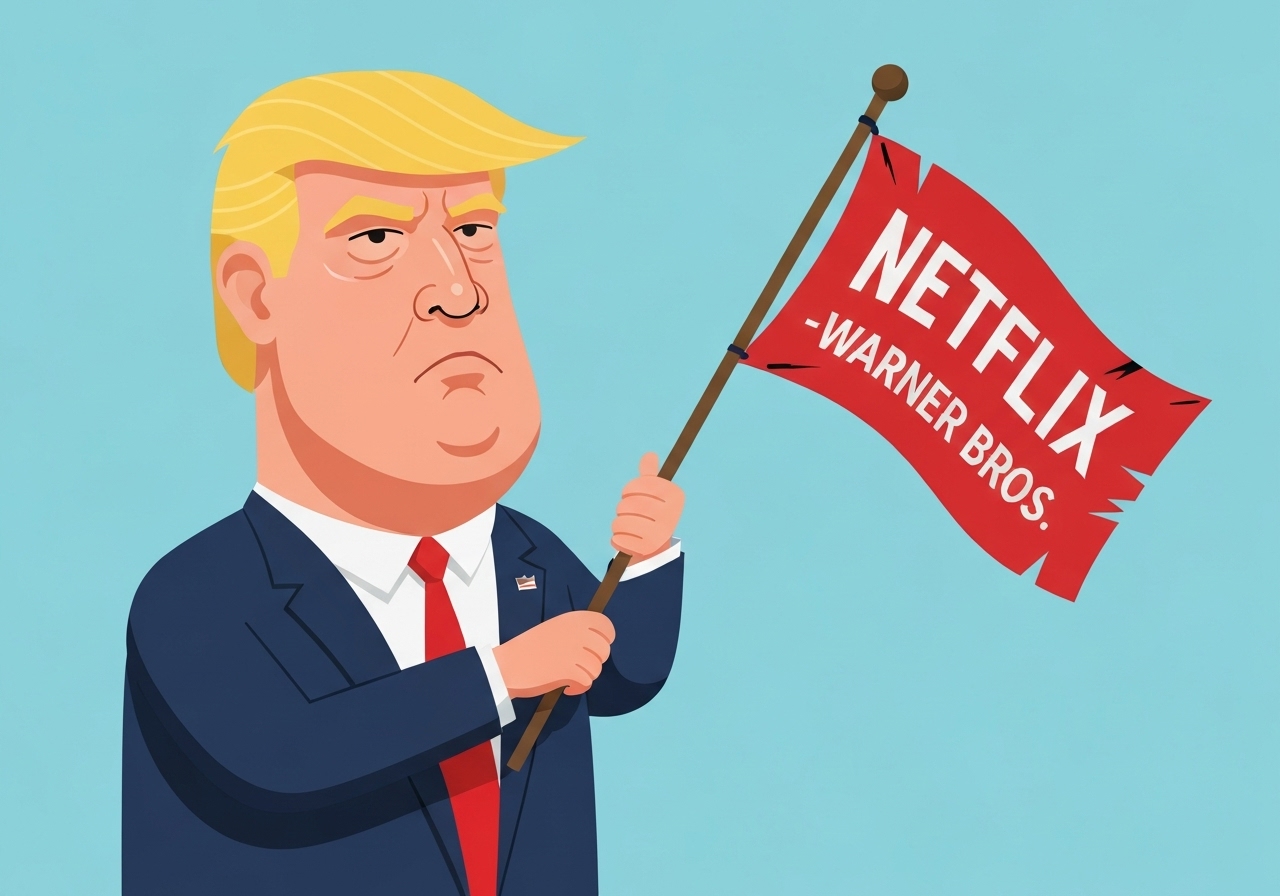
US President Donald Trump said on Sunday in Washington DC that Netflix’s announced $72bn (£54bn) agreement to acquire Warner Bros Discovery’s film studio and HBO streaming assets “could be a problem,” signaling an unusual level of White House attention on the proposed tie-up. The companies disclosed the deal on Friday, saying franchises such as Harry Potter and Game of Thrones would move to Netflix, and that the transaction is expected to close after Warner Bros completes a planned corporate split in the second half of 2026. Regulators in the United States — including the Justice Department’s competition division — have not yet approved the deal, and industry groups and unions have already voiced concerns about its competitive and labour impacts. Trump said he would be personally involved in decisions about the merger while praising Netflix co-CEO Ted Sarandos, who recently visited the Oval Office.
- Deal size: Netflix agreed to buy Warner Bros Discovery’s studio and HBO assets for $72bn (£54bn), announced on a Friday and slated for completion after Warner’s planned split in H2 2026.
- Franchises moving: Major franchises named in the announcement include Harry Potter, Game of Thrones, Looney Tunes, The Matrix and The Lord of the Rings.
- Regulatory scrutiny: The US Justice Department’s competition division oversees major mergers and could challenge the transaction if it finds the combined firm too dominant in relevant markets.
- Political involvement: President Trump said on Sunday he would be personally involved in any final decision and warned the combined market share “could be a problem.”
- Industry reaction: The Writers Guild of America’s East and West branches called for the merger to be blocked, citing threats to jobs, wages and content diversity.
- Competing bidders: Netflix reportedly beat rival bids from Comcast and Paramount Skydance; Paramount Skydance had previously sought all of Warner Bros assets.
- Market definitions matter: Some media executives argue a broader competitive set — including cable, broadcast and large platforms like YouTube — could make the deal less dominant than a narrow streaming-only view suggests.
Background
The transaction follows decades of consolidation and platform shifts across film and television. Netflix, founded in 1997 as a postal DVD rental business, has since grown into the world’s largest subscription streaming service and a major content investor. Warner Bros Discovery owns a long-established studio, cable networks and the HBO streaming brand — assets built over many decades through production, licensing and distribution.
Media industry consolidation has accelerated since the 2010s as streaming economics pushed companies to acquire exclusive libraries and franchise rights. Regulators in the US, EU and elsewhere have been increasingly attentive to deals that reshape who controls content distribution, advertising channels and subscriber relationships. Labor groups and guilds have argued that mergers can concentrate bargaining power and affect employment conditions in entertainment.
Main Event
On Friday, Netflix and Warner Bros Discovery announced an agreement under which Netflix would acquire Warner’s studio and HBO streaming businesses for $72bn. The companies framed the transaction as a way to bring iconic franchises to Netflix and to position the combined business for long-term competition with a wider set of global platforms. The deal is structured to close after Warner Bros completes a planned split of its remaining businesses in the second half of 2026.
At an event held at the John F. Kennedy Center in Washington DC on Sunday, President Trump said Netflix already has a “very big market share” and that the merger would increase that share substantially. He also told the audience that Ted Sarandos, Netflix’s co-CEO, recently visited the Oval Office and that he respects Sarandos’ work in film and television.
Industry figures have taken mixed positions. Some executives and former regulators told the BBC and other outlets that the core competitive issue is the combination of Netflix’s distribution scale with Warner’s studio and HBO library, while others argued that a properly broad market definition — including YouTube, broadcast and cable—would reduce the perceived dominance of the merged firm. The Writers Guild chapters called for blocking the deal, warning of job losses and reduced content diversity.
Analysis & Implications
Legal path: In the US the Justice Department’s competition division will assess whether the merger violates antitrust law by lessening competition or tending to create a monopoly in defined markets. That technical assessment typically examines market shares, barriers to entry, and likely effects on prices, output and innovation. Trump’s public comments, and his statement that he would be personally involved, raise the prospect that political considerations could affect the timetable and intensity of review.
Market dynamics: The merger would combine Netflix’s global subscriber base and distribution algorithms with Warner’s studio production capacity and premium franchises. That could strengthen Netflix’s negotiating leverage with advertisers, talent and distribution partners. However, some analysts note that video consumption is fragmented across many platforms — including ad-supported services, cable bundles and free platforms like YouTube — which weakens the notion of a single dominant video provider.
Labour and content concerns: Unions such as the Writers Guild argue consolidation reduces competition for creative labour, potentially depressing wages and limiting bargaining leverage for writers and other crew. Regulators may weigh these labour-market implications alongside consumer price and content diversity effects when considering remedies or conditions for approval.
Comparison & Data
| Franchise / Asset | Planned Destination |
|---|---|
| Harry Potter | Netflix |
| Game of Thrones | Netflix |
| Looney Tunes | Netflix |
| The Matrix | Netflix |
| The Lord of the Rings | Netflix |
The table above lists marquee franchises highlighted in the companies’ announcement. While franchise ownership boosts a streamer’s catalog value, regulators typically evaluate overall market concentration using subscriber figures, viewership shares and revenues across competitive platforms. A broader competitive set that includes linear TV and major ad-supported platforms would likely lower the merged company’s share of total video consumption.
Reactions & Quotes
“Netflix has a very big market share… it would go up by a lot — this could be a problem.”
President Donald Trump (speech at the John F. Kennedy Center)
Trump’s comment underlines an atypical direct presidential engagement in merger review, and he framed his remarks around market share rather than technical antitrust criteria.
“The only two pieces that matter are the combination of Netflix and Warner Brothers’ HBO streaming business.”
Blair Westlake (media executive, former Universal Studios TV chair)
Westlake argued on the BBC’s Today programme that Netflix’s owned library is smaller than Warner’s and that regulators should focus on streaming-to-streaming consolidation, though he also noted broader competition from platforms like YouTube.
“We are likely to see an unprecedented level of presidential control in the resolution of what used to be a technical analysis of a merger.”
Bill Kovacic (former FTC chair)
Kovacic warned that presidential involvement could shift merger review dynamics away from standard antitrust practice toward a more political process.
Unconfirmed
- The precise scale of any market-share increase for Netflix if the deal is approved is not yet public and will depend on regulators’ market definitions.
- Specific concessions that regulators might demand, and whether those would satisfy the Justice Department or other scrutiny, have not been disclosed.
- Reports of behind-the-scenes negotiations between the White House and competition authorities over this merger have not been publicly confirmed beyond commentators’ statements.
Bottom Line
The proposed $72bn deal would materially reshape the content landscape by pairing Netflix’s distribution reach with Warner’s deep studio and franchise library. That combination has prompted immediate political and industry pushback, focused on market share, labour impacts and content diversity.
Regulators will have to weigh narrow streaming-market concerns against a broader view that includes broadcast, cable and major online platforms. The unusual public involvement by President Trump suggests the review process could be more politicised than typical merger assessments, potentially lengthening the timeline and increasing the likelihood of remedies or litigation.