
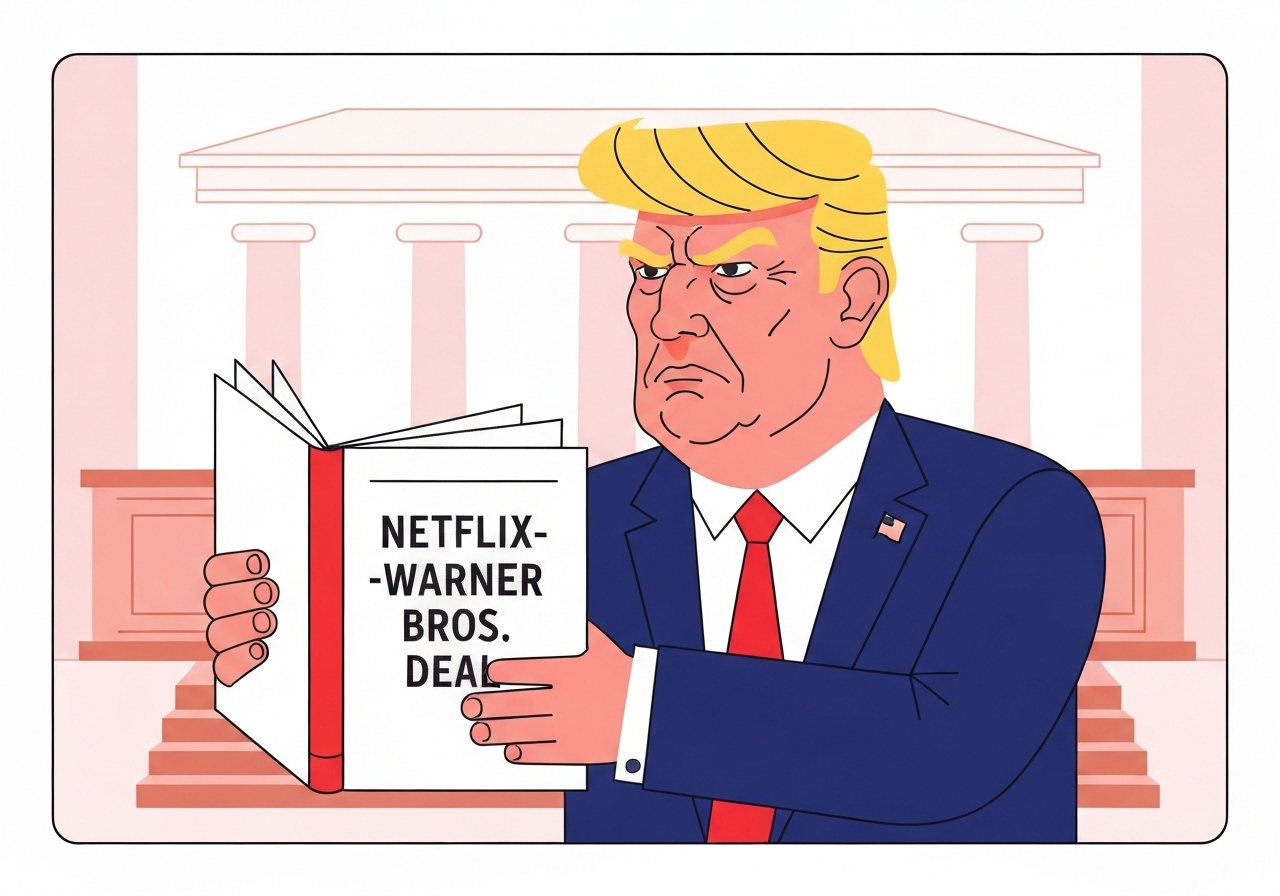
Lead: On December 7, 2025, President Donald Trump signaled potential antitrust scrutiny of Netflix Inc.’s proposed $72 billion acquisition of Warner Bros. Discovery Inc. The comments, made as he arrived at the Kennedy Center, emphasized that the combination of a dominant streaming platform and a major studio “will need review.” The remark immediately renewed attention on the likely, lengthy Justice Department review that could determine whether the deal proceeds as proposed. Market observers say regulatory scrutiny could reshape the timeline and terms for what would be one of the largest media mergers in recent years.
Key Takeaways
- President Trump publicly stated on Dec. 7, 2025, at the Kennedy Center that the Netflix–Warner Bros. Discovery transaction “will need review,” flagging antitrust concerns.
- The proposed transaction is valued at approximately $72 billion and would combine the world’s largest streaming service with a major Hollywood studio.
- The deal will be subject to a review by the U.S. Department of Justice, a process that can extend months and include in-depth market-share analysis.
- Industry analysts warn that regulators will focus on subscription market share, content control, and distribution bottlenecks rather than just headline dollar value.
- Similar past media mergers—Disney’s acquisition of 21st Century Fox ($71.3 billion, 2019) and AT&T’s purchase of Time Warner ($85.4 billion, 2018)—faced intensive regulatory and litigation scrutiny, setting relevant precedents.
- Political remarks from a sitting president can increase public and congressional attention, potentially accelerating agency resources devoted to the review.
Background
The streaming market has consolidated rapidly over the past decade as companies have pursued scale to finance original content and global distribution. Netflix, which transformed the market as a direct-to-consumer streamer, has pursued growth through subscriber expansion and content investments rather than large-scale studio acquisitions until this proposal. Warner Bros. Discovery, formed through prior industry consolidation, owns a deep library of film and television IP, linear networks and distribution channels that remain valuable in licensing and advertising markets. Regulators in the U.S. and abroad have increased scrutiny of transactions that join platform power with content ownership because they can alter bargaining dynamics with rivals, advertisers and independent creators.
Antitrust enforcers typically examine whether a merger would substantially lessen competition or create a dominant player able to harm consumers through higher prices, reduced choice, or exclusionary conduct. The federal Hart-Scott-Rodino (HSR) process and subsequent Department of Justice (DOJ) investigations allow for document requests, interviews, and potential litigation. Past large media deals involved lengthy premerger reviews and, at times, court cases or divestiture requirements. Stakeholders—including competitors, consumer groups and state attorneys general—often weigh in during high-profile transactions, shaping the scope of a formal review.
Main Event
As President Trump arrived at the Kennedy Center on Dec. 7, 2025, reporters asked about the Netflix–Warner Bros. Discovery proposal and he responded that the transaction “will need review,” calling attention to possible market-share issues. The brief exchange was picked up widely in U.S. and international press and prompted immediate commentary from industry watchers concerned about political signaling ahead of formal regulatory filings. The merger’s announced $72 billion price tag has placed it among the largest entertainment transactions in the last decade and ensures both public and agency focus.
Company executives have not publicly released a comprehensive regulatory timetable tied to the announcement; traditionally, such a deal would trigger an HSR filing and a period of agency review that can be extended. Legal teams for both parties typically prepare data rooms in anticipation of document requests and economic analysis from the DOJ’s Antitrust Division and from state regulators. If the DOJ identifies competitive concerns, it can negotiate remedies, request divestitures, or pursue litigation to block the deal entirely.
Market actors are watching specific competitive metrics: subscriber overlap in core markets, control of marquee titles, and the combined firm’s role in advertising and content licensing. Competitors and partners—ranging from rival streamers to cable distributors—could submit evidence or concerns that shape the scope of the review. The public nature of the president’s comment raises the prospect of heightened scrutiny from Congress and additional statements from other political actors, though the legal process remains with the agencies.
The timing of the remark—shortly after the proposal became public—may influence short-term market reactions, but legal outcomes will rest on documented market effects, not political statements. Still, presidential attention can prompt faster responses from enforcement agencies that seek to show thoroughness on matters of public concern. As the DOJ assembles its review, it will draw on internal economists, external experts and precedent from prior media transactions to evaluate potential competitive harms.
Analysis & Implications
The administration’s public comment elevates the political profile of a corporate merger that already has major industry consequences. A combined Netflix and Warner Bros. Discovery would integrate a top global subscription service with an extensive content library, potentially changing bargaining dynamics with licensors and aggregators. From an economic perspective, regulators will analyze whether the merged firm could foreclose competitors from access to key titles or raise prices for consumers by reducing independent content supply.
Regulatory focus will likely center on both vertical and horizontal concerns. Horizontal issues relate to direct overlap in streaming subscribers and market concentration; vertical concerns focus on control of content that competitors license or pay to access. Remedies short of blocking—such as firewalls around licensing, divestitures of specific assets or behavioral conditions—may be feasible but are often complex to design and enforce in digital markets. The DOJ’s willingness to accept such remedies will depend on the strength of evidence about likely competitive harms.
International regulators will also have a voice: the European Union, United Kingdom, and other jurisdictions have growing capabilities to scrutinize large media mergers and could impose their own conditions or timelines. A multijurisdictional review can extend the closing timeline and increase the chance that regulators extract concessions. For shareholders and management, prolonged regulatory uncertainty could affect valuation, strategy and integration planning, making contingency planning essential for both firms.
Comparison & Data
| Deal | Value (approx.) | Year |
|---|---|---|
| Netflix — Warner Bros. Discovery | $72 billion | 2025 |
| The Walt Disney Company — 21st Century Fox | $71.3 billion | 2019 |
| AT&T — Time Warner | $85.4 billion | 2018 |
The Netflix–Warner proposal’s headline value is comparable to other landmark media deals of the last decade, but regulatory outcomes have varied. The Disney–Fox transaction closed after divestitures and long review; AT&T’s deal faced litigation and behavioral scrutiny. These precedents illustrate that even financially similar transactions can encounter very different legal paths depending on market structure and political context. For regulators, size matters less than the transaction’s effect on competition in specific markets—streaming subscriptions, advertising, and content licensing are likely focal points here.
Reactions & Quotes
Immediately after the president’s comment, market participants and legal observers emphasized that formal agency processes will determine the outcome. Below are two concise, context-framed quotations that have shaped early coverage and understanding.
“That will need review.”
President Donald J. Trump
The president’s succinct statement, made at the Kennedy Center, served to publicize potential antitrust concerns early in the deal cycle. While presidential remarks are not determinative of legal outcomes, they can increase public attention and, in some cases, lead to expedited responses from oversight bodies.
“The Department of Justice reviews mergers that could substantially lessen competition and may seek remedies or litigation where warranted.”
U.S. Department of Justice (merger review guidance)
This paraphrased summary reflects the DOJ’s established merger-review mandate and explains the authority that the Antitrust Division exercises in large transactions. It underscores that the agency evaluates competitive impact using economic analysis and, where necessary, legal action.
Unconfirmed
- Whether the DOJ will ultimately seek to block the deal is unknown; no formal enforcement decision has been announced by the agency.
- Specific market-share calculations for the combined Netflix–Warner entity across global markets have not been publicly released and will be a focus of the agency’s analysis.
- Any negotiated remedies or divestitures between the companies and regulators remain hypothetical until formal filings and agency positions are disclosed.
Bottom Line
The president’s on-the-record comment has put political and public attention squarely on the Netflix–Warner Bros. Discovery proposal, but the legal trajectory will be shaped by the DOJ’s substantive review. The core questions for regulators will be whether the combination materially lessens competition in subscription streaming, content licensing or advertising markets, and whether feasible remedies can address any harms. Stakeholders should expect a protracted review process, potential input from multiple jurisdictions, and active engagement from competitors and consumer groups.
For subscribers, advertisers and investors, the outcome will influence content availability, pricing power and competitive dynamics across the media industry. Companies involved should prepare for document-intensive scrutiny and possible operational contingencies, while observers should await formal filings and agency statements to move from speculation to documented assessment.
Sources
- Bloomberg — Reporting on president’s comments and initial market reaction (media)
- U.S. Department of Justice, Antitrust Division — Official guidance on merger review process (official)