
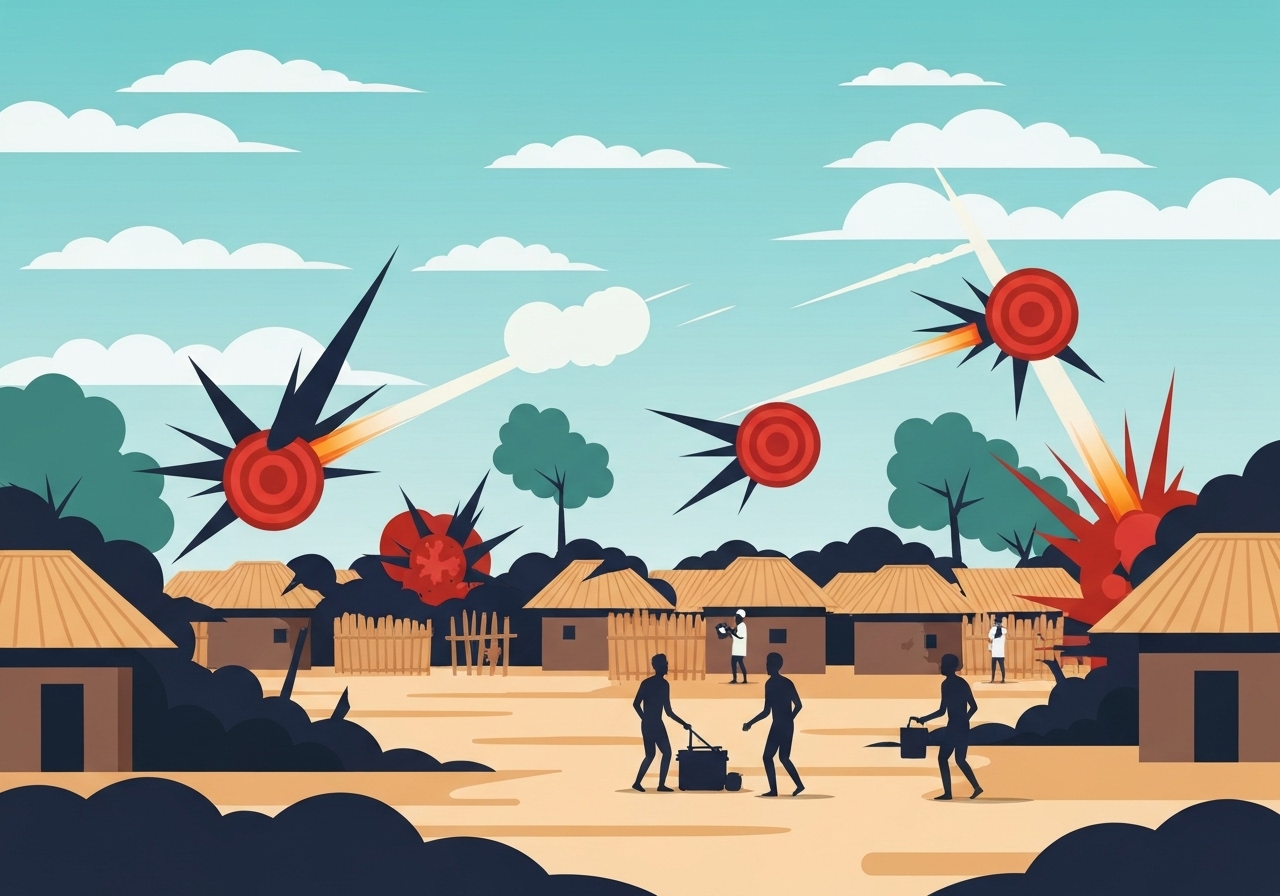
Lead: On the night of December 25, 2025, President Donald Trump announced that U.S. forces had carried out a “deadly strike” against Islamic State fighters in northwest Nigeria’s Sokoto State. The president posted the claim on Truth Social, saying the operation targeted militants he accused of killing Christians in the region. U.S. Africa Command (AFRICOM) confirmed it “conducted a strike at the request of Nigerian authorities,” saying multiple ISIS fighters were killed. The action follows U.S. strikes in Syria last week after the killing of two U.S. soldiers and an interpreter.
Key Takeaways
- The strike was announced by President Trump on December 25, 2025, and described as targeting ISIS fighters in Sokoto State, northwest Nigeria.
- AFRICOM said it acted “at the request of Nigerian authorities” and reported multiple ISIS casualties; no precise casualty count has been released.
- The announcement came days after U.S. strikes in Syria, which followed an attack that killed two U.S. soldiers and an interpreter.
- Trump has publicly pressured Nigeria in recent weeks, ordering Pentagon planning and threatening suspension of aid over attacks on Christians.
- Nigeria says militant violence is driven more by geography and local disputes than by religion; Abuja has welcomed assistance but insists on respected territorial integrity.
- Defense Secretary Pete Hegseth posted on X expressing gratitude to Nigerian authorities and signalling more operations could follow.
Background
Nigeria is roughly divided between Christian and Muslim populations, and violent extremist groups have been active in several regions for years. Militant actors, including affiliates of the Islamic State and local militias, have carried out attacks that Nigerian officials say often reflect local competition over land and resources rather than purely sectarian motives. In recent months the U.S. administration publicly criticised Nigeria for failing to protect Christian communities and ordered Pentagon contingency planning, including possible military options and consideration of aid restrictions.
Washington has maintained a military presence and intelligence relationship with Nigeria and broader West Africa through AFRICOM and other partnerships. U.S. policy in the region balances counterterrorism support, diplomatic relations, and concerns about sovereignty. The December strike arrives against that complex backdrop, and comes shortly after a separate series of U.S. strikes in Syria triggered by the targeted killing of American service members.
Main Event
According to the White House announcement on December 25, President Trump said the strikes were aimed at “ISIS Terrorist Scum in Northwest Nigeria” and framed the operation as retaliation for a wave of killings he said primarily affected Christians in the area. The president wrote on Truth Social that he had warned militants they would face consequences and that U.S. forces had executed “numerous perfect strikes.”
AFRICOM released a statement saying it had “conducted a strike at the request of Nigerian authorities in Sokoto State killing multiple ISIS terrorists.” The command described the action as coordinated with Nigerian partners; however, Nigerian federal officials had not issued an immediate, formal public comment at the time of the announcements. Local and national Nigerian sources previously emphasised that any foreign assistance must respect the country’s territorial integrity.
Defense Secretary Pete Hegseth amplified the message on X, thanking Nigerian authorities for cooperation and suggesting additional operations could follow if threats persist. U.S. military spokespeople framed the strike as a targeted counterterrorism action rather than a unilateral occupation, while the White House presentation used forceful, politically charged language invoking protection of religious communities.
Analysis & Implications
The strike raises immediate legal and diplomatic questions. AFRICOM’s statement that it acted “at the request of Nigerian authorities” is a standard formulation for partnered counterterrorism actions, but independent confirmation from Nigerian federal sources is crucial to clarify consent and command relationships. If Nigeria formally requested assistance, the operation fits within existing bilateral security cooperation; if not, the strike could strain relations and raise concerns about sovereignty.
Politically, the president’s framing—emphasising protection of Christians and promising harsher consequences—aligns with recent rhetoric that linked U.S. action to religious persecution claims. That calculus may play domestically for the administration, but it risks polarising local narratives in Nigeria and may complicate counterinsurgency efforts that depend on local intelligence and broad political support.
Operationally, a single strike can degrade militant capabilities temporarily, but past experience in West Africa shows that removing fighters rarely eliminates the underlying drivers of violence. Displacement, reprisals, or collateral damage could produce new grievances. Long-term stability will depend on coordinated Nigerian security operations, community protection measures, and humanitarian responses in affected areas.
Comparison & Data
| Date | Location | Action | Reported U.S. Casualties |
|---|---|---|---|
| Dec 25, 2025 | Sokoto State, Nigeria | U.S. strike on ISIS targets (AFRICOM) | None reported |
| Mid-December 2025 | Eastern Syria | U.S. strikes in response to an attack | 2 U.S. soldiers and 1 interpreter killed (killing prompted strikes) |
The table compares the December 25 Nigeria strike—reported as killing multiple ISIS fighters without a precise count—with the earlier Syria incidents that involved the deaths of two U.S. soldiers and an interpreter. While the Syria events prompted a rapid U.S. kinetic response in that theater, the Nigeria action appears framed as both a direct counterterrorism move and a response to broader political pressures.
Reactions & Quotes
U.S. military and administration officials offered succinct public statements tying the operation to partner cooperation and counterterrorism objectives.
“We conducted a strike at the request of Nigerian authorities in Sokoto State killing multiple ISIS terrorists.”
U.S. Africa Command (AFRICOM) — official statement
AFRICOM characterised the strike as executed with Nigerian cooperation; that formulation is typically used when operations are conducted with host-nation approval. The command did not publish an exact casualty tally or granular details about the targets in its initial public release.
Senior civilian leadership also framed the action as part of ongoing preparedness and partnership.
“ISIS found out tonight — on Christmas. More to come… Grateful for Nigerian government support & cooperation.”
Pete Hegseth, U.S. Secretary of Defense (post on X)
Defense Secretary Hegseth’s post underscored readiness language and thanked Nigerian cooperation, signalling the department views the strike as part of coordinated efforts rather than an isolated U.S. intervention.
The president used forceful language to describe the rationale and results.
“There would be hell to pay, and tonight, there was.”
President Donald J. Trump (post on Truth Social)
Trump’s public remarks mix operational claims with political framing focused on religious victimhood; that rhetorical approach may affect how communities and foreign partners interpret U.S. motives.
Unconfirmed
- The exact number of ISIS fighters killed in the Sokoto State strike has not been publicly disclosed by AFRICOM or Nigerian authorities.
- While AFRICOM said it acted at Nigeria’s request, the timing and formal nature of any written consent from Abuja remain unconfirmed in public sources.
- The attribution that militants were “primarily” killing Christians at “levels not seen for many years” is asserted by the president but lacks independent, detailed casualty breakdowns in the public record.
Bottom Line
The December 25 strike marks a notable escalation of U.S. kinetic activity tied to messages about protecting religious communities and responding to militant attacks. AFRICOM’s statement that the operation was carried out at Nigeria’s request frames the action as partnered counterterrorism, but public confirmation from Nigerian federal authorities is necessary to clarify legal and diplomatic standing.
Looking ahead, immediate consequences will hinge on Nigeria’s formal response, on-the-ground reporting from Sokoto State about civilian impact, and whether the U.S. follows with additional operations. Longer-term stability will depend less on single strikes and more on coordinated security, governance, and community-level measures that address the root causes of militancy.
Sources
- NPR (news report summarising the announcement and available statements)
- U.S. Africa Command (AFRICOM) (official military command statements/press releases)
- Reuters (international news reporting on Nigeria-U.S. cooperation and prior coverage)