
Lead
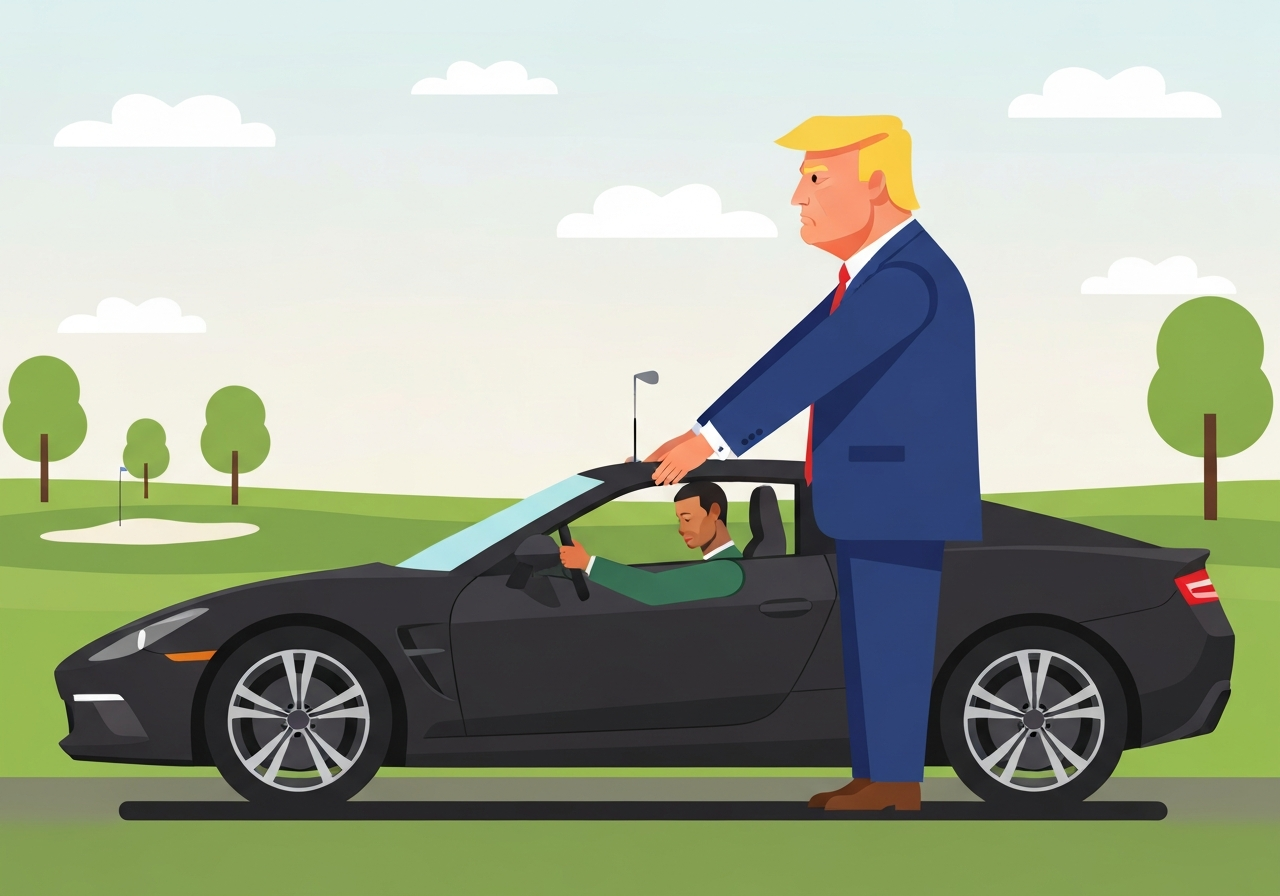
President Donald Trump has set a firm rule that Tiger Woods may not drive his grandchildren following Woods’s March 27 Land Rover crash and subsequent DUI charge. The restriction applies to the five children of Vanessa Trump and Donald Trump Jr., whom Woods has regularly spent time with during a relationship with Vanessa that sources say began about a year ago. Insiders told Rob Shuter’s Naughty But Nice Substack that Trump permits Woods’s presence around the children but draws a strict line at allowing him behind the wheel. The decision reflects the president’s strong stance on substance use and risk when family safety is involved.
Key Takeaways
- Tiger Woods, 50, was reported to have rolled his Land Rover and been charged with DUI on March 27; the incident prompted renewed family concern about driving safety.
- Woods has been dating Vanessa Trump, 48, for about a year and regularly spends time with her five children from her marriage to Donald Trump Jr.
- Vanessa and Donald Jr., both 48, share five children: Kai (18), Donald III (17), Tristan (14), Spencer (13) and Chloe (11).
- A source quoted by Naughty But Nice Substack says President Trump treats driving privileges as a strict boundary: “It’s a hard no” for Woods behind the wheel with the grandchildren.
- Trump publicly expressed sympathy for Woods while calling him “an amazing person,” but privately maintains the driving prohibition for family safety concerns.
- Insiders describe the rule as creating awkwardness for the couple, while still allowing Woods to be part of the children’s lives in other ways.
Background
Tiger Woods, a five-time Masters champion and one of golf’s most prominent figures, was involved in a single-vehicle rollover on March 27 that media reports say resulted in DUI charges. Woods has since been a frequent presence around Vanessa Trump and her children; the relationship between Woods and Vanessa has been characterized in reports as lasting roughly a year. Vanessa is the former spouse of Donald Trump Jr.; their marriage lasted from 2005 to 2018.
President Donald Trump, now 79, has had a public and private role in family affairs since leaving the White House. Reports of his objections to certain behaviors—especially involving substance use—have been a consistent element of reporting about family dynamics. In this instance, sources tell a newsletter that Trump drew a specific boundary: while Woods may interact with the grandchildren, he should not drive them following the March 27 incident.
Main Event
According to reporting in Naughty But Nice Substack, insiders described the president’s stance as categorical: no rides with Woods at the wheel for any of the five Trump grandchildren. Those sources emphasized that the prohibition is narrowly focused on driving, not on Woods’s broader presence in the children’s lives. The children—Kai (18), Donald III (17), Tristan (14), Spencer (13) and Chloe (11)—were noted to have attended a recent TGL Finals event in Palm Beach days before the crash, where Vanessa and some of the children cheered for Woods.
Friends and family reportedly find the rule awkward for Vanessa and Woods but understandable given the circumstances. One insider framed the president’s view as rooted in risk aversion: Trump reportedly prefers strict boundaries around alcohol and drugs when family members are involved. The source told the newsletter that the president would “feel safer with Britney Spears driving them than Tiger Woods,” a hyperbolic remark cited to convey the firmness of the restriction.
When asked directly by reporters about Woods’s crash, President Trump offered a brief public comment expressing sympathy and characterizing Woods as an “amazing person,” while acknowledging Woods was experiencing “some difficulty.” That public remark contrasts with the private boundary reported by insiders and highlights a common pattern where public statements are more conciliatory than private family rules.
Analysis & Implications
Family risk management is the clearest lens for this decision. A high-profile driving incident followed by a DUI charge raises liability and safety questions for any public figure who spends time with minor relatives. For President Trump, a family-first posture combined with sensitivity to substance-related risk appears to have produced a discrete, enforceable rule: no driving by the individual associated with a recent alcohol- or drug-related charge.
Politically and socially, the episode illustrates how private family safety judgments quickly become public narratives when they involve well-known figures. Woods’s status as a celebrity athlete and Trump’s status as a former president mean that a private boundary—about who may drive—can be reported as a statement about values, risk tolerance and public image management. That dynamic complicates the couple’s navigation of normal family activities.
For Woods, the immediate reputational impact depends on legal outcomes and public perception of responsibility after the March 27 incident. If the DUI charge is resolved in a way that clarifies responsibility and remediation, restrictions may be relaxed. Until then, family-imposed limits like the one described are a foreseeable consequence. For the Trump family, the situation underscores an intention to prioritize perceived safety over the optics of excluding a public figure from certain family roles.
Comparison & Data
| Child | Age |
|---|---|
| Kai | 18 |
| Donald III | 17 |
| Tristan | 14 |
| Spencer | 13 |
| Chloe | 11 |
The table above lists the children and ages reported in coverage. Preserving these specifics helps readers understand the family context: most are minors, and one (Kai, 18) is a near-adult with collegiate golf plans. Those ages increase the sensitivity of decisions about who may transport or supervise them. Age distribution also affects legal and parental consent issues when an adult outside the immediate parental unit is involved in caregiving or transport.
Reactions & Quotes
I feel so badly. He’s got some difficulty. There was an accident and that’s all I know. Very close friend of mine. He’s an amazing person, amazing man. But some difficulty.
President Donald Trump (reported to reporters)
Trump’s public remark combines sympathy with acknowledgment of trouble; sources say his private family rule on driving is much firmer.
It’s a hard no. He doesn’t want Tiger behind the wheel with his grandkids. Not happening.
Insider to Naughty But Nice Substack (reported)
The newsletter-sourced insider framed the boundary as specific and non-negotiable, emphasizing it applies only to driving and not to general contact.
Trump hates anything to do with drugs or alcohol. That’s a line for him, especially when it comes to his family.
Another insider (reported)
This comment was offered to explain the president’s rationale, tying the driving prohibition to broader attitudes about substance use and family protection.
Unconfirmed
- The exact legal details and ultimate disposition of the DUI charge against Tiger Woods after the March 27 incident remain publicly reported but may be subject to pending court actions or updates.
- It is not independently confirmed whether President Trump communicated the driving prohibition directly to Vanessa Trump, Donald Trump Jr., or other family members, or whether it was described informally to close advisors.
- The reported timeline of Woods and Vanessa Trump’s relationship as “about a year” comes from media sources and has not been confirmed by direct statements from the couple.
Bottom Line
This reported rule—allowing Tiger Woods to be part of the grandchildren’s lives but forbidding him to drive them—reflects a risk-averse family decision following a high-profile March 27 crash and DUI charge. The boundary is narrow and focused on driving, signaling that the family aims to balance continued personal contact with protective limits where perceived safety is affected.
How this develops will depend on legal outcomes for Woods and on whether the family relaxes the restriction after remediation or legal closure. In the near term, expect continued media attention because the situation involves prominent public figures, clear safety concerns, and a private decision that quickly became a matter of public reporting.
Sources
- Yahoo Entertainment — news/entertainment report summarizing the story.
- Naughty But Nice with Rob Shuter (Substack) — newsletter report cited by sources in this article (reported).
- ZUMAPRESS — photo agency/press attributed for event images referenced in coverage.