
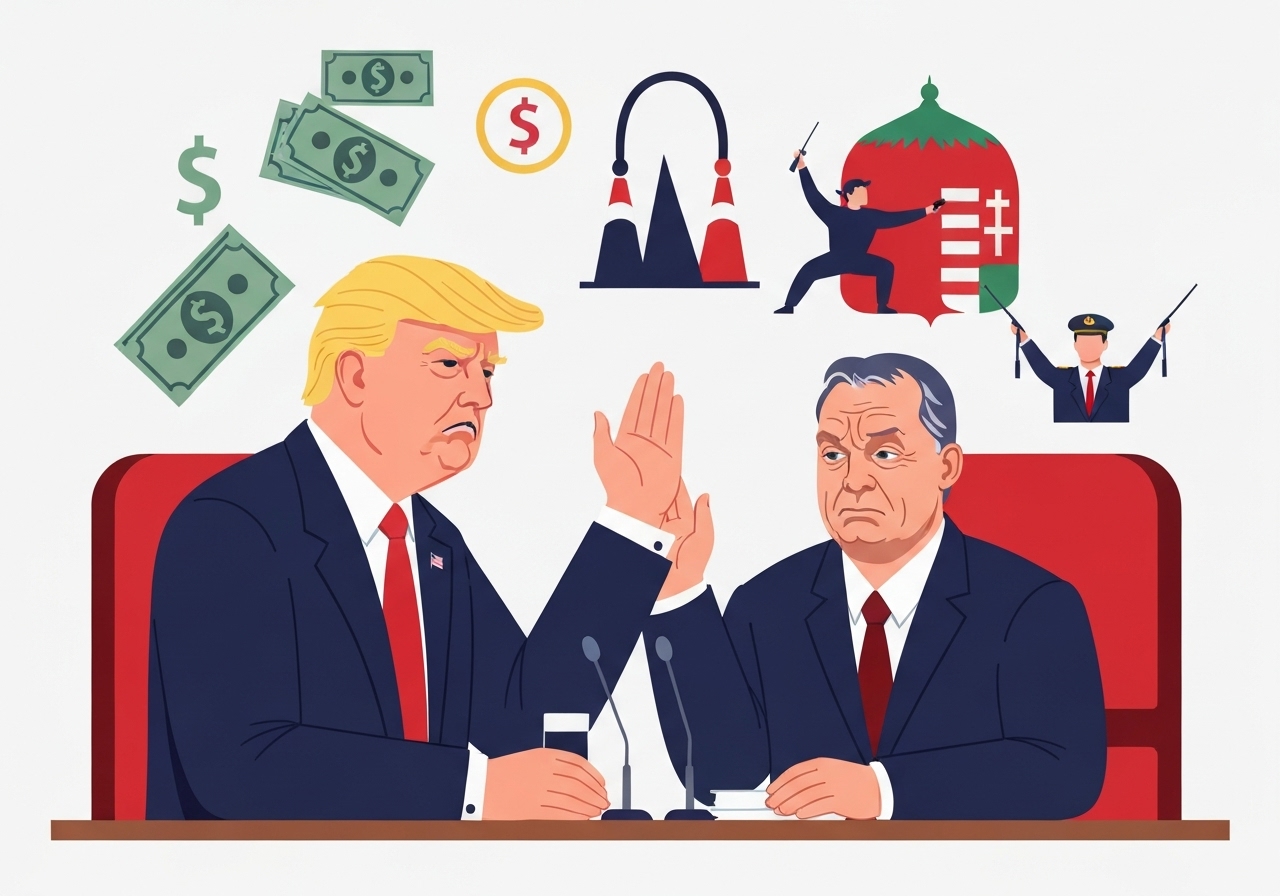
President Donald Trump and Hungary’s Prime Minister Viktor Orbán meet in Washington on Friday, Nov. 7, 2025, against a backdrop of fresh U.S. penalties on Russia’s two largest energy companies. Those sanctions, announced last month to pressure Moscow over the war in Ukraine, threaten Hungary’s energy supply — it imports about 86 percent of its oil from Russia — and have become a central point of contention. Orbán has publicly sought an exemption, arguing the measures imperil Hungary’s fragile economy and his reelection prospects. The White House visit will test whether the Trump administration will use sanctions relief as leverage or insist on broader European action on Ukraine.
Key Takeaways
- The meeting took place in Washington on Nov. 7, 2025, after U.S. sanctions were announced the previous month on Russia’s two largest energy firms.
- Hungary imports roughly 86% of its oil from Russia, a dependence that has grown since the 2022 invasion of Ukraine (Atlantic Council figures).
- Without a U.S. exemption, Budapest risks secondary penalties that could include fines or restricted access to American financial institutions.
- Since Trump’s re-election, some Biden-era measures targeting Hungary were lifted, but a suspension of the bilateral personal income tax treaty remains in force.
- Orbán opposes Ukraine’s EU accession and has repeatedly resisted full European military and financial support for Kyiv, complicating U.S. demands that Europe shoulder more of the Ukraine burden.
- Hungary already enjoys an EU exemption from crude-oil restrictions, creating a unique intra‑Western split over energy policy toward Russia.
Background
Viktor Orbán has cultivated a distinct foreign-policy profile: outspoken sympathy for Vladimir Putin, public calls for territorial concessions by Ukraine to secure a cease-fire, and a pattern of clashing with Brussels and NATO partners. Domestically, Orbán faces one of the toughest reelection battles of his career, making economic stability — especially uninterrupted energy supplies — a pressing campaign issue. Hungary’s heavy reliance on Russian oil has been a long-standing vulnerability for Budapest; analysts say the share of Russian-origin oil rose after Moscow’s 2022 full-scale invasion of Ukraine, leaving Hungary more exposed to measures that target Russian energy companies.
U.S.-Hungarian ties have swung since the Biden administration, when Washington imposed measures in response to democratic backsliding in Hungary. After Trump won re-election, some U.S. penalties were eased, and Orbán has proclaimed a renewal of U.S.–Hungarian access in Washington. Still, other restrictions remain, and the new U.S. sanctions on major Russian energy firms — intended to tighten pressure on Moscow — create a fresh fault line between American strategic aims and Budapest’s immediate economic needs.
Main Event
Orbán arrived in Washington seeking a narrow carve-out from the sanctions, arguing publicly that his country’s energy-dependent economy cannot absorb the sudden loss of Russian supplies. In social media posts ahead of departure he said that Hungarian–American relations had “skyrocketed” since Trump’s return to office and claimed the two leaders had repaired damage done under the previous administration. Those statements framed the visit as a diplomatic win for Budapest while underlining the political stakes at home.
White House officials have signaled they want European partners to increase their support for Ukraine, and they maintain that the sanctions were calibrated to pressure Moscow’s war effort by targeting its energy infrastructure and key trading companies. That raises a dilemma: offering Hungary an exemption would ease Orbán’s domestic political pressure but could weaken the sanctions’ overall impact and complicate transatlantic cohesion. Days before the sanctions were announced, President Trump also reversed a proposed Budapest summit with Putin, highlighting the fluidity of Washington’s Russia approach.
Analysts say the meeting made clear that Washington holds leverage: relief from U.S. measures could be conditional, tying any exemption to concessions on other matters such as Orbán’s stance on Ukraine’s European ambitions or specific security cooperation. Budapest, for its part, has stressed that secondary sanctions would be economically damaging and politically intolerable for a government facing voter anxiety about energy prices and supply.
Analysis & Implications
The immediate diplomatic consequence is a stress test on U.S.–Hungarian rapport: a U.S. exemption would signal that Washington prioritizes bilateral ties and immediate economic stability in Budapest, while refusal would underscore a broader U.S. aim to maintain unified pressure on Moscow. Either choice has trade-offs for transatlantic unity; exemptions can create precedents other energy‑dependent states might seek, while strict enforcement risks alienating a NATO ally and driving it closer to Moscow diplomatically.
Politically, Trump can use the sanctions as leverage to press Orbán on issues where Washington seeks cooperation, notably encouraging European states to increase financing and logistical support for Ukraine. But Orbán’s public resistance to Ukraine’s EU accession and frequent veto threats mean Budapest could withhold support on European initiatives that Washington is pushing, complicating any quid pro quo. The dynamic places Orbán in a classic bargaining position: he may gain short-term relief but would likely be expected to reciprocate on other geopolitical items.
Economically, the risk of secondary sanctions is real: targeted entities or their partners could face fines or exclusion from U.S. banking channels, raising costs for Hungarian importers and potentially accelerating shifts in payment and supply arrangements. That could spur Budapest to deepen bilateral arrangements with non-Western suppliers or seek mitigations inside the EU, widening fractures within allied economic policy toward Russia.
Comparison & Data
| Metric | Value / Note |
|---|---|
| Hungary oil imports from Russia | Approximately 86% (Atlantic Council) |
| U.S. measures targeted | Two largest Russian energy companies (sanctions announced Oct. 2025) |
| EU stance on crude | Hungary exempted from E.U. crude-oil export restrictions |
The table summarizes the core figures framing the dispute: Hungary’s unusually high oil dependence on Russia, the October 2025 U.S. sanctions aimed at two major Russian energy firms, and Hungary’s existing exemption within EU crude rules. These data points explain why Budapest pushed so hard for Washington consideration and why allies are wary of creating carve-outs that could blunt collective pressure on Moscow.
Reactions & Quotes
Orbán framed the visit as a vindication of his outreach to Washington and a correction of relations strained under the prior U.S. administration. His comments were intended for both an international audience and domestic voters anxious about energy and the economy.
“Hungarian–American relations have skyrocketed. Every door in Washington has opened again to Hungary,”
Viktor Orbán, Prime Minister of Hungary (social media statement)
Experts cautioned that the sanctions create negotiating leverage for the United States and that relief would likely come only in exchange for policy concessions.
“Trump has leverage,”
James Batchik, Associate Director, Atlantic Council Europe Center
Unconfirmed
- Whether the Trump administration will grant Hungary a full or partial exemption from the October 2025 energy sanctions remains undecided as of Nov. 7, 2025.
- No public confirmation exists that Washington has tied an exemption explicitly to Orbán’s position on Ukraine’s EU accession; reports of linkage are speculative.
Bottom Line
The Washington meeting crystallized a larger strategic dilemma: how to maintain unified pressure on Russia while managing the economic vulnerabilities of allies heavily reliant on Russian energy. Hungary’s 86 percent oil dependence makes sanctions uniquely painful for Budapest and gives Orbán bargaining power, but any U.S. exemption risks weakening the sanctions architecture and complicating allied cohesion.
Going forward, watch for whether Washington conditions relief on policy shifts from Budapest, particularly on Ukraine-related matters, and whether the outcome reshapes intra‑European negotiations over energy and security. For voters in Hungary, the dispute is a domestic political flashpoint; for Western policymakers, it is a test of whether broad sanctions regimes can accommodate key allies without losing their collective bite.
Sources
- The New York Times — media report summarizing the meeting and reactions
- Atlantic Council — think tank data on Hungary’s oil imports and European energy analysis
- White House — official U.S. government site for sanctions statements and policy context