
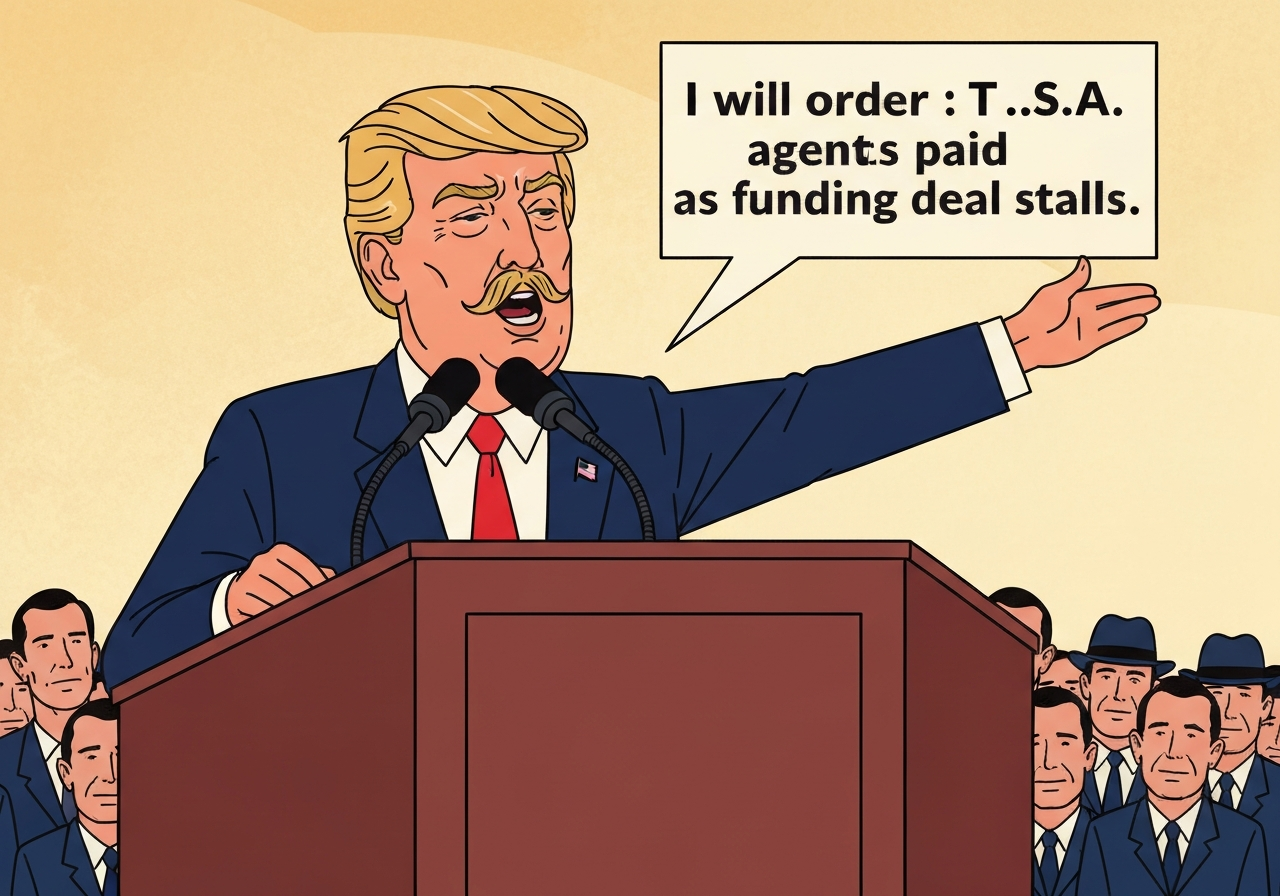
On March 26, 2026, President Donald Trump announced he would sign an emergency order to ensure Transportation Security Administration agents are paid after weeks without compensation, as lawmakers on Capitol Hill failed to reach a Homeland Security funding agreement. The step came amid growing airport delays and reports of long security lines, with some travelers facing waits of more than two hours. About 50,000 T.S.A. employees have been working without pay for over a month, and hundreds have quit or stopped appearing for duty. The White House said funds enacted last summer could cover the payroll, though officials gave limited detail on timing or mechanics.
Key Takeaways
- President Trump said on March 26, 2026, he would sign an emergency order to pay T.S.A. agents who have been unpaid for weeks.
- Roughly 50,000 T.S.A. personnel have worked without pay for more than a month; hundreds reportedly have left or are absent from posts.
- DHS funding lapsed on Feb. 14, 2026, triggering a partial shutdown that continues into late March and disrupted airport operations.
- Travelers have experienced checkpoint waits exceeding two hours in some locations, straining airport capacity and schedules.
- Administration officials indicated the money comes from funds enacted into law last summer as part of the tax and domestic policy measure.
- Neither party in Congress had agreed to separately fund T.S.A.; Republicans repeatedly rejected Democrats’ push to split out agency funding.
- The dispute traces to a broader fight over immigration enforcement that intensified after killings of two U.S. citizens by federal immigration agents earlier in the year.
Background
The Department of Homeland Security’s discretionary funding expired on Feb. 14, 2026, after negotiators in Congress failed to pass a continuing resolution acceptable to both parties. Since the lapse, the department has been operating under a partial shutdown, leaving visible components such as the Transportation Security Administration exposed to the political brinkmanship. T.S.A. frontline staff continued to work during the lapse but, as a result, tens of thousands have gone without pay for weeks—an unusually protracted period for a security agency whose daily operations affect millions of travelers.
Negotiations became entangled with a separate policy dispute over immigration enforcement. Lawmakers on the left pushed to condition funding on limits to certain enforcement tactics following the killings of two U.S. citizens by federal immigration agents earlier in the year; Republicans rejected those constraints and also opposed a stand-alone funding carve-out for T.S.A. The stalemate left both parties reluctant to yield, using funding leverage to press competing priorities in a charged political environment.
Main Event
On Thursday, the president publicly said he would issue an emergency order to authorize pay for T.S.A. employees. The White House did not release the text of such an order at the time of the announcement, and senior administration aides speaking anonymously said existing law enacted last summer contains funds that could be tapped for payroll. Reporters noted, however, that those funds are already available without an executive proclamation, suggesting the move was in part aimed at demonstrating executive action.
Airport terminals across the country continued to show signs of strain. Checkpoint lines lengthened in several major airports, with official and traveler accounts describing waits at times pushed beyond two hours. T.S.A. reported that hundreds of agents had quit or stopped appearing for shifts, compounding staffing shortages and forcing longer lines where agencies struggled to reassign resources.
Lawmakers in both chambers remained divided. Republicans publicly blamed Democrats for the impasse, arguing that Democrats’ insistence on policy conditions blocked a clean funding bill. Democrats countered that they had sought targeted measures to address enforcement tactics and had pressed for separate T.S.A. funding for weeks—requests Republicans repeatedly declined. The stalemate meant neither side moved to pass a narrow pay bill for T.S.A. before the president’s announcement.
Analysis & Implications
Operationally, delayed pay for T.S.A. staff risks degrading passenger screening capacity if attrition continues. When experienced screeners leave, training backlogs and redeployments take weeks or months to resolve; sustained absences therefore create a lingering drag on throughput at busy hubs. Airports already operate close to capacity during peak travel periods, so even modest staff shortages can produce outsized delays for both passengers and airline schedules.
Politically, the president’s emergency-order announcement is a tactical play: it allows the administration to claim responsiveness while leaving Congress to continue negotiating the larger funding fight. Because legal advisers note the funds in question were enacted last summer, the move may be aimed at shifting public attention and political costs onto lawmakers who delayed action. If the administration does implement payments quickly, it could blunt some pressure on members of Congress—particularly Republicans—who have faced criticism for the disruption.
Legally and procedurally, the administration’s claim that an executive action is needed is contested. Multiple legal and budgetary analysts say the statutory language from last summer’s law already authorizes spending in many areas of DHS; thus the practical effect of an “order” could be limited to administrative direction rather than new appropriations. That ambiguity could prompt legal challenges or further Congressional scrutiny if the administration attempts to reallocate funds in ways lawmakers view as inconsistent with their intent.
Comparison & Data
| Metric | Value |
|---|---|
| T.S.A. employees working unpaid | ~50,000 |
| Shutdown / funding lapse | Feb. 14, 2026 |
| Date of president’s announcement | March 26, 2026 |
| Reported maximum checkpoint wait | More than 2 hours |
| Estimated weeks without pay | Over 5 weeks |
The table above places the administration announcement alongside the core operational indicators reported by agencies and travelers. The gap between the Feb. 14 funding lapse and the March 26 announcement spans more than five weeks, a period that saw increasing attrition and operational strain at checkpoints. Historical precedent shows that short funding gaps can be absorbed; prolonged lapses, however, raise the risk of sustained service degradation if staffing losses are not rapidly reversed.
Reactions & Quotes
Officials and lawmakers offered immediate responses that framed the announcement in political and operational terms. Supporters characterized the move as necessary to protect travelers; critics said it sidestepped Congress’s responsibility to appropriate funds and left broader policy disputes unresolved.
“I will sign an emergency order to pay Transportation Security Administration agents who have gone without compensation,”
President Donald Trump (March 26, 2026 announcement)
Administration spokespeople emphasized urgency and the need to stabilize airport operations, while congressional critics called for a durable funding solution rather than a temporary executive fix. The president’s statement aimed to demonstrate direct action but did not specify timing or mechanics for payroll disbursement.
“Funds enacted into law last summer could be used to cover payroll,”
Senior administration official (anonymized)
Budget experts noted that those funds exist in statute but said executing payroll requires internal departmental steps and, potentially, reprogramming determinations. Members of Congress said they would seek briefings from the administration to understand how the payments would be executed and whether they required further approvals.
“We have urged separate funding for T.S.A. to avoid exactly this kind of political standoff,”
Senate Democrat (statement reported)
Democratic statements reiterated that they had pushed for a stand-alone T.S.A. appropriation to insulate screening operations from broader policy fights. Republicans countered that Democrats’ policy demands were the barrier to a full DHS funding package.
Unconfirmed
- Whether the administration will release a signed order and the precise legal mechanism for payroll disbursement remains unconfirmed.
- The timeline for when unpaid T.S.A. agents would actually receive back pay and how far back payments would cover is not yet verified.
- Reports vary on the exact number of agents who have quit or stopped appearing; the widely reported figure is “hundreds,” but a precise verified count has not been published.
Bottom Line
The president’s announcement on March 26, 2026, signals an attempt to end an acute personnel and operational crisis at airports without resolving the broader funding and policy standoff in Congress. If implemented quickly and effectively, deploying existing statutory funds could ease immediate strain at checkpoints and reduce traveler disruption. However, a one-off executive action is unlikely to settle the underlying political dispute over DHS funding and immigration enforcement, which will continue to shape negotiations and potential future shutdown risks.
Lawmakers will face pressure to produce a lasting appropriations solution that separates routine security operations from wider political fights. Travelers and airport operators should expect continued volatility in staffing and wait times until Congress or the administration provides clear, verifiable steps and timelines for restoring normal pay and staffing levels.
Sources
- The New York Times — news report summarizing administration announcement and Congressional response