
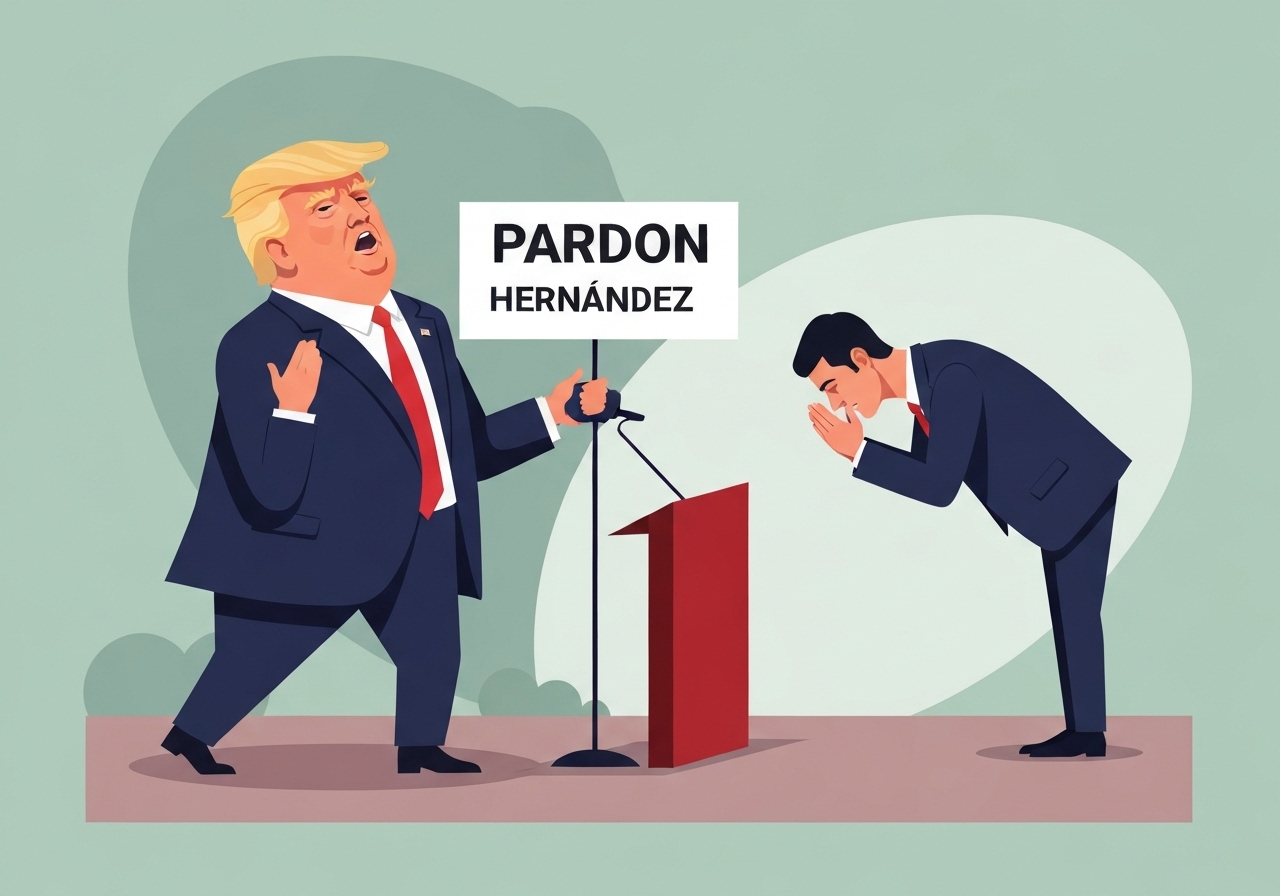
Lead: President Donald Trump announced from West Palm Beach, Florida, that he intends to pardon former Honduran president Juan Orlando Hernández, who was convicted in 2024 of drug trafficking and weapons charges and sentenced to 45 years in U.S. prison. Trump framed the decision on social media, saying people he respects view Hernández’s treatment as unfair. Hernández has been serving his sentence at the U.S. Penitentiary, Hazelton, after being extradited in 2022. Family members in Tegucigalpa responded with public prayers and gratitude following the announcement.
Key Takeaways
- President Trump said on social media from West Palm Beach, Fla., that he plans to pardon Juan Orlando Hernández, convicted in 2024 and sentenced to 45 years.
- Hernández, who served two terms as Honduras’ president, was extradited to the U.S. in 2022 and imprisoned at USP Hazelton, West Virginia.
- Trump justified the move by citing views of people he “greatly respect[s],” calling Hernández’s treatment harsh and unfair.
- Hernández’s family publicly prayed on their Tegucigalpa home steps and expressed hope for his return “in the coming days.”
- Lawyer Renato C. Stabile praised the announcement as correcting an injustice and signaled optimism about U.S.–Honduras ties.
- The pardon message was linked to Trump’s endorsement of Nasry “Tito” Asfura in Honduras’ presidential race; Trump warned of negative consequences if Asfura loses.
- Honduran politics are polarized: contenders include Asfura (National Party, 67), Rixi Moncada (Libre), and Salvador Nasralla (Liberal).
Background
Juan Orlando Hernández led Honduras for two terms before leaving office in 2022. Months after the end of his presidency, Honduran authorities detained him and he was extradited to the United States to face charges tied to drug trafficking and weapons offenses. In March 2024, a U.S. court found Hernández guilty of conspiring to import cocaine into the United States; the sentence imposed was 45 years.
The prosecution arose amid long-standing U.S. investigations into Central American drug networks and their links to political actors. Extraditions from Honduras have been an element of broader U.S. policy to prosecute international traffickers domestically, reflecting both bilateral security cooperation and political tension. Hernández has appealed his conviction while serving time at USP Hazelton in West Virginia.
Main Event
On Friday in West Palm Beach, President Trump posted that, in his view and according to people he respects, Hernández had been “treated very harshly and unfairly,” and said he would issue a pardon. The announcement was made on social media rather than via a White House press release, and it immediately reverberated in Honduras and among Hernández’s legal team. Family members in Tegucigalpa gathered at their home—where authorities had removed Hernández in 2022—and knelt in prayer after learning of the planned pardon.
Attorneys for Hernández responded with gratitude. Renato C. Stabile called the pardon a correction of a “great injustice” and framed it as opening the door to renewed U.S.–Honduras cooperation. Another lawyer, Sabrina Shroff, declined to comment publicly. Hernández himself was reported to have been notified by family; a close associate said his voice broke when told the news.
The timing of the announcement intersects with an active Honduran presidential campaign. Trump used the post to endorse Nasry “Tito” Asfura, the 67‑year‑old conservative former mayor of Tegucigalpa and National Party candidate, while warning that a loss for Asfura could bring regional consequences. Trump has also used strong rhetoric about Venezuela and its leader Nicolás Maduro in relation to broader hemispheric contests for influence.
Analysis & Implications
A presidential pardon for a foreign head of state convicted in U.S. courts raises legal, diplomatic and political questions. Legally, the U.S. Constitution grants the president broad pardon power for federal offenses; politically, using that power in a high‑profile, foreign‑focused case will test bilateral relations with Honduras and regional partners. The move may be welcomed by Hernández’s supporters as corrective; critics will likely view it as politicized intervention in judicial outcomes.
Domestically in Honduras, the pardon could bolster the National Party’s favored candidate by energizing supporters who see Hernández as a wronged leader. Conversely, opponents—especially those aligned with the Libre party or critics of the National Party—may frame the action as interference tied to a U.S. endorsement. The net effect on the election outcome will depend on voter perceptions in the coming days and on how Honduran institutions and civil society respond.
Internationally, Washington’s decision could affect U.S. relationships across Latin America. Partners concerned with rule of law and anti‑corruption could criticize a pardon that appears to override a federal conviction for narcotics offenses. The announcement also occurs against the backdrop of U.S. pressure on Venezuela and broader strategies in the Caribbean and Central America related to migration and drug interdiction.
Comparison & Data
| Event | Year | Outcome |
|---|---|---|
| Hernández leaves office / detained | 2022 | Arrested in Honduras and extradited to U.S. |
| U.S. conviction | March 2024 | Guilty of conspiracy to import cocaine; 45‑year sentence |
| Incarceration | 2024–present | Serving sentence at USP Hazelton, West Virginia |
The table summarizes the timeline from Hernández’s 2022 extradition through his 2024 conviction and current imprisonment. These milestones are central to understanding both the legal basis for the sentence and why a presidential pardon would be consequential for law enforcement cooperation and bilateral ties.
Reactions & Quotes
Family and legal representatives responded rapidly and emotionally to the announcement, while political actors in Honduras and the United States framed the move through partisan lenses.
“According to many people that I greatly respect, he was treated very harshly and unfairly.”
President Donald Trump (social media post)
Trump’s concise social‑media rationale tied the pardon to private counsel and perceived unfair treatment; it served simultaneously as political messaging ahead of the Honduran vote.
“He still didn’t know of this news and believe me, when we shared it his voice broke with emotion.”
Family spokesperson — on Hernández being told of the pardon
Family members expressed relief and faith, saying they expect Hernández to return to Honduras in the near term though no firm travel date was provided.
“A great injustice has been righted and we are so hopeful for the future partnership of the United States and Honduras.”
Renato C. Stabile, Hernández lawyer
Hernández’s attorney framed the pardon as correction of a wrongful outcome and emphasized hopes for renewed bilateral cooperation.
Unconfirmed
- Exact date and logistics for Hernández’s return to Honduras have not been announced and remain unconfirmed.
- Claims that Hernández’s prosecution was a coordinated plot by drug traffickers and the “radical left” lack independent corroboration in public court records.
- The detailed legal basis and formal paperwork timeline for the planned pardon have not been released publicly as of the announcement.
Bottom Line
The planned pardon marks a consequential use of U.S. presidential clemency in a case involving a former foreign head of state convicted of serious narcotics offenses. It will have immediate political impact in Honduras, where voters are deciding leadership, and could influence broader U.S. relations in the region depending on how governments and institutions respond.
Observers should watch for official U.S. documentation of the pardon, the timing of Hernández’s return, and reactions from Honduran institutions and international partners. Those developments will determine whether the move reshapes bilateral cooperation or deepens domestic and regional polarization.