
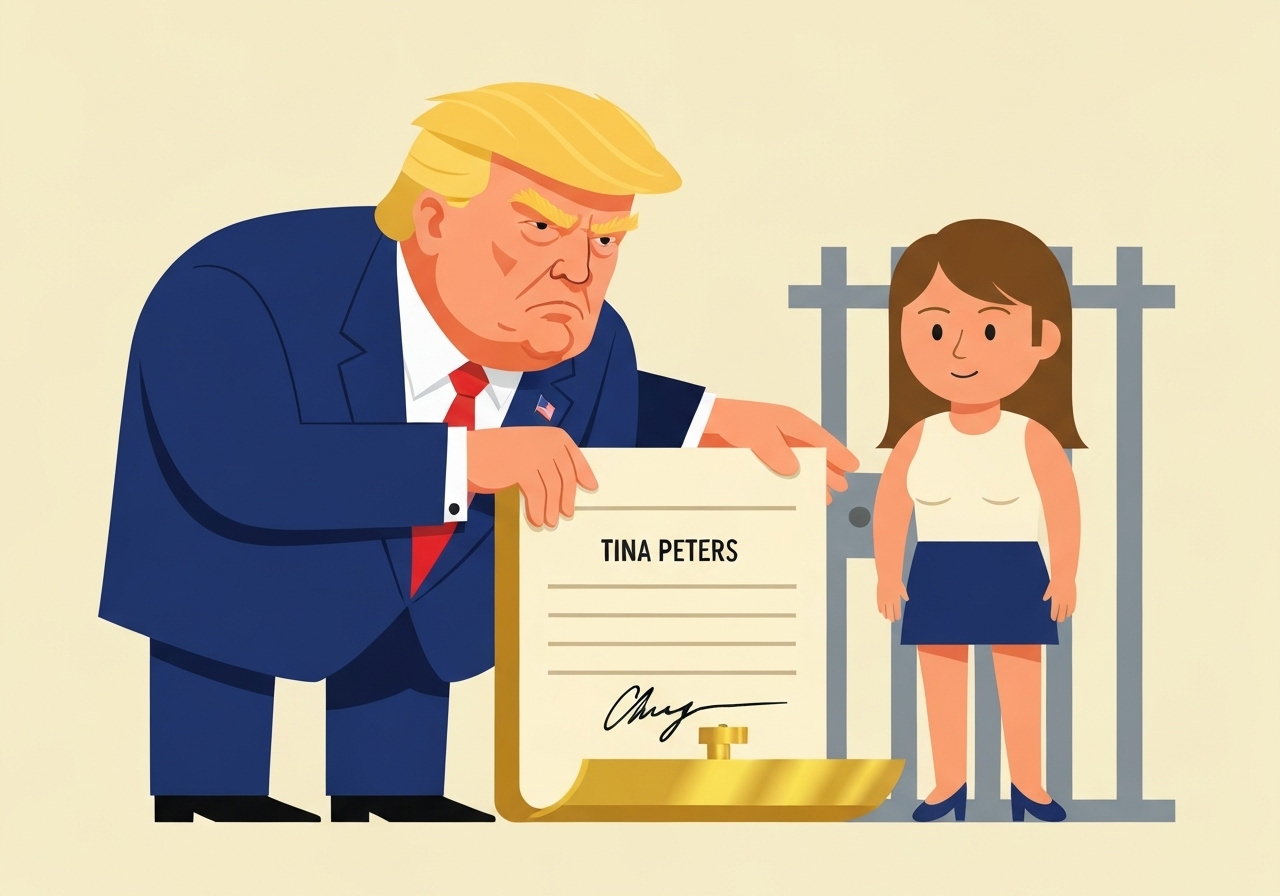
President Donald Trump announced on December 11, 2025, that he had granted a pardon to Tina Peters, a former Mesa County clerk serving a nine-year state sentence after a 2024 conviction for crimes tied to unauthorized access of voting machines. The move comes even though Peters was prosecuted, tried and sentenced in Colorado state court, and legal scholars widely say the presidential pardon power covers federal—not state—offenses. Colorado officials including Secretary of State Jena Griswold and Attorney General Phil Weiser denounced the pardon as beyond presidential authority and a threat to state sovereignty. Peters’s legal team has pushed a novel theory that federal clemency might apply to state convictions; that claim has not been adjudicated in any court.
Key Takeaways
- Tina Peters was granted a presidential pardon on December 11, 2025, while serving a nine-year sentence imposed in October 2024. The sentence followed a jury conviction on seven state charges.
- The state charges included three counts of attempting to influence a public servant and one count of conspiracy to commit criminal impersonation; prosecutors say she allowed unauthorized access to county voting machines in 2021.
- Colorado officials assert the president lacks constitutional power to pardon state convictions; Attorney General Phil Weiser called the idea without precedent in American law.
- Peters’s attorney, Peter Ticktin, presented a theory that a presidential pardon could reach state convictions, but he acknowledged the issue “has never been raised in any court.”
- The White House and Peters’s counsel were contacted for comment; state leaders including Gov. Jared Polis and Secretary Griswold said courts and state systems must resolve the matter.
- Mr. Trump has intervened previously on behalf of allies tied to his 2020 election fraud claims, and has granted clemency to several figures charged in state cases since leaving office.
Background
Tina Peters served as Mesa County clerk before prosecutors say she and associates “devised and executed a deceptive scheme” in 2021 to allow an unauthorized individual to access county voting equipment. Images taken from voting machines later appeared online, and prosecutors say Peters became “fixated” on purported machine problems after aligning with national figures who spread false claims about the 2020 election.
At trial, a jury found Peters guilty on multiple state felony and misdemeanor counts. In October 2024 Judge Matthew Barrett, at sentencing, sharply criticized Peters’s conduct and demeanor, describing her as defiant. Peters has consistently denied acting with malice and maintains she sought to ensure election integrity. Her appeal efforts have continued while she remains in state custody.
Main Event
On the evening of December 11, 2025, Mr. Trump posted a statement on his platform saying he would pardon Peters, framing her as a “patriot” who pursued honest elections and accusing Democrats of targeting her. The pardon announcement did not cite a federal charge underpinning the clemency.
Colorado officials responded quickly. Secretary of State Jena Griswold emphasized Peters was convicted by a jury for state crimes in Colorado and asserted the president lacks constitutional authority to overturn state convictions. Attorney General Phil Weiser called the pardon theory unprecedented and said it would not withstand legal scrutiny.
Peters’s legal team had earlier urged federal intervention; the Federal Bureau of Prisons requested last month that Colorado transfer Peters to federal custody, a move state officials resisted. A federal magistrate also denied Peters’s request for release pending appeal this week, keeping her in state custody while legal challenges continue.
The incident has echoes in Mr. Trump’s broader clemency record: since leaving office he has publicly supported and, in some cases, granted pardons to people charged in connection with efforts to overturn the 2020 election, including alternate electors and close associates.
Analysis & Implications
Constitutional scholars note the presidential pardon power, under Article II, covers “Offences against the United States,” which historically has been read to exclude state prosecutions. If a court were to accept the argument that a president can pardon state convictions, it would mark a radical expansion of federal clemency power and raise separation-of-powers and federalism concerns.
Practically, the pardon creates immediate legal ambiguity: state officials can refuse to recognize a federal pardon as a basis to release someone convicted under state law, and courts would likely be asked to resolve whether such a pardon has any legal effect. Colorado leaders have indicated they will defend the state’s authority to prosecute and sentence under state law.
Politically, the pardon is also a message to a constituency that supports Mr. Trump’s claims about the 2020 election. It may further polarize state-federal relations, encourage similar clemency attempts in other state prosecutions, and prompt states to tighten controls over custody and transfer of inmates in politically sensitive cases.
If litigation proceeds, the U.S. Supreme Court could ultimately be asked to settle the constitutional question. That process would take months or years and could produce a landmark decision clarifying the limits of presidential clemency.
Comparison & Data
| Authority | Typical Scope | Legal Basis |
|---|---|---|
| Presidential Pardon | Federal offenses only (historical practice) | Article II, U.S. Constitution |
| State Clemency | State offenses (pardon/commutation by governor or state board) | State constitutions and statutes |
The table summarizes prevailing practice: presidents have historically issued clemency for federal convictions, while governors or state boards handle state convictions. The controversy here stems from counsel for Peters proposing an untested constitutional interpretation that could blur those lines.
Reactions & Quotes
“Tina Peters was convicted by a jury of her peers for state crimes in a state court. Trump has no constitutional authority to pardon her.”
Jena Griswold, Colorado Secretary of State (official)
Griswold framed the pardon as an overreach that threatens state sovereignty and the integrity of state criminal justice systems.
“The idea that a president could pardon someone tried and convicted in state court has no precedent in American law.”
Phil Weiser, Colorado Attorney General (official)
Weiser emphasized the absence of legal precedent and said the state would defend its independence in criminal prosecutions.
“Democrats have been relentless in their targeting of TINA PETERS, a Patriot who simply wanted to make sure that our Elections were Fair and Honest.”
Donald J. Trump (statement on Truth Social)
Mr. Trump used the pardon to reinforce his narrative about election integrity, language that aligns with Peters’s past claims and national allies who accused voting systems of misconduct in 2020.
Unconfirmed
- The legal viability of a presidential pardon for a state conviction remains unresolved and has not been decided by any court.
- Claims that the pardon will immediately secure Peters’s release from Colorado custody are premature; state officials have indicated they will contest such a result.
Bottom Line
President Trump’s December 11, 2025, pardon of Tina Peters sets up a constitutional confrontation between federal clemency assertions and state sovereignty over criminal law. While the pardon is a politically significant gesture to Mr. Trump’s supporters, its immediate legal effect on a state conviction is doubtful under long-standing constitutional practice.
The issue is likely to move through litigation if Peters’s legal team or federal actors press the matter; a definitive resolution would carry far-reaching implications for federalism, the limits of presidential power, and how politically charged state prosecutions are handled in the future. For now, Colorado officials say the state’s court process and penalties remain in force.
Sources
- CBS News (news report)
- Office of the Colorado Secretary of State (official statements and press office)
- Colorado Attorney General (official statements)
- The White House (official communications)