
Lead
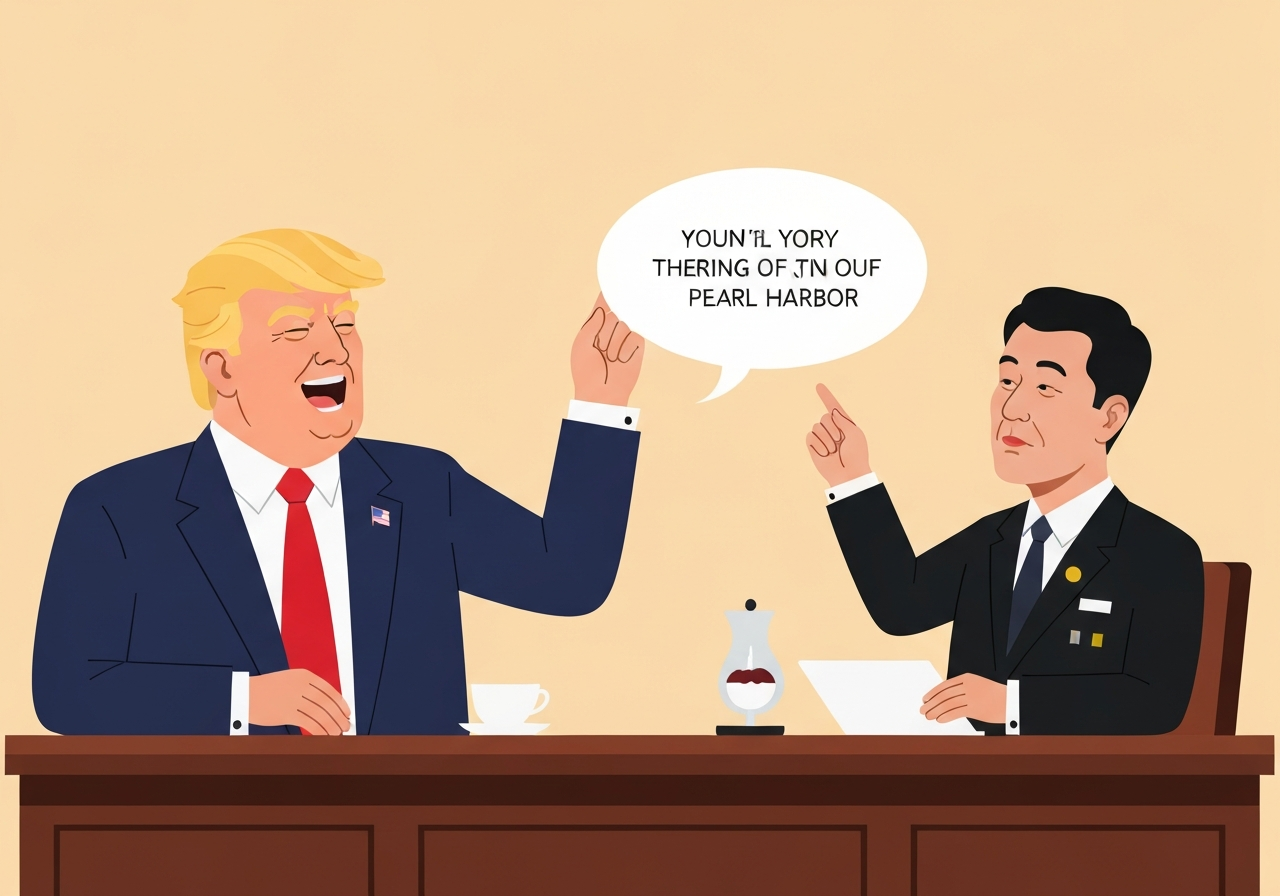
On March 19, 2026, President Donald J. Trump made an unexpected reference to the Dec. 7, 1941 attack on Pearl Harbor during an Oval Office meeting with Japan’s prime minister, Sanae Takaichi. He invoked the attack while explaining why allies, including Japan, were not given advance notice of a U.S.-Israeli strike on Iran. The remark drew laughter from some attendees but left the prime minister visibly startled and silent. The exchange was widely noted as a break with decades of diplomatic restraint regarding Pearl Harbor.
Key Takeaways
- President Trump spoke at the Oval Office on March 19, 2026, during a meeting with Japan’s prime minister, Sanae Takaichi.
- He linked the surprise of the U.S.-Israeli strike on Iran to Pearl Harbor, referencing Dec. 7, 1941, in his reply to a question about ally notifications.
- Takaichi reacted nonverbally — widening her eyes and remaining silent — while some officials and journalists in the room laughed.
- The United States occupied Japan from 1945 until 1952 after World War II and helped shape Japan’s postwar constitution, including Article 9’s renunciation of war.
- Diplomatic norms have long discouraged U.S. presidents from invoking Pearl Harbor in official meetings with Japanese leaders; this comment departs from that practice.
- The exchange could complicate U.S.-Japan diplomacy at a time of heightened regional security tensions following the reported U.S.-Israeli action against Iran.
Background
For generations U.S. leaders treated the Pearl Harbor attack as a traumatic historical event and a sensitive subject in relations with Tokyo. After World War II, the United States led the Allied occupation of Japan from 1945 to 1952 and took part in drafting Japan’s postwar constitution, which included limits on military force. Article 9, promulgated in 1947, became a central symbol of Japan’s pacifist turn and of Tokyo’s reliance on the U.S.-Japan security relationship for deterrence.
Because of that history, American presidents traditionally avoided harsh or flippant references to Pearl Harbor in public diplomacy with Japanese officials, prioritizing alliance cohesion as the Cold War and then the broader security environment in Asia took shape. The U.S.-Japan security treaty, first concluded in 1951 and revised in 1960, formalized a long-term defense partnership that has underpinned bilateral cooperation for decades. In that context, discussions of surprise attacks or warnings to allies are not only operational questions but also politically sensitive gestures.
Main Event
The exchange occurred during a meeting in the Oval Office when a reporter asked why Japan and other allies had not been given prior notice of a U.S.-Israeli strike on Iran. According to attendees, Mr. Trump replied that the United States ‘‘didn’t tell anybody about it because we wanted surprise,’’ and then added, referencing Pearl Harbor, that ‘‘who knows better about surprise than Japan, OK? Why didn’t you tell me about Pearl Harbor, OK? Right?’’
Those words produced some laughter among officials and journalists present. Ms. Takaichi, who traveled to Washington for bilateral talks, did not answer aloud; observers said she widened her eyes and took a breath while keeping her hands folded. The interaction lasted only moments but was captured in photographs and reported immediately by news outlets.
U.S. officials who spoke privately described the comment as another instance of Mr. Trump setting aside diplomatic convention. Japanese government spokespeople did not offer a public rebuke in the immediate aftermath, and there was no official joint statement addressing the remark. Still, foreign-policy specialists said the episode is likely to be discussed in Tokyo as an awkward moment in otherwise routine alliance consultations.
Analysis & Implications
Invoking Pearl Harbor in a diplomatic encounter with a Japanese leader touches on a lasting historical trauma and tests the boundaries of alliance etiquette. For many in Japan and the U.S., Pearl Harbor is more than a historical fact; it is the origin point of a relationship that moved from conflict to a security partnership built on American reassurance and Japan’s postwar restraints. A leader’s casual reference risks reopening sensitive memories and complicates public perceptions of mutual respect.
Strategically, the comment matters because Tokyo relies on clear communication with Washington on matters of regional security, especially given rising tensions with Iran and the broader Middle East fallout that can affect global supply chains and energy markets. If allies conclude they cannot rely on timely consultation, trust could erode in ways that require additional diplomatic repair, new consultation mechanisms, or clarifying agreements about notification and coordination.
Domestically in Japan, exposure to such an Oval Office moment may influence political debate. Prime Minister Takaichi is a conservative leader who has signaled a tougher security posture; how she frames the encounter at home could affect discussions about Japan’s defense policy and public sentiment on alliance management. In Washington, the incident underscores how presidential rhetoric can create foreign-policy reverberations independent of formal policy choices.
Comparison & Data
| Year | Event |
|---|---|
| 1941 | Pearl Harbor attack, Dec. 7 |
| 1945–1952 | Allied occupation of Japan |
| 1947 | Promulgation of Japan’s postwar constitution (Article 9) |
| 1951 | Treaty of San Francisco / U.S.-Japan Security Treaty (initial) |
The table summarizes the key milestones that shape modern U.S.-Japan relations and the sensitivity around references to Pearl Harbor. Those dates are frequently cited in diplomatic histories and remain touchstones when leaders discuss security cooperation, constitutional limits on force, and the mutual obligations of the alliance.
Reactions & Quotes
We didn’t tell anybody about it because we wanted surprise. Who knows better about surprise than Japan, OK? Why didn’t you tell me about Pearl Harbor, OK? Right?
President Donald J. Trump, Oval Office, March 19, 2026
The Japanese people forever renounce war as a sovereign right of the nation and the threat or use of force as means of settling international disputes.
Japanese Constitution, Article 9 (official English translation)
Analysts and diplomats have pointed to the exchange as emblematic of the potential gap between presidential style and long-standing diplomatic sensibilities. In Tokyo, officials were reported to be monitoring the domestic reaction and assessing whether a formal clarification or outreach from Washington would be warranted.
Unconfirmed
- Whether Prime Minister Takaichi interpreted the comment as a deliberate insult or as an offhand remark has not been publicly clarified by her office.
- It is not confirmed that the exchange will lead to any formal diplomatic protest or changes in consultation practices between the United States and Japan.
Bottom Line
The Oval Office remark on March 19, 2026, is notable not only for its content but for what it reveals about the intersection of presidential rhetoric and alliance politics. Even a brief, offhand comment can create diplomatic unease when it touches a sensitive shared history, and this moment is likely to prompt private conversations aimed at damage control and reassurance.
Observers should watch for any formal statements from Tokyo or follow-up outreach from Washington that clarifies consultation procedures on regional military actions. The incident underscores that, beyond policy mechanics, the tone and framing of high-level diplomacy remain consequential for alliance trust and public perceptions in both countries.
Sources
- The New York Times — U.S. national newspaper reporting on the Oval Office exchange (media).
- Prime Minister of Japan and His Cabinet: Constitution of Japan (English) — official government translation of Article 9 (official government source).
- Encyclopaedia Britannica: Treaty of San Francisco — historical overview of occupation end and treaty (reference).