
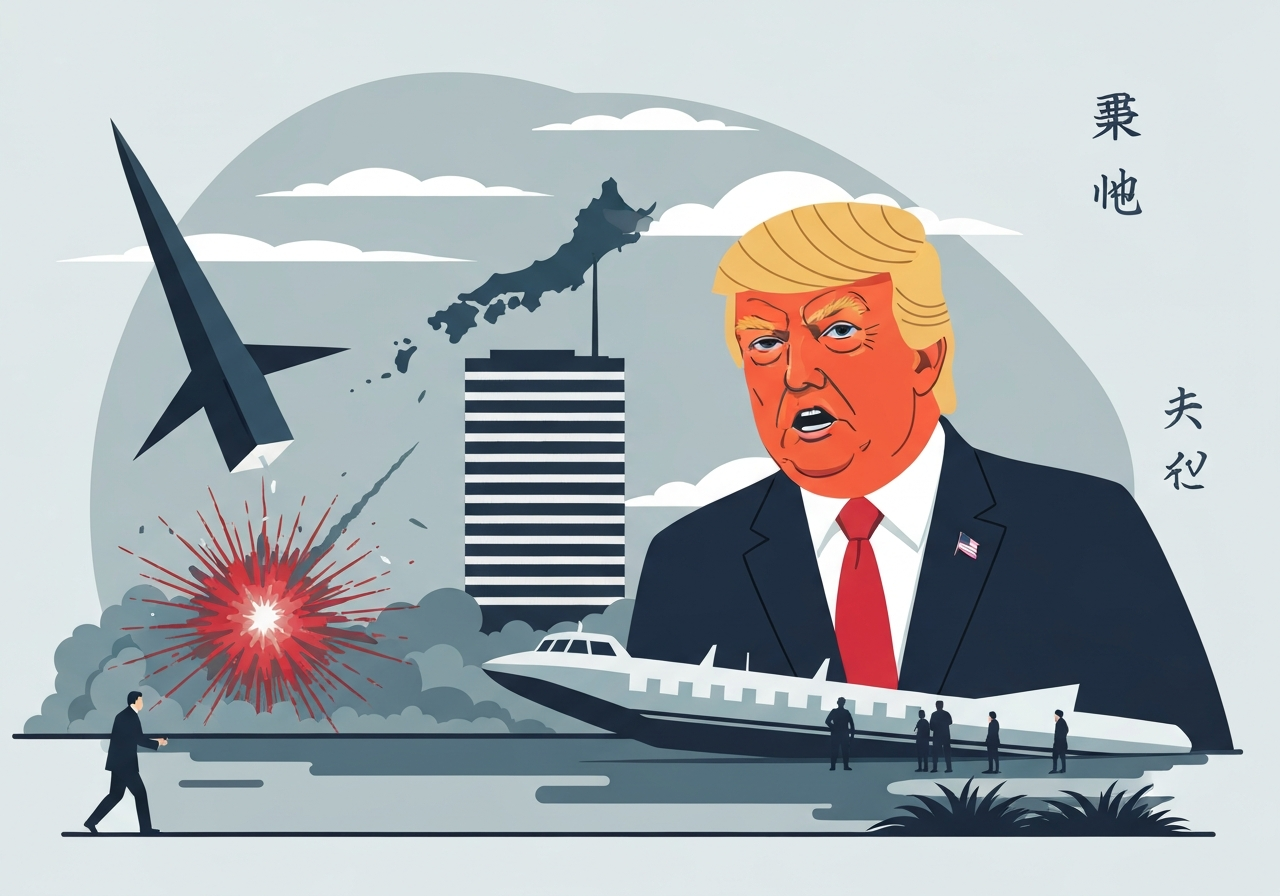
Japanese officials and the public reacted with surprise, embarrassment and unease after President Donald Trump referenced the World War II attack on Pearl Harbor to justify keeping allies uninformed before his strike on Iran. The remark, delivered during a Washington summit where Japan’s Prime Minister Sanae Takaichi sat beside him, revived sensitive wartime memories and prompted immediate criticism from Japanese media and commentators. The episode highlighted the diplomatic tightrope Tokyo walks as it seeks deeper security cooperation with Washington while managing fraught historical memories at home.
Key Takeaways
- President Donald Trump cited Pearl Harbor in Washington to explain why he did not brief allies ahead of the U.S. action against Iran, saying, “Who knows better about surprise than Japan? Why didn’t you tell me about Pearl Harbor, OK?”
- Prime Minister Sanae Takaichi was visibly uncomfortable at the summit; she remained largely nonverbal while seated beside President Trump during the exchange.
- The Asahi newspaper criticized the remark as ignoring historical lessons and urged it not be dismissed; the editorial called it problematic for justifying a sneak attack.
- Commentators including Tsuneo Watanabe (Sasakawa Peace Foundation) and others suggested the comment signaled a departure from conventional U.S. diplomatic norms and strained allied trust.
- Japan depends on the U.S. for security — hosting about 50,000 U.S. troops and relying on the U.S. nuclear deterrent — making Tokyo cautious about confrontational diplomacy despite domestic discomfort.
- Debate over Japan’s World War II responsibility remains politically charged; leaders such as Takaichi have argued Japan has apologized sufficiently and have signaled possible visits to the contentious Yasukuni Shrine.
Background
Relations between Tokyo and Washington are anchored in deep security and economic ties. The United States maintains roughly 50,000 troops in Japan and extends a nuclear umbrella that remains central to Japanese defense planning. For that reason, Japanese leaders often handle public references to World War II with care, because historical sensitivities can inflame domestic politics and complicate diplomatic relations with neighbors.
Memory of the 1941 attack on Pearl Harbor remains a potent symbol in both countries. In recent decades, bilateral reconciliation efforts included gestures such as the joint 2016 tributes by then-President Barack Obama and Prime Minister Shinzo Abe at the Arizona Memorial and the Hiroshima Peace Park. Yet within Japan, debates persist: some conservatives, including Prime Minister Sanae Takaichi, say the country has apologized enough, while others caution against moves that could be read as downplaying wartime aggression.
Main Event
At a summit in Washington, a Japanese reporter asked why allies in Europe and Asia were not warned before the U.S. strike on Iran. President Trump responded by invoking Pearl Harbor, a comparison that many in Japan found jarring given the sensitivity of the subject. The remark was delivered casually and drew immediate attention because Takaichi was seated beside him.
The immediate reaction in Japan mixed embarrassment with anger. The Asahi newspaper published an editorial saying the comment “should not be overlooked,” arguing that using Pearl Harbor to justify a surprise attack ignored the lessons of history. On social media, responses ranged from accusations of rudeness to suggestions that Trump was implying Japan was not an equal partner.
Some Japanese commentators faulted Takaichi for not publicly rebuking the president in the moment. Others said she was right to prioritize the summit’s agenda — deepening U.S.-Japan cooperation — over a public history dispute. The exchange also renewed discussion about how Japan balances deference to a crucial ally with the domestic political imperative to defend national dignity.
Analysis & Implications
The incident underscores the fragility of historical memory in contemporary diplomacy. For Tokyo, the calculus is complex: it needs close security ties with Washington to deter regional threats, yet it must also manage a domestic electorate sensitive to wartime history. A single sarcastic comparison to Pearl Harbor can therefore reverberate widely, affecting public opinion and political discourse.
Strategically, the episode may complicate Japan’s efforts to expand its military role. Japan’s postwar constitution restricts the use of force to self-defense, and leaders such as Takaichi are pursuing reinterpretations or reforms to broaden that scope. Public alienation over perceived slights by a major ally could make such domestic policy shifts harder to sell to a skeptical population.
Diplomatically, the comment could feed suspicion among other U.S. partners about consultation practices. Allies expect to be briefed on major military actions affecting regional security; the perception that the U.S. acted unilaterally could push partners to seek clearer assurances or contingency planning. How Washington responds to allied concerns in the days and weeks after the remark will shape short-term trust.
Reactions & Quotes
Japanese media and commentators responded quickly, framing the comment as a serious misstep and a revival of delicate wartime issues.
“Making such a remark to justify a sneak attack and boast about its outcome is a piece of nonsense that ignores lessons from history.”
Asahi (editorial, Japanese national newspaper)
Scholars and former officials saw the exchange as illustrative of shifting U.S. diplomatic tone.
“I get the impression that the comment was intended to bring the Japanese reporter or Ms. Takaichi into complicity in order to justify his ‘sneak attack’ on Iran during diplomatic negotiations and without telling allied countries.”
Tsuneo Watanabe, senior fellow at Sasakawa Peace Foundation (op-ed in Nikkei)
The reporter whose question prompted the exchange later explained his intent and responded to the fallout.
“I was meaning to say, ‘Why didn’t you tell us, why are you troubling us?'”
Morio Chijiiwa, TV Asahi reporter
Unconfirmed
- Whether President Trump intended the Pearl Harbor reference primarily as a rhetorical provocation rather than a policy justification remains a matter of interpretation and has not been explicitly confirmed by his office.
- Details about which specific allies were or were not briefed before the Iran strike are not fully public and require official confirmation for a complete accounting.
Bottom Line
The exchange in Washington revealed how quickly historical wounds can reappear in high-stakes diplomacy. For Japan, the incident posed a dual challenge: maintaining a vital security partnership with the United States while responding to domestic expectations about historical sensitivity and national dignity. Prime Minister Takaichi’s measured public silence reflected that tension.
Looking ahead, the episode may prompt Tokyo and other U.S. partners to press for clearer communication channels and consultation norms around military actions. How U.S. leaders address allied concerns — and how Japanese leaders balance alliance management with domestic politics — will determine whether this moment becomes a lasting strain or a short-lived controversy.
Sources
- Associated Press — news organization (original report summarizing summit and reactions)
- Asahi Shimbun — national newspaper (editorial cited)
- Nikkei — national business newspaper (op-ed referenced)
- Sasakawa Peace Foundation — policy research foundation (Tsuneo Watanabe affiliation)
- TV Asahi — broadcaster (reporter Morio Chijiiwa)