
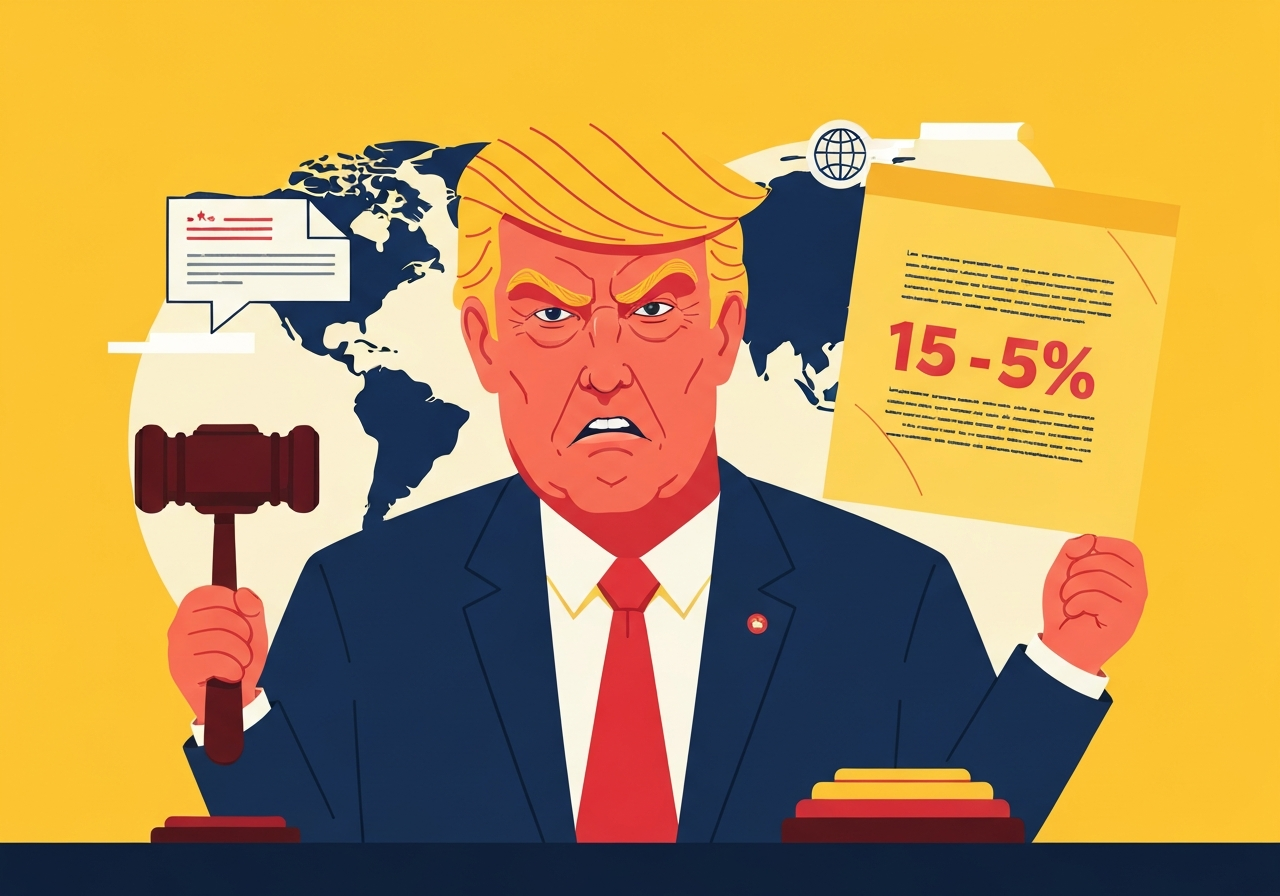
Lead: President Donald Trump said on Saturday, Feb. 21, 2026, that he will raise a temporary worldwide tariff from 10% to 15% following a U.S. Supreme Court decision that curtailed his earlier authority to impose levies under IEEPA. The announcement, posted on Truth Social, came after the high court struck down use of the International Emergency Economic Powers Act for tariffs and after Mr. Trump on Friday issued a proclamation setting a 10% duty that is scheduled to take effect Feb. 24. He cited Section 122 of the Trade Act of 1974 as the legal basis for the higher, temporary 15% rate, which federal law permits for up to 150 days. The move sets up immediate economic and legal questions, and administration aides said further steps could follow under additional trade statutes.
Key Takeaways
- President Trump announced a rise in a temporary global tariff from 10% to 15% on Feb. 21, 2026, via Truth Social.
- The initial 10% proclamation was signed on Friday and is scheduled to begin Feb. 24; the 15% limit is allowed under Section 122 of the Trade Act of 1974 for up to 150 days.
- The Supreme Court ruled that IEEPA (International Emergency Economic Powers Act) cannot be used to impose tariffs, overturning the legal basis for many prior levies.
- Mr. Trump said his administration will publish the list of countries and products covered and pursue other tariff measures that require Commerce Department investigations.
- Legal challenges are likely: the 15% temporary authority is legally constrained and could be contested in court or altered by litigation.
- Certain earlier tariffs — for steel, aluminum and autos — issued under other authorities were not affected by the Supreme Court decision.
Background
The dispute stems from two separate legal pathways presidents have used to impose trade levies. In recent years, the Trump administration relied on IEEPA to justify broad import restrictions, arguing national economic security justified emergency measures. The Supreme Court’s Feb. 20–21, 2026, ruling limited that option, finding IEEPA an improper basis for tariffs of the scope the administration sought. Separately, Section 122 of the Trade Act of 1974 authorizes temporary duties up to 15% for 150 days to address large and serious balance-of-payments problems, a narrower and more time-limited authority.
Trade policy under Mr. Trump has mixed elements: some measures required Commerce Department probes and interagency processes, while others were enacted by executive proclamation. That mix has produced ongoing legal scrutiny and industry uncertainty. Businesses and trading partners watch closely because even temporary changes to tariff rates can shift supply chains, pricing and investment decisions within weeks. The administration frames the measures as corrective steps to address long-term trade imbalances it says disadvantaged U.S. workers and manufacturers.
Main Event
On Friday, Mr. Trump signed a proclamation that enacted a 10% duty on most imports by citing authorities the administration has used in the past; the proclamation was set to take effect Feb. 24. The Supreme Court then ruled that the IEEPA could not be used to impose tariffs in the manner the White House had claimed, a decision that invalidated part of the legal rationale for broader levies. In response, on Saturday Mr. Trump announced via Truth Social that he would immediately raise the temporary worldwide tariff ceiling to 15%, invoking the Trade Act provision that permits such a rate for 150 days.
The president described the Supreme Court decision as “poorly written” in his post and said his administration would issue the specific list of tariffs and covered countries under the legally permissible framework. Officials have not published the detailed schedule or the final proclamation raising the rate to 15% as of the announcement; aides said the administration would determine the exact tariff lines and effective dates. The president also indicated parallel action under other sections of federal law that require Commerce Department investigations, signaling a multi-track approach to trade restrictions.
Observers noted that some of Mr. Trump’s prior tariffs — notably on steel, aluminum and autos — remain in force because they were implemented under separate statutory authorities not affected by the Supreme Court’s ruling. That distinction matters for affected industries and trading partners, since products and sectors will face different legal and procedural treatments depending on the authority invoked. Market participants reacted to the announcement with immediate volatility in some industry stocks and currencies linked to trade exposure.
Analysis & Implications
The immediate economic effect of moving from a 10% to a 15% blanket tariff depends on which goods and countries are specified. A higher temporary levy could raise import prices for consumer goods and intermediate inputs, increasing costs for manufacturers and possibly accelerating inflationary pressures in the near term. Supply-chain managers may shift sourcing or accelerate purchases to avoid the higher rate, producing front-loading effects that complicate forecasts. The White House’s stated objective is to pressure trading partners on long-standing imbalances; whether that produces measurable shifts in trade deficits is uncertain within the 150-day window.
Legally, the administration has tightened its reliance on Section 122, which offers a short, testable authority but also invites expedited judicial review. Courts will likely be asked to assess whether the administration’s factual record meets the statute’s threshold of “large and serious” balance-of-payments disruptions. If judges find the evidentiary foundation lacking, the 15% levies could be stayed or struck down, producing further uncertainty. Concurrent Commerce Department investigations under other statutes would proceed on longer timelines and could yield more durable restrictions if they produce affirmative findings.
Internationally, trading partners may retaliate or pursue dispute settlement through tariffs, negotiations or multilateral fora. A sudden, across-the-board 15% duty would put pressure on exporters to the U.S., especially in sectors with thin margins. Allies and major trading partners are likely to lodge formal protests and could seek remedies through the World Trade Organization or bilateral diplomacy. The political cost and diplomatic friction could complicate U.S. cooperation on other global priorities.
Comparison & Data
| Authority | Max Temporary Duty | Duration | Immediate Status |
|---|---|---|---|
| IEEPA (past reliance) | No explicit tariff cap | Indeterminate | Invalidated for tariff use by Supreme Court |
| Section 122, Trade Act of 1974 | 15% | 150 days | Invoked for new 15% measure |
| Statutes requiring Commerce probe | Varies by statute | Depends on investigation | Under active review by administration |
The table shows legal routes and constraints: Section 122 provides a time-limited 15% ceiling, while IEEPA’s use for tariffs was curtailed. That legal differentiation will shape which products are subject to immediate duties and which require lengthier administrative processes. Analysts caution that even temporary measures can have outsized distributional effects, hitting consumers, import-dependent manufacturers, and exporters in partner countries differently.
Reactions & Quotes
Administration spokespeople framed the step as a lawful, necessary response to what they describe as unfair trade practices. They emphasized reliance on Section 122 where permissible and signaled follow-on measures under other statutes. Business groups and some economists warned of higher costs for U.S. consumers and supply-chain disruption if the move broadens.
“I will be, effective immediately, raising the 10% Worldwide Tariff…to the fully allowed…15% level,”
President Donald Trump (Truth Social)
The president’s post served as the public declaration of intent; it framed the action as a legal and political counter to the court’s ruling. Legal analysts noted the post is a statement of intent but that formal implementation requires a published proclamation specifying covered goods and effective dates.
“The U.S. Supreme Court’s decision limits the executive branch’s emergency powers for tariffs, altering the legal landscape for trade policy,”
Trade law analyst (academic)
Experts pointed out the practical difference between authority and policy: even with Section 122 available, the administration must meet statutory thresholds, and courts may scrutinize the factual record supporting any proclamation. Industry associations said they would evaluate impacts and consider legal responses if needed.
Unconfirmed
- Exact timing and text of a formal proclamation raising the rate to 15% had not been published as of Feb. 21, 2026; implementation date therefore remains unconfirmed.
- The precise list of countries and tariff lines that will be covered by the planned 15% duty was not available and may change before formal issuance.
- Whether courts will uphold a 15% proclamation under Section 122 on the available record is uncertain and depends on forthcoming administrative findings and litigation outcomes.
Bottom Line
President Trump’s announcement to raise a temporary global tariff to 15% is a rapid policy response to a Supreme Court limitation on emergency authorities. The legal route he cites provides a visible but time-limited mechanism that will be tested in short order by courts, markets and trading partners. Businesses should prepare for near-term price effects and logistical shifts, while policymakers and foreign governments will evaluate diplomatic and dispute-settlement options.
Ultimately, the measure underscores the limits and levers of executive trade policy: a higher temporary duty can be implemented quickly but faces legal, economic and diplomatic constraints that may limit its long-term efficacy. Watch for the administration’s formal proclamation, the Commerce Department’s investigations, and any litigation that follows to determine how durable and wide-ranging these measures will be.
Sources
- CBS News — Media report summarizing the president’s announcement and related developments (news)
- U.S. Supreme Court — Official court site for opinions and orders referenced in the ruling (official)
- The White House — Executive proclamations and administration statements (official)