
Lead
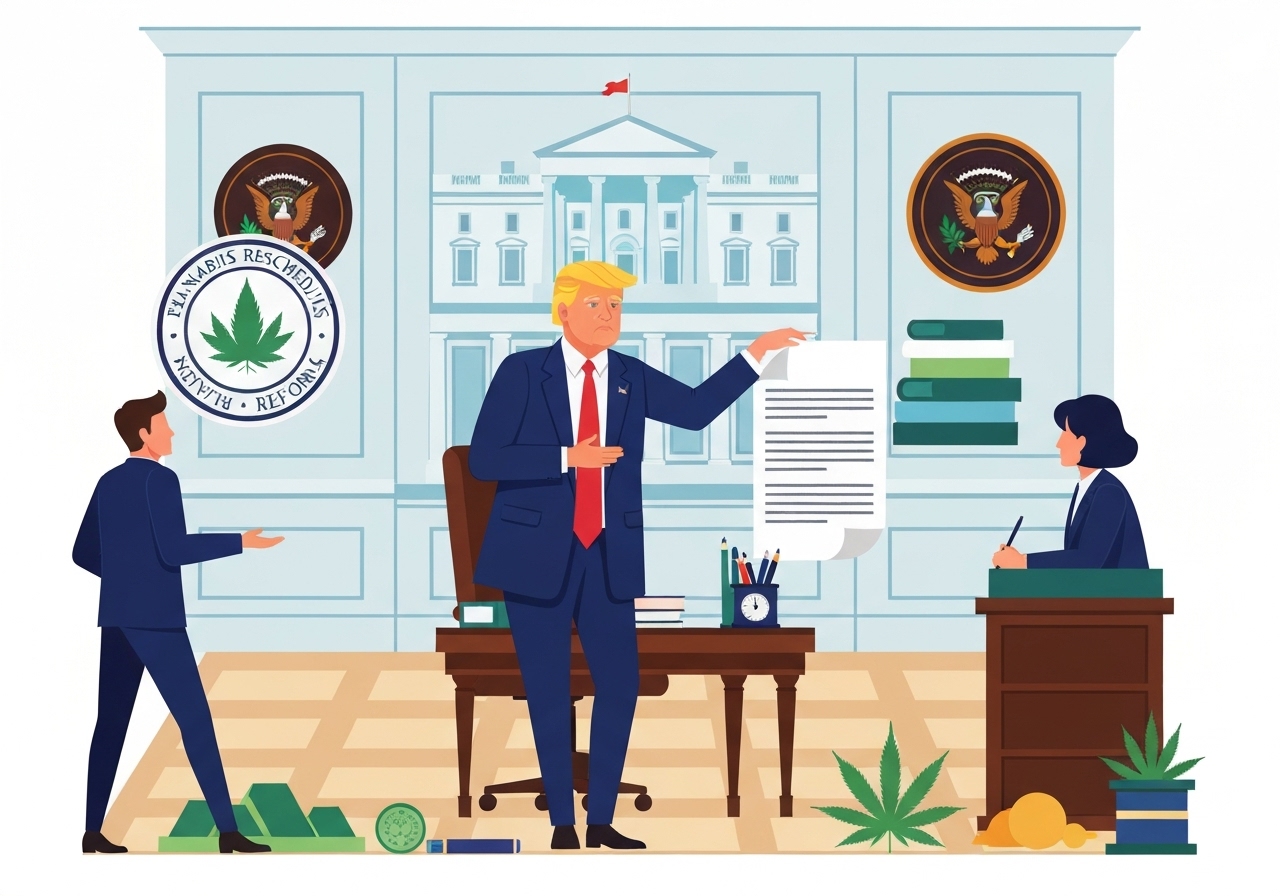
President Donald Trump signed an executive order on Thursday directing the attorney general to move cannabis from Schedule I to Schedule III under federal law, a change intended to widen research and ease some restrictions. The order does not legalise cannabis federally but would reclassify it alongside drugs such as codeine-containing pain relievers. The administration also asked White House staff to work with Congress to expand access to cannabidiol (CBD) and directed health officials to develop methods to study CBD’s real-world effects.
Key Takeaways
- The president signed an executive order instructing the attorney general to reclassify cannabis from Schedule I to Schedule III under the Controlled Substances Act.
- Schedule III includes substances such as ketamine, anabolic steroids and some codeine products; the DEA says these have a “moderate to low” potential for dependence.
- The order preserves federal illegality but is intended to enable expanded medical research and potentially change tax treatment for state-licensed cannabis businesses.
- Trump asked White House officials to work with Congress to allow access to cannabidiol (CBD) and tasked health agencies to build models assessing CBD’s benefits and risks.
- The move drew praise from reform groups and industry leaders who cite roughly 425,000 U.S. workers in the cannabis sector; it also prompted objections from some Republican lawmakers citing public-health concerns.
- Nearly half of U.S. states (24) have legalised recreational cannabis and a majority allow medical use; cannabis has been Schedule I since 1971.
- The Biden administration and the DEA had previously pursued reclassification efforts, including a DEA proposed rule in April 2024 that stalled amid procedural and legal hurdles.
Background
Controlled Substance scheduling in the United States dates to federal and international drug-control frameworks that assign substances to Schedules I through V based on accepted medical use and abuse potential. Cannabis was placed in Schedule I in 1971 at the federal level, a classification meaning no accepted medical use and a high potential for abuse. That federal stance has diverged sharply from state laws: as of now, 24 states allow recreational use and a majority permit medical access.
Federal scheduling has broad consequences beyond criminal enforcement: it affects research approvals, pharmaceutical development pathways and tax treatment for businesses. Under current rules, many state-authorised cannabis dispensaries face limits on business deductions because federal law treats cannabis as a controlled substance; rescheduling could alter how the Internal Revenue Code is applied to such businesses.
Policy debates have long split along public-health, criminal-justice and economic lines. Advocates argue rescheduling would clear obstacles to clinical research and reduce regulatory burdens on an established industry; opponents warn that loosening federal controls could normalise use and create health and safety risks, especially for young people.
Main Event
In a signing ceremony held in the Oval Office, President Trump framed the order as a response to patients in “great pain,” including those with chronic or terminal conditions and veterans with service-related injuries. He contrasted cannabis with prescription opioids, noting that both can have legitimate medical uses but also carry risks.
The executive order specifically directs the attorney general to initiate the administrative process to reclassify cannabis from Schedule I to Schedule III, and asks White House staff to coordinate with Congress on provisions to expand cannabidiol (CBD) access. Health agencies were assigned to design “methods and models” to assess CBD’s real-world health benefits and risks.
A senior administration official described the order as a “commonsense action” to enable better study of cannabis and CBD. The White House framing emphasised research facilitation and patient access rather than immediate nationwide legalisation.
The reclassification would not instantly change federal criminal statutes or state laws. Instead, it triggers a procedural path in which the attorney general and relevant agencies must complete rulemaking and update enforcement and regulatory guidance, a process that can take months and face legal challenges.
Analysis & Implications
Rescheduling cannabis to Schedule III would represent a substantive shift in federal policy by recognising a narrower abuse profile and an accepted medical use compared with Schedule I. That change could reduce regulatory barriers for clinical trials, allowing researchers to conduct larger, multi-site studies and potentially accelerate FDA review of cannabis-derived therapies.
For the cannabis industry, Schedule III status could materially affect taxes and banking. Under current practice, many cannabis businesses are restricted by federal tax rules that limit deductions for companies trafficking in Schedule I substances; moving cannabis to Schedule III could open routine tax deductions and ease accounting burdens, improving profitability and investor interest.
Politically, the order exposes a split within the Republican Party and across Congress. A bloc of GOP lawmakers signalled firm opposition, arguing public-health risks remain and that federal endorsement could normalise use. Conversely, reform advocates and many state officials welcomed the change as aligning federal policy with a patchwork of state laws and public opinion trends.
Internationally, the move could influence treaty discussions and other countries’ domestic debates on cannabis policy. While rescheduling does not legalise cannabis, it may encourage jurisdictions weighing medical access expansions or regulatory reforms to reassess risk classifications and research priorities.
Comparison & Data
| Schedule | Criteria | Examples | Typical dependence risk |
|---|---|---|---|
| Schedule I | No accepted medical use; high abuse potential | Marijuana (since 1971), heroin | High |
| Schedule III | Accepted medical use; moderate to low dependence potential | Ketamine, anabolic steroids, codeine-containing products | Moderate to low |
The table highlights the regulatory distinction the administration is seeking to change. Moving cannabis to Schedule III would align it with substances recognised as having medical uses and a lower dependence risk than Schedule I drugs. This classification shift primarily affects research approvals, prescription frameworks and tax/accounting rules rather than state criminal penalties.
Reactions & Quotes
Supporters framed the order as overdue alignment of federal policy with states and medical needs. Industry representatives pointed to workforce and investment implications, arguing the change will stabilise an expanding sector.
“This change will empower the 425,000 people working in the US cannabis industry…”
Tim Barash, Coalition of Cannabis Scheduling Reform (advocacy group)
Opponents warned of social and health risks; a group of Republican senators said the decision could undermine broader economic and social goals.
“In light of the documented dangers of marijuana… facilitating the growth of the marijuana industry is at odds with growing our economy and encouraging healthy lifestyles for Americans.”
Letter from 22 Republican U.S. Senators (official communication)
Unconfirmed
- Exact timeline: The precise schedule for administrative rulemaking and when regulatory changes will take effect remains unspecified.
- Tax impact specifics: How and when federal tax treatment under provisions such as IRS Code 280E would change for state-licensed businesses is not yet confirmed.
- Enforcement outcomes: Whether federal prosecutorial priorities or sentencing practices will change immediately after rescheduling has not been established.
Bottom Line
The executive order marks the most significant federal shift on cannabis in decades by setting in motion a move from Schedule I to Schedule III. While the action preserves federal illegality for now, it could expand clinical research, alter tax and financial treatment for the cannabis industry and reduce regulatory barriers to medicinal study.
Expect legal and legislative pushback and a multistage administrative process before concrete regulatory changes arrive. For patients, researchers and businesses, the order opens new opportunities but also leaves unresolved questions about timing, enforcement and the precise scope of future legal reforms.