
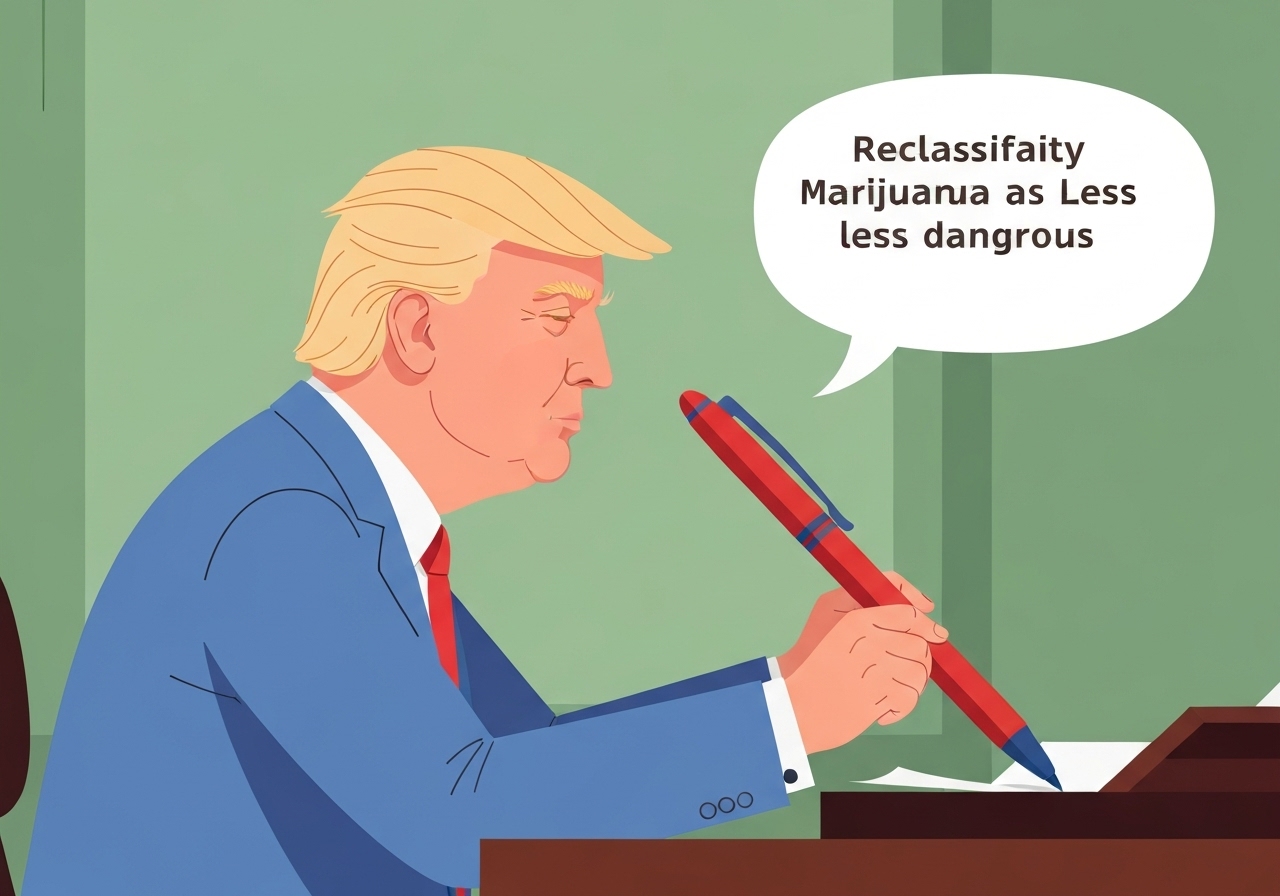
On Thursday, December 18, 2025, President Donald Trump signed an executive order to move cannabis out of the federal government’s most restrictive category of controlled substances, saying the change recognizes medical uses while stopping short of nationwide legalization. The order directs a reclassification from Schedule I to Schedule III and creates a pilot program to allow Medicare reimbursement for products containing cannabidiol (CBD). Senior administration officials told other outlets the measure would not immediately alter federal arrests related to marijuana and still requires formal rulemaking by the Drug Enforcement Administration (DEA). The administration says the shift is intended to ease research barriers and regulatory burdens for certain businesses without changing state cannabis laws.
Key Takeaways
- President Trump signed an executive order on December 18, 2025, to reschedule marijuana from Schedule I to Schedule III under federal law.
- The order establishes a pilot program permitting Medicare reimbursement for CBD-containing products, a non-intoxicating cannabis derivative.
- Reclassification to Schedule III would align cannabis with substances such as ketamine and certain prescription medications, but would not legalize recreational use at the federal level.
- The change must still pass through the DEA’s formal rule-making process before taking legal effect at the federal level.
- Officials told reporters the order would not immediately change how federal law enforcement handles marijuana arrests.
- Advocates say rescheduling could reduce the impact of federal tax code Section 280E on state-legal cannabis businesses and improve banking access; regulators and banks will need to adjust policies.
- Rescheduling is expected to lower administrative hurdles for clinical research, potentially easing Institutional Review Board (IRB) and supply constraints.
Background
Under the Controlled Substances Act, Schedule I has been reserved for drugs the federal government defines as having high potential for abuse and no accepted medical use; cannabis has occupied that classification for decades. That federal designation has conflicted with a growing patchwork of state laws: numerous states now permit medical cannabis and a subset allow recreational use. The mismatch has produced legal, financial and research challenges for patients, clinicians, and businesses operating in state-legal markets.
For years medical researchers and policy advocates have criticized the Schedule I status as a barrier to clinical study and patient access. Federal tax rules—particularly Section 280E of the Internal Revenue Code—have prevented many state-legal cannabis firms from claiming typical business deductions, increasing effective tax burdens. Banks have often declined to provide services to cannabis businesses because of anti-money-laundering concerns tied to federal illegality.
Main Event
The president signed an executive order on December 18, 2025, directing the executive branch to reclassify cannabis from Schedule I to Schedule III. The text of the order frames the move as recognition that certain cannabis-derived products have legitimate medical applications and a lower abuse potential than previously assessed. The order explicitly creates a pilot program allowing Medicare to reimburse qualifying CBD-containing products for enrolled beneficiaries, though details on eligibility and timing were limited in the administration’s initial statement.
Administration officials briefed reporters and told other outlets that the order does not legalize marijuana at the federal level and would not immediately change law enforcement practices tied to existing federal statutes. The officials emphasized that the DEA must complete a formal rule-making process before the scheduling change can take full legal effect, and that Health and Human Services (HHS) input may be part of that regulatory review.
Observers noted immediate operational questions: how quickly the DEA would open and complete rulemaking; whether IRS guidance on Section 280E would follow; and how banks, payment processors and insurers would interpret the shift while federal criminal statutes remain unchanged. Business groups in state-legal markets responded cautiously, saying that regulatory clarity—and not only scheduling language—will determine practical impacts.
Analysis & Implications
Rescheduling cannabis to Schedule III would remove it from the same legal bucket as substances classified as having no accepted medical use, a symbolic and regulatory signal that could unlock practical changes. One central effect would be to reduce administrative hurdles for scientific researchers who currently face supply, approval and licensing constraints tied to Schedule I requirements. Easier research could accelerate clinical trials assessing therapeutic indications and safety profiles for cannabinoids.
On the economic side, Schedule III status would change how some federal rules apply to cannabis-related businesses. The Internal Revenue Service has long applied Section 280E to deny ordinary business deductions to entities trafficking in Schedule I or II substances; rescheduling could prompt reinterpretation or guidance that lowers federal tax liabilities for qualifying firms. Improved clarity could also encourage greater banking participation, since many institutions cite federal illegality as the chief barrier to serving cannabis clients.
But significant limits remain. The order, by itself, does not alter state criminal laws or automatically expunge convictions, nor does it remove the possibility of federal prosecution under other statutes if federal agencies continue certain enforcement priorities. The DEA’s rule-making timeline and potential legal challenges mean that any practical changes to arrests, prosecutions or federal regulatory programs could lag the presidential announcement by months or longer.
Politically, the move represents a middle-path approach: acknowledging medical utility without endorsing full federal legalization. That positioning may aim to bridge constituencies that favor medical access and those opposed to unfettered recreational legalization. Still, Congress retains the power to change statutory law or to codify scheduling decisions, and courts may be asked to resolve disputes over administrative process and agency authority.
Comparison & Data
| Schedule | Federal definition (short) | Representative examples |
|---|---|---|
| Schedule I | No accepted medical use; high potential for abuse | Heroin, LSD (previously: cannabis) |
| Schedule III | Accepted medical use; moderate to low potential for dependence | Ketamine, certain anabolic steroids (marijuana proposed) |
The table highlights categorical differences regulators cite when setting schedule status. Moving an item between schedules typically requires scientific review and administrative rulemaking; practical effects depend on parallel regulatory changes in tax, banking and health programs.
Reactions & Quotes
The president said he would sign an order to move marijuana to Schedule III, describing the change as recognition of legitimate medical uses.
President Donald Trump / White House statement
That statement framed the move as a policy shift without immediate broad legalization. In other briefings, administration officials emphasized constraints: the DEA must complete formal rulemaking and the order does not automatically alter federal criminal enforcement.
A senior administration official noted the change would not instantly alter federal arrests and described the rescheduling as the start of a regulatory process rather than its conclusion.
Senior administration official (briefing reported to news outlets)
Unconfirmed
- Whether Medicare reimbursement for CBD products will be immediate or subject to lengthy implementation rules is not disclosed in the order and remains unconfirmed.
- The precise timeline for DEA rulemaking and any HHS recommendations on this reclassification has not been published and remains uncertain.
- Claims about immediate reductions in federal prosecutions or arrests are unconfirmed; administration briefings indicate enforcement practices may not change right away.
Bottom Line
The administration’s executive order signals a notable federal policy shift by directing cannabis out of Schedule I, acknowledging medical uses and aiming to reduce certain research and business barriers. However, the order is an administrative step that requires further agency action—most importantly DEA rulemaking—before legal and operational effects are realized.
For patients, researchers and businesses, the announcement is potentially consequential but incomplete: timelines, implementing guidance from federal agencies, IRS interpretations of tax rules, and banking sector responses will determine how quickly people see practical change. Observers should watch DEA notices, HHS assessments, and subsequent agency guidance for concrete next steps.
Sources
- The Guardian — news report summarizing the executive order and immediate reactions (media)
- The New York Times — referenced reporting on briefings with senior administration officials (media)
- Drug Enforcement Administration (DEA) — federal agency responsible for scheduling and rulemaking (official)