
Lead
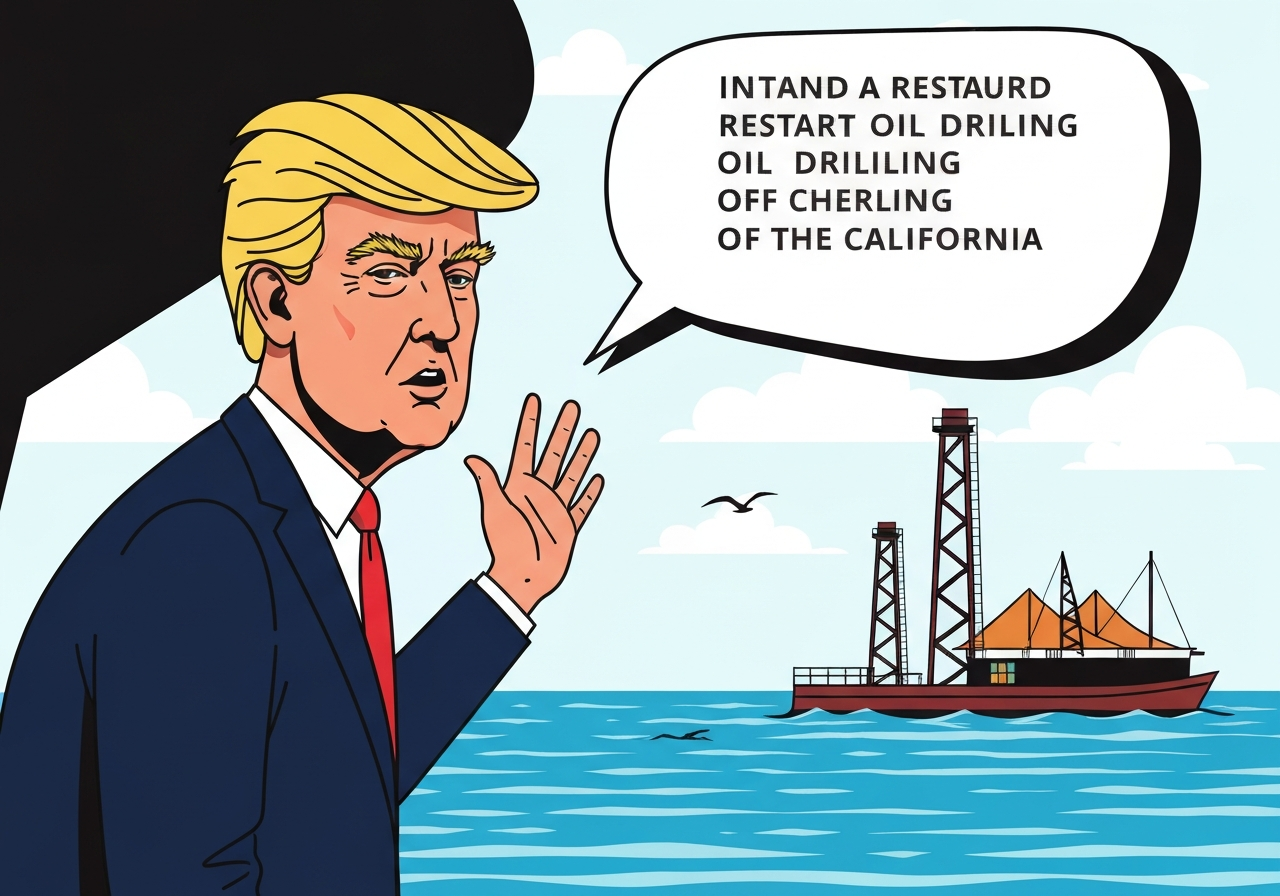
On March 13, 2026, President Trump used executive authority to order the restart of offshore oil operations off Santa Barbara County, citing energy shortages linked to the war with Iran. The administration invoked the Defense Production Act to empower the Department of Energy to compel Sable Offshore Corp. to restore the Santa Ynez Unit and the Santa Ynez Pipeline System. Energy Secretary Chris Wright framed the move as necessary to protect West Coast military fuel supplies and national defense readiness. California Governor Gavin Newsom immediately pledged legal action, saying the order conflicts with existing court restrictions and ongoing criminal matters involving the pipeline operator.
Key Takeaways
- The March 13 executive action directs the Department of Energy to use the Defense Production Act to speed restarting the Santa Ynez Unit and Santa Ynez Pipeline System off Santa Barbara County.
- Energy Secretary Chris Wright said the restart will shore up supplies for West Coast military bases; the DOE estimates Sable’s facilities could yield about 50,000 barrels per day, roughly 1.5 million barrels per month.
- The move comes amid the Iran war and a reported closure of the Strait of Hormuz that the administration cites as holding up an estimated 20 million barrels per day of crude, while benchmark oil has touched $100 a barrel.
- California average gas prices have surpassed $5.40 per gallon, according to the American Automobile Association, a key rationale cited for the administration’s urgency.
- Governor Gavin Newsom and state officials announced plans to challenge the order in court, pointing to multiple judicial restrictions and criminal investigations tied to the pipeline operator.
- Environmental groups warn that restarting the pipeline risks new spills; the Santa Ynez pipeline ruptured in 2015 and was one of the state’s largest coastal spills.
- Sable Offshore has sought for years to reactivate dormant infrastructure; the administration says the action is an emergency measure tied to national security.
Background
The Biden-era and state-level moratoria on new offshore leasing have long made California a focal point of disputes between energy companies and coastal advocates. Sable Offshore Corp., a Houston-based company, has repeatedly pursued permits and approvals to revive assets off the Santa Barbara County coast that have been idle since the 2015 pipeline rupture, which produced one of the largest state spills in recent history. That incident intensified scrutiny from regulators and environmental groups and led to criminal investigations and court interventions that have limited restart options.
The present administration’s decision arrives against the immediate backdrop of the Iran war, which closed the Strait of Hormuz and sharply curtailed oil flows that markets previously relied on. The White House argues that sudden supply disruptions and rising global crude prices have direct effects on national security and military readiness, particularly for installations on the West Coast. State leaders, local communities, and conservation organizations counter that California’s coastline and fisheries face unacceptable ecological and economic risk if dormant infrastructure is forced back into service.
Main Event
On March 13, President Trump signed an executive order authorizing the Department of Energy to apply the Defense Production Act to accelerate oil and gas development tied to the Santa Ynez facilities. Within hours Energy Secretary Chris Wright issued a directive naming Sable Offshore Corp. and instructing it to restore operations of the Santa Ynez Unit and the Santa Ynez Pipeline System. The DOE framed the action as a narrow, urgent step to reestablish a pipeline system the administration describes as “vital to national security” and to ensure military fuel access along the West Coast.
Governor Gavin Newsom immediately denounced the action and vowed litigation, arguing that the order attempts to override multiple judicial orders and ongoing criminal probes tied to the pipeline operator. Newsom described the measure as an unlawful power grab and pledged to use the state’s legal resources to block the restart. Local officials and communities in Santa Barbara County voiced alarm, saying the restart directive lifts a years-long moratorium on risky infrastructure without adequate local consent or updated safety verification.
Sable Offshore has for several years pushed to reactivate the Santa Ynez facilities, citing both economic and energy-security benefits. The company has argued that the assets could meaningfully add to domestic supply; the Department of Energy cites an estimate of about 50,000 barrels per day of potential output from the county facilities. Opponents note that even if brought online, the output represents only a small fraction of the global supply gap caused by disruptions in the Strait of Hormuz.
Analysis & Implications
The administration’s invocation of the Defense Production Act marks an unusual application of a Cold War–era statute originally designed to prioritize industrial production for national defense. Deploying it to compel a private operator to restart coastal oil infrastructure raises legal and constitutional questions likely to be adjudicated in fast-moving litigation. If courts block enforcement, the administration may face both political and strategic setbacks; if courts allow the order, it could set a precedent for future federal intervention in energy operations on environmental and public-safety grounds.
From an energy-market perspective, Sable’s estimated 50,000 barrels per day is modest relative to the disruption the administration cites. The DOE’s comparison to roughly 20 million barrels a day affected by the Strait of Hormuz closure highlights a scale mismatch: the Santa Barbara output would not replace large international flows but could provide short-term regional relief. Markets may react to the announcement as a policy signal; however, analysts caution that incremental supply on this scale is unlikely to reverse the upward pressure on oil prices driven by broader geopolitical tensions.
Environmental and economic trade-offs are central. Restarting older infrastructure that was involved in a 2015 spill poses concrete risks to marine ecosystems, fisheries, and tourism-dependent local economies. Regulators and engineers will need to demonstrate upgraded safety protocols and pipeline integrity to reduce the chance of a repeat incident. Politically, the move deepens fault lines between the federal administration, which emphasizes energy security, and California officials who prioritize coastal protection and state regulatory authority.
Comparison & Data
| Item | Estimate |
|---|---|
| Potential output from Santa Barbara facilities | ~50,000 barrels per day (~1.5 million barrels/month) |
| Reported crude affected by Strait of Hormuz closure | ~20 million barrels per day (administration estimate) |
| Benchmark crude price (two weeks into Iran war) | ~$100 per barrel |
| Average California retail gas price | Over $5.40 per gallon (AAA) |
These figures illustrate the gap between a localized production increase and the much larger global supply disruption cited by the administration. The DOE’s 50,000 b/d estimate is meaningful for regional logistics but small as a share of global flows. Price responses at the pump depend on refinery capacity, distribution logistics, and market sentiment, so bringing pipelines online does not automatically translate into sizable, immediate relief for consumers.
Reactions & Quotes
Federal officials emphasized national security and military-readiness rationales in public statements. The DOE described the pipeline system as essential to sustaining fuel access for West Coast installations and framed the order as an emergency measure to protect defense operations.
“This order will strengthen America’s oil supply and restore a pipeline system vital to our national security and defense,”
Chris Wright, U.S. Department of Energy
California political leaders and environmental organizations responded with sharp criticism, highlighting legal barriers and environmental risk. Governor Newsom and other state officials said the federal move would be met with immediate court challenges, arguing that the restart would violate multiple judicial restrictions and skirt state authority.
“This is an attempt to illegally restart a pipeline whose operators are facing criminal charges and are prohibited by multiple court orders from restarting,”
Gov. Gavin Newsom (statement)
Conservation groups called the action a misuse of emergency powers that would prioritize a private company’s interests over coastal protection. They stressed the unresolved safety questions stemming from the 2015 rupture and warned of ecological consequences if safeguards are insufficient.
“Mandating a restart of these defective oil pipelines won’t curb high gas prices, but it will put coastal wildlife at huge risk of another oil spill,”
Talia Nimmer, Center for Biological Diversity (attorney)
Unconfirmed
- Whether forced restart will materially reduce national or California pump prices in the near term remains unproven; market analysts say short-term relief is unlikely from this sole source.
- The extent to which the DPA directive can legally override existing court orders and criminal inquiries is unresolved and will depend on imminent litigation outcomes.
- Precise timelines for a safe, fully operational restart for the Santa Ynez facilities have not been publicly verified by independent engineering audits.
Bottom Line
The administration’s order is a high-stakes move that prioritizes an immediate energy-security narrative over longstanding state environmental protections and pending legal constraints. Quantitatively, the Santa Barbara facilities’ potential 50,000 barrels per day will offer limited relief against the much larger supply shocks tied to the Iran war, and therefore may have only modest influence on global prices.
Legally and politically, the decision is likely to prompt rapid court battles and further polarize state-federal relations on energy and environmental policy. For residents, local economies, and the environment of Santa Barbara County, the most consequential outcome will be whether courts require additional safety verification or prevent the restart entirely; the coming weeks of litigation and regulatory review will determine the practical result.
Sources
- Los Angeles Times — news report summarizing the March 13 announcements and local reactions (media).
- U.S. Department of Energy — official federal agency (official).
- Office of the Governor of California — statements from Governor Gavin Newsom (official/state government).
- Center for Biological Diversity — environmental advocacy organization statement (NGO).
- American Automobile Association (AAA) — retail gasoline price data cited (industry association).