
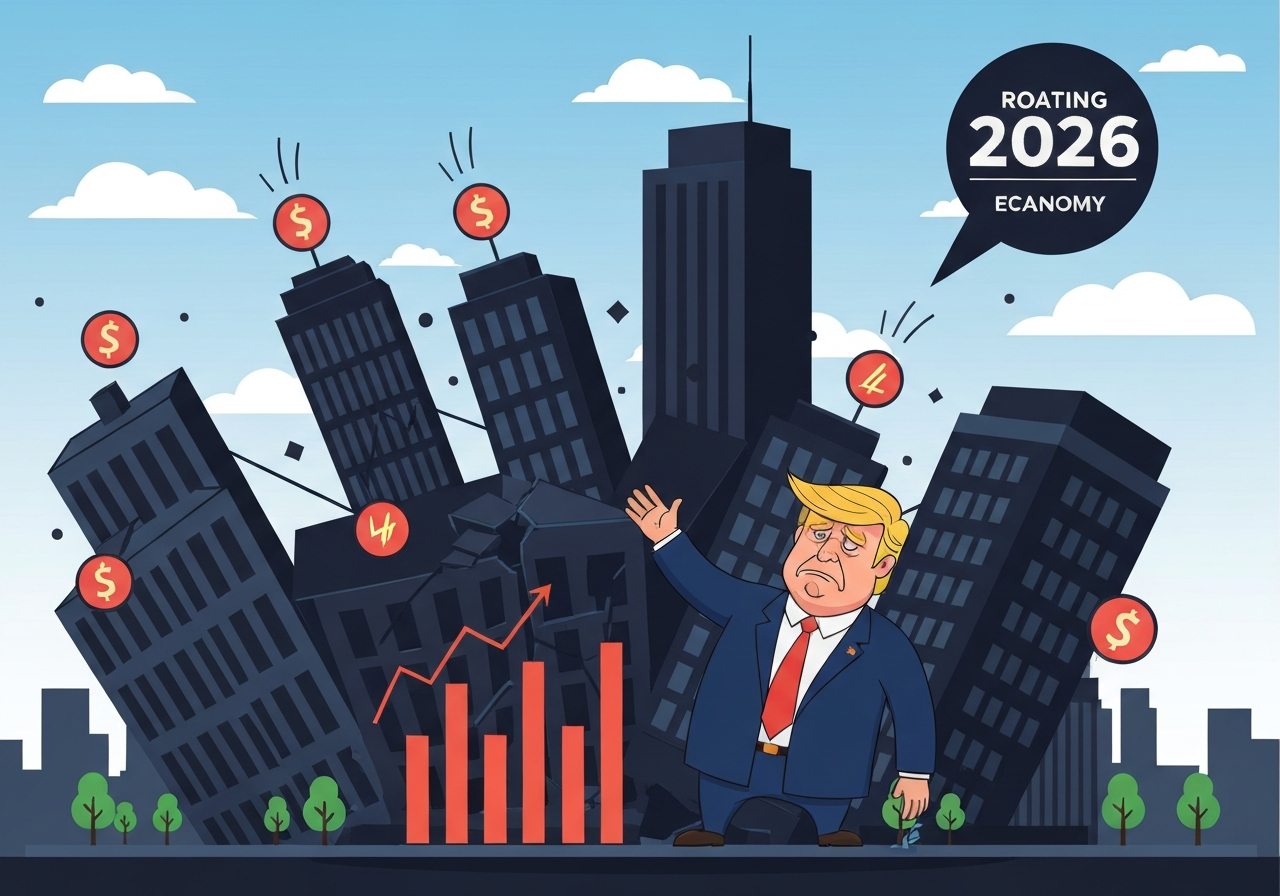
Lead: In Washington, President Donald Trump entered 2026 promising a ‘‘roaring’’ economy, but new data through February show job losses, a sharp rise in gasoline prices and weaker markets that undercut that claim. Official reports show a gain of 130,000 jobs in January followed by a loss of 92,000 in February and a December revision to a 17,000-job loss; excluding health care, the private sector would have shed about 202,000 jobs since Trump took office in January 2025. Pump prices jumped 19% over a month to a national average of $3.45, and the Dow Jones Industrial Average fell roughly 5% over the past month. The mixed early-year readings complicate the administration’s message and could shape voter perceptions ahead of this year’s congressional contests.
Key Takeaways
- Jobs: January showed +130,000, February -92,000, and December was revised to -17,000, revealing greater volatility in the labor market.
- Net private job change: Without health care, the economy would have lost about 202,000 jobs since January 2025.
- Gas prices: AAA reports a 19% monthly jump to a $3.45 national average after strikes that began on Feb. 28 raised supply concerns.
- Inflation risk: Goldman Sachs warned that persistent oil-price pressure could push inflation from 2.4% in January toward 3.0% by year-end.
- Stocks: The Dow has declined about 5% over the last month, erasing part of earlier gains under the administration.
- Productivity: Business-sector labor productivity rose 2.8% in Q4, even as labor’s share of income fell to a record low.
- Comparative growth: U.S. GDP grew 2.8% in 2024 under the previous administration and 2.2% in 2025 under the current administration.
Background
President Trump framed his State of the Union address and early 2026 public appearances around a confident economic narrative, using phrases such as the ‘‘roaring economy’’ and highlighting stock and sector gains as proof of policy success. That narrative is set against a complex policy mix: tariffs and trade measures remain in play, and the administration has promoted energy directives and immigration changes as job-creation tools. At the same time, geopolitics has intruded; strikes and confrontations with Iran that began Feb. 28 have heightened concerns about oil flows through the Strait of Hormuz and pushed energy costs upward.
Economists and independent analysts point to a mixed record. Productivity gains and certain construction hiring are cited by officials as evidence of durable momentum, while revisions to monthly employment figures and falling labor’s share of income indicate uneven distribution of gains. Voter sentiment historically tracks pocketbook issues such as gasoline prices, unemployment and market performance, making early-year economic turbulence politically salient as midterm voters assess candidates and party competence.
Main Event
The labor market showed significant swings at the turn of the year. After a January headline gain of 130,000 jobs that the White House highlighted, February’s report revealed a loss of 92,000 jobs and revisions that turned December into a 17,000-job decline. That sequence has produced an emerging pattern of softness beyond month-to-month noise; removing health care from the tally produces a cumulative private-sector decline of roughly 202,000 jobs since January 2025.
Energy and inflation dynamics shifted in late February after military strikes tied to Iran. AAA’s national average for gasoline rose to $3.45, a 19% increase over one month, reflecting both physical disruptions and risk premia in crude markets. The administration has outlined plans to mitigate supply interruptions, including efforts to ensure tanker transits through strategic chokepoints, but those measures carry execution risk and timing uncertainty.
Markets reacted to the combined signals. The Dow Jones Industrial Average fell about 5% over the past month from its recent highs, while consumer sentiment diverged between households with and without stock holdings. University of Michigan survey data cited a notable rise in sentiment among stock owners that was offset by declines among nonowners, underlining inequality in the distribution of financial confidence.
On the supply side, business-sector labor productivity rose a solid 2.8% in the fourth quarter, a positive marker for potential long-term growth. Yet analyses from policy researchers note that productivity improvements have not translated into a larger share of income for workers: labor’s share fell to its lowest recorded level last year, raising concerns about who benefits from growth.
Analysis & Implications
Politically, the early-2026 economic readings complicate the administration’s messaging as it seeks to defend narrow congressional majorities. Trump’s repeated assertions that the economy is ‘‘roaring’’ clash with headlines about job losses, rising energy costs and a sliding stock index—factors that influence swing voters and midterm turnout. If the negative signals persist into the spring, Democratic challengers could leverage cost-of-living narratives to narrow the incumbent party’s advantage in targeted districts.
From a macroeconomic perspective, rising oil prices pose a real upside risk to headline inflation. Goldman Sachs’ note that inflation could rise from 2.4% in January toward 3.0% by year-end is conditional on sustained energy-price pressure; policymakers must weigh the trade-off between support measures and allowing market adjustments. The Federal Reserve will monitor incoming data, especially PCE inflation and employment trends, when setting monetary policy expectations.
Economically, the divergence between productivity gains and worker compensation underscores structural distribution issues. Higher productivity without wage growth can boost profits and asset prices, benefiting shareholders and investors more than wage-dependent households. That gap has social and political consequences: consumer demand depends on broad-based wage growth, so without it the economy risks slower household spending even if headline output expands.
On energy policy and geopolitics, the administration is effectively making a bet that either the Iran-related disruptions will be short-lived or that diplomatic and operational measures will keep shipping lanes open. Both outcomes are uncertain; prolonged conflict or further escalatory steps could magnify inflationary pressures and strain fiscal and foreign-policy responses.
Comparison & Data
| Indicator | 2024 | 2025 / Early 2026 |
|---|---|---|
| U.S. GDP growth (annual) | 2.8% | 2.2% (2025) |
| PCE inflation (annual) | 2.6% | 2.6% (2025) |
| Business labor productivity (Q4) | — | +2.8% |
| Gasoline national avg | — | $3.45 (up 19% month-over-month) |
| Labor market swing | — | Jan +130k; Feb -92k; Dec revised -17k |
These measures show that while output and productivity have positives, near-term readings on jobs and energy are headwinds. The GDP comparison highlights that growth under the previous administration was stronger in 2024 (2.8%) than the 2.2% recorded in 2025. Inflation by the PCE measure held at 2.6% in both years, but energy-driven shocks could alter that trajectory in 2026.
Reactions & Quotes
White House and administration supporters emphasize underlying strengths and expect a rebound.
“The long run trend…has been clear: President Trump’s economic agenda continues to unleash robust private sector job, investment, and economic growth,”
Kush Desai, White House deputy press secretary (official statement)
This comment frames recent disruptions as short-term and credits administration policy for laying the groundwork for future gains.
“WOW! The Golden Age of America is upon us!!!”
Donald Trump (social media post, Feb. 11)
That post followed the January jobs headline and illustrates the administration’s upbeat public messaging prior to the February reversal.
“A sizable increase in sentiment among stock owners was fully offset by a decline among consumers without stock holdings,”
Joanna Hsu, Director, University of Michigan Surveys of Consumers (research comment)
Hsu’s observation highlights how market gains do not always translate into broader consumer confidence.
Unconfirmed
- That the current conflict will be brief and therefore leave energy markets largely unaffected—timing and outcome remain uncertain.
- Projections that inflation will definitively hit 3.0% by year-end depend on sustained oil-price pressure and are conditional on many variables.
- Claims that new “Trump accounts” or similar market incentives will meaningfully raise household investment rates in the short term lack firm evidence to date.
Bottom Line
The opening months of 2026 have tested the administration’s upbeat economic narrative: volatility in jobs, a sharp monthly jump in gasoline costs and a pullback in major stock indices contrast with pockets of productivity strength. These mixed signals matter politically because voters weigh immediate cost-of-living issues—especially fuel prices and employment—when judging incumbents and parties heading into midterms.
Economically, the situation calls for close monitoring: if energy-price effects persist and labor markets remain soft, inflation and growth outcomes could diverge from the administration’s optimistic forecast. Policymakers, markets and voters will all watch the next several monthly reports for whether early-year weakness proves transient or the start of a longer trend.
Sources
- Associated Press (news agency) — original reporting and aggregation of data
- U.S. Bureau of Labor Statistics (official government labor and productivity releases)
- AAA (industry data on national gasoline averages)
- Goldman Sachs (investment bank analyst research)
- University of Michigan, Surveys of Consumers (academic research and consumer sentiment)
- Economic Security Project (policy research commentary)
- The White House (official statements)