
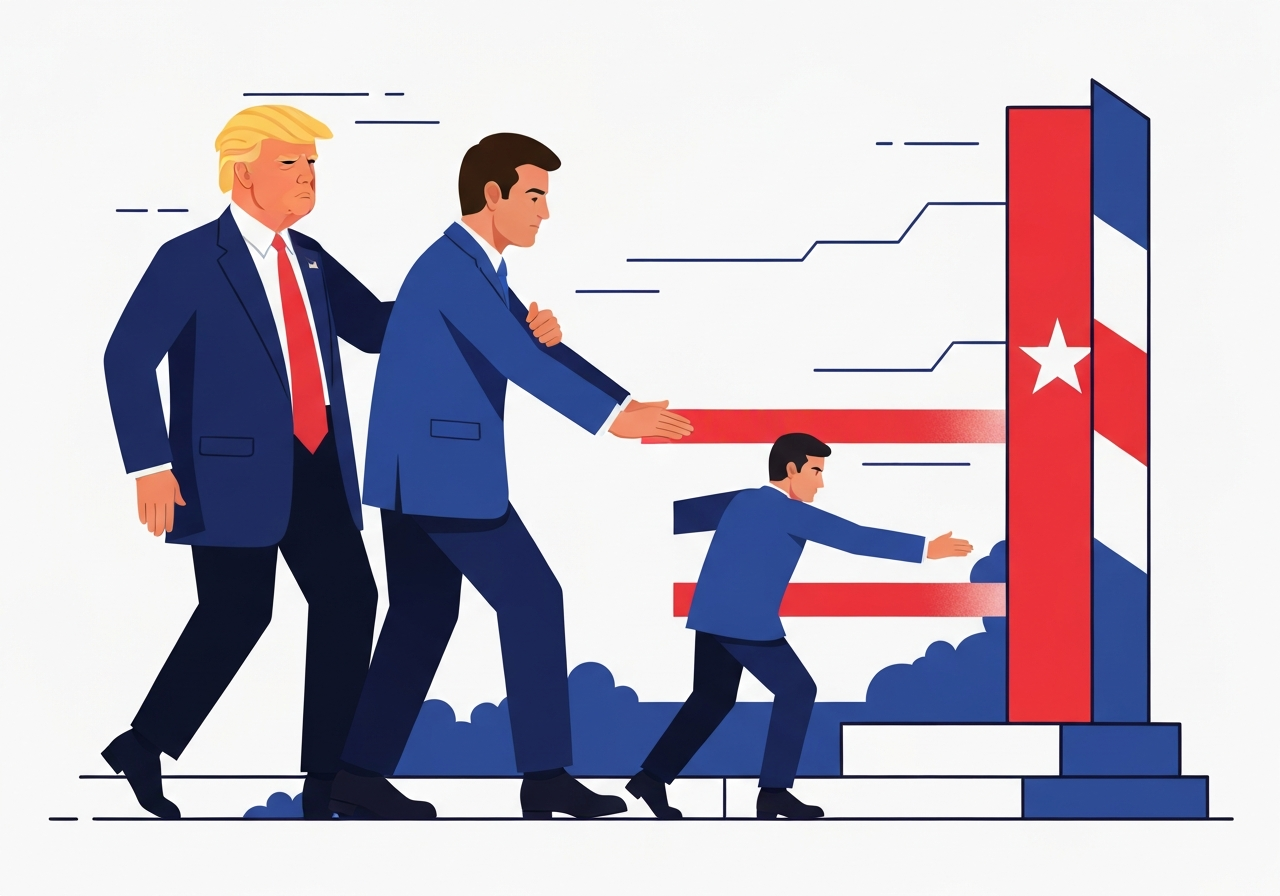
In the early hours of Wednesday, a speedboat carrying 10 Cuban exiles approached the Cuban coast after apparently departing from Florida and was intercepted by a Cuban coastguard patrol boat. The encounter led to an exchange of fire that left four people aboard the speedboat dead and six wounded. The Cuban government said the group intended an “infiltration with terrorist aims” and reported that passengers wore camouflage and carried assault rifles, explosives and ballistic vests. US Secretary of State Marco Rubio said Washington will conduct an independent inquiry, insisted the incursion was not a US government operation and signaled the US remains ready to act once the facts are clear.
Key takeaways
- Ten Cuban exiles in a US-registered speedboat were intercepted by Cuban coastguard forces early Wednesday; four were killed and six injured during a reported shootout.
- Cuba alleges the group carried assault rifles, explosives and ballistic vests and framed the approach as an attempted infiltration with terrorist objectives.
- US Secretary of State Marco Rubio said the United States will investigate, denied official US involvement and described the incident as highly unusual at sea.
- The episode heightened already intense US–Cuba tensions driven by recent US policy moves, including restrictions on oil and other pressure measures that Havana says have worsened shortages.
- The US has labeled Cuba an extraordinary threat and, according to statements cited by Washington, alleges growing security ties between Cuba and states like Russia and China.
- Historic grievances — from the 1959 revolution to the Bay of Pigs and the 1962 missile crisis — continue to shape mutual distrust and policy choices today.
Background
Relations between Washington and Havana have been defined by longstanding hostility dating to the 1959 Cuban revolution. After Fidel Castro’s overthrow of the US-backed Batista regime, Cuba nationalized US assets and aligned with the Soviet Union, a trajectory that produced the failed Bay of Pigs invasion in 1961 and the Cuban Missile Crisis in 1962. Those events created the Cold War architecture that still informs policymaking and public attitudes on both sides.
Over recent decades US policy toward Cuba has oscillated. A cautious thaw began under President Barack Obama, but subsequent administrations tightened restrictions. The current US posture — intensified under President Trump’s return to office and under the influence of Secretary of State Marco Rubio, according to political accounts cited in media coverage — has included tighter sanctions, limits on trade and targeted measures on fuel shipments. Havana says those measures have deepened shortages of power and fuel and strained essential services.
At the same time, Washington has framed Cuba as a security concern, alleging that the island hosts foreign intelligence facilities and maintains ties with actors Washington calls hostile. Cuban officials reject many of those characterizations and point to the US embargo and recent punitive measures as drivers of the island’s economic distress. United Nations commentary cited in recent reporting warned of a potential humanitarian collapse linked to acute fuel and power shortages that disrupt refrigeration, water supply and medical services.
Main event
According to Cuban authorities, a US-registered speedboat carrying 10 men approached the Cuban shoreline in the predawn hours of Wednesday after leaving Florida. A Cuban coastguard patrol intercepted the vessel and, by official account, gunfire broke out during the interception. Cuban state statements reported four fatalities and six wounded among those aboard the speedboat. Cuban officials described the passengers as wearing camouflage and carrying weapons and explosives.
The Cuban government framed the action as a thwarted infiltration with terrorist aims, releasing details about the equipment found aboard and emphasizing the security threat. Cuban state media and ministry statements said the operation was stopped before it could reach the coast. Independent verification of some of those details is not yet available publicly.
In Washington, Secretary of State Marco Rubio said the United States would launch its own investigation into the incident, stressed that it was not an official US operation and denied involvement of US government personnel. Rubio called such shootouts at sea highly unusual and said the US would be prepared to respond appropriately once it had established the facts. His comments underscore the diplomatic sensitivity of any cross-border maritime incidents involving US-registered vessels.
Analysis & implications
The shooting amplified an already fraught bilateral relationship. If Cuban accounts are accurate, the incident suggests a small, armed group chose a high-risk maritime approach despite intense scrutiny of departures from Florida. For Havana, the event provides a security justification for tougher internal controls and for pressing international audiences about alleged external threats.
For Washington, the episode presents a diplomatic dilemma: the need to investigate claims tied to a US-registered vessel while avoiding escalation with Havana. Rubio’s public denial of US involvement aims to limit bilateral fallout, but the accusation itself complicates US messaging, particularly among Cuban-American constituencies and regional partners.
Economically, the incident arrives against a backdrop of fuel shortages Cuba attributes in part to US pressure and actions affecting Venezuela’s oil relationship with Havana. Interruptions of fuel and electricity have tangible humanitarian effects and can intensify social pressure on the Cuban government — a dynamic US policy makers say justifies pressure, while Cuban officials say it amounts to coercion that punishes ordinary citizens.
Regionally, the episode risks encouraging further securitized responses. Neighboring states and maritime authorities may increase patrols or tighten monitoring of small craft traffic. If allegations of foreign intelligence facilities or deeper ties with outside powers are pressed without public evidence, diplomatic mistrust could harden and reduce space for negotiated de-escalation.
Comparison & data
| Year/Period | Event | Impact |
|---|---|---|
| 1959 | Cuban Revolution | Overthrow of Batista; long-term US–Cuba rupture begins |
| 1961 | Bay of Pigs | Failed US-backed invasion; increased Cuban–Soviet ties |
| 1962 | Cuban Missile Crisis | Near-nuclear confrontation; US embargo legacy |
| End of January | US national emergency declared (as reported) | Heightened US legal posture toward Cuba |
The table highlights milestone moments that shape contemporary policy choices. The recent designation of Cuba as an extraordinary threat, together with tightened measures on oil and trade, forms the immediate context for the maritime incident. Quantitative measures such as the number of reported outages or specific volumes of oil disrupted are part of official claims but vary by source; independent verification will be needed to translate those claims into comparable data points.
Reactions & quotes
US reaction centered on an offer to investigate and a firm denial of official involvement, while Cuban authorities stressed a security narrative that framed the approach as hostile. Public responses from Cuban-American communities and regional governments are evolving as details emerge.
“It was highly unusual to see shootouts in open sea like that,”
Marco Rubio, US Secretary of State
Rubio used the phrase to underline both concern and distance from the operation. His office said the United States would seek facts and that no government personnel were involved, a statement intended to reduce immediate bilateral escalation while keeping investigative options open.
“An infiltration with terrorist aims,”
Cuban government statement
Cuban officials framed the interception as a defensive action that prevented a planned attack. That description bolsters Havana’s argument for strict security measures and international sympathy for its response, but it relies on claims that independent observers have not yet fully corroborated.
“If the Cuban people are suffering, it is because the regime is standing in the way of help,”
Marco Rubio (public remarks)
This statement reflects the policy logic used by some US officials to justify pressure: that restrictive measures should be conditional on political and economic liberalization. Critics say such an approach risks deepening humanitarian pain without producing political change.
Unconfirmed
- Whether the group aboard the speedboat had operational links to organized terrorist groups; no corroborated intelligence publicly confirms such affiliations.
- Independent verification that all items described by Cuban officials (explosives, ballistic vests) were present and operational remains pending.
- Precise origin details linking the departure to specific individuals or organizations in Florida beyond the vessel’s reported point of origin are not yet publicly established.
- Claims in some reporting that Venezuelan President Nicolas Maduro was captured by US forces in January are not independently verified here and remain unconfirmed.
Bottom line
The maritime shooting involving a US-registered speedboat and the Cuban coastguard has intensified a tense bilateral relationship already strained by sanctions, fuel restrictions and historic grievances. Cuban authorities present the interception as a security success that validates heightened defensive measures; US officials have pledged an independent probe while denying state involvement. The incident therefore becomes both a factual event requiring immediate investigation and a political symbol that each side may use to justify policy positions.
What matters next is verification: transparent, independent inquiries into the vessel’s manifest, chain of custody, and any external ties will determine whether this episode is a criminalized attempt at violent infiltration, a misadventure by nonstate actors, or something more complex. Policymakers in Washington and Havana face a narrow window to prevent escalation and to manage the humanitarian and diplomatic fallout that follows.