
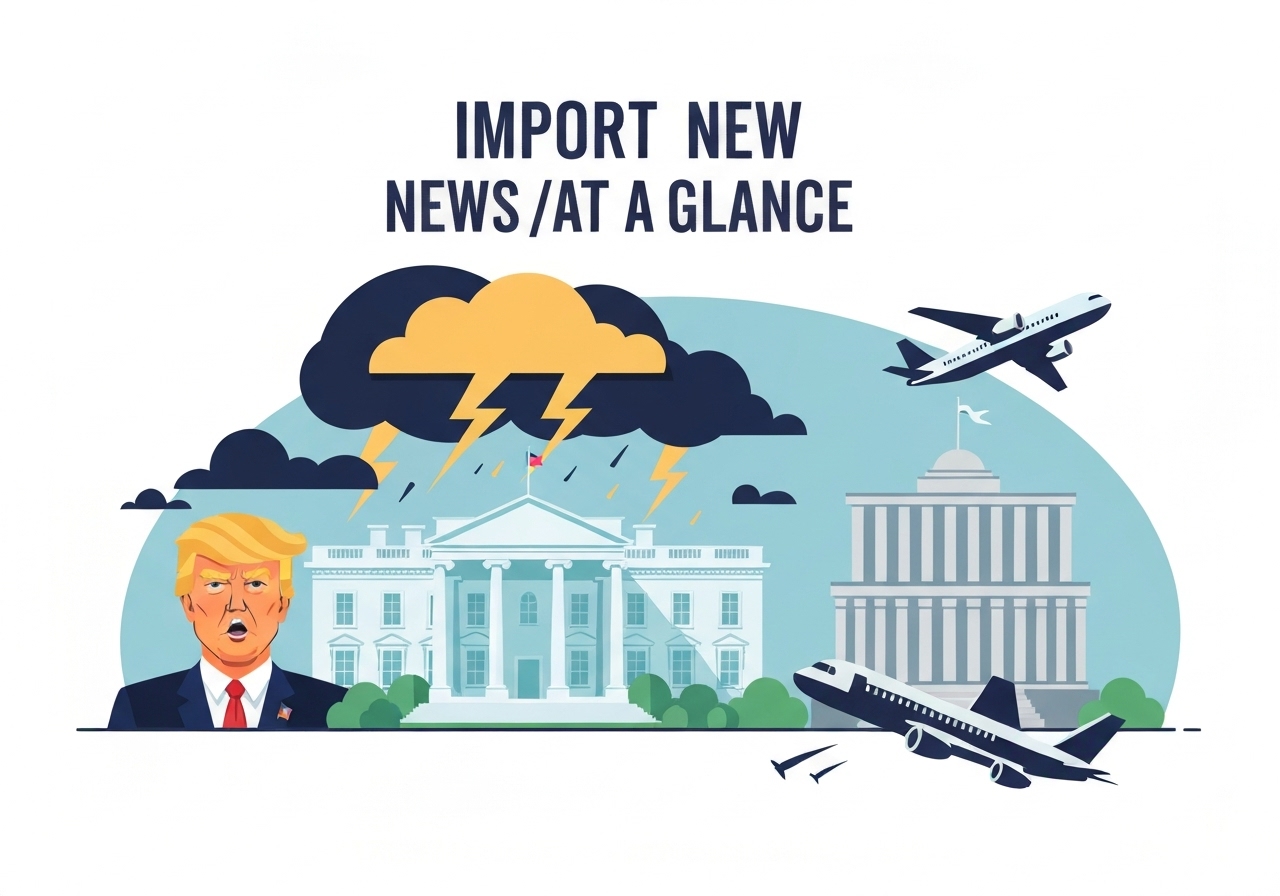
President Donald Trump on Saturday urged Senate Republicans to redirect the federal funds that now subsidize premiums under the Affordable Care Act toward direct payments to individuals, a proposal he framed as an alternative to Obamacare as the US government entered its 39th day of a partial shutdown. His call came as senators met over the weekend and Republican lawmakers began to debate proposals that could unravel the ACA, even as practical and political obstacles — including the continued role of private insurers and the need for Democratic votes to reopen government — remained apparent. At the same time, US airlines reported 1,460 flight cancellations on the second day of cuts tied to the shutdown, deepening strains at major airports as the disruption enters the Thanksgiving travel period. Several other developments were reported over the same 24 hours, from tariff petitions by industry groups to reports about a proposed stadium name and a disputed aircraft purchase involving a federal official.
Key takeaways
- President Trump urged Senate Republicans to shift “hundreds of billions” in ACA subsidies into direct payments for individuals; he presented the measure as a way for people to buy private coverage and keep leftover funds.
- Senators met on the 39th day of the federal shutdown; some Republicans — including Lindsey Graham, Rick Scott and Bill Cassidy — publicly welcomed the idea, though it faces major political barriers.
- US carriers canceled 1,460 flights on the second day of shutdown-related schedule reductions, a disruption officials warn could worsen as Thanksgiving approaches.
- Republican efforts to repeal or replace the ACA would require at least eight Democratic votes to reopen the government under current procedural math, making bipartisan agreement difficult.
- Business groups asked the Commerce Department to add roughly 700 items to a previous list of 407 products subject to steel-related tariffs, raising concern in Europe about expanding levies.
- Reports said Donald Trump pushed for the Washington NFL stadium — a $3.7bn project — to carry his name; sources described the effort as informal and ongoing.
- Entertainment news: Olivia Rodrigo publicly criticized the administration after one of her songs was used in an immigration-related social media clip posted by official accounts.
Background
The partial federal shutdown began more than a month ago and by the weekend had become the longest in modern US history, prolonging furloughs for many federal employees and straining services tied to the federal workforce. Major strands of the standoff include funding for border security, but debate has broadened to encompass healthcare policy and broader fiscal priorities for Republicans in Congress. The Affordable Care Act, enacted in 2010, remains politically divisive: Republicans have long sought to repeal or replace it, but past attempts produced mixed outcomes and left millions reliant on its subsidies and protections.
Health-policy funding at the center of this weekend’s news involves payments that reduce consumers’ out-of-pocket costs and keep premiums lower for some enrollees; Trump’s suggestion was to take those federal dollars and give them directly to individuals instead. Policymakers and analysts immediately flagged practical issues: people would still typically need to purchase plans sold by private insurers; reworking the subsidy architecture would require statutory changes and likely bipartisan support to avoid worsening coverage gaps. Meanwhile, the logistics of air travel and federal oversight are entangled with the shutdown because staffing and air-traffic management decisions involve agencies affected by funding gaps.
Main event
On Saturday President Trump posted a recommendation to Senate Republicans that funds currently used to subsidize health insurance under the ACA be redirected into direct payments so people could buy private plans. He framed the proposal as returning agency and money to individuals, arguing that it would let consumers purchase better coverage and retain leftover funds. The post repeated the administration’s longer-standing criticism of the ACA while proposing a market-based alternative, but it did not include legislative language or a ready mechanism for immediate implementation.
Senators convened on day 39 of the shutdown and began to negotiate earnestly for the first weekend session since the impasse began. Republican senators including Lindsey Graham (SC), Rick Scott (FL) and Bill Cassidy (LA) signaled public curiosity or support for the president’s idea, but Democratic senators uniformly treated the proposal as a nonstarter because it would effectively dismantle core ACA protections and likely increase costs for many patients. Legislative strategists noted that even if Republicans coalesced around an approach, reopening the government in the near term still requires the support of at least eight Democrats to meet the votes needed in certain procedural steps.
Federal oversight and operational effects of the shutdown showed up in transportation: US carriers cut routes under a government-mandated reduction plan and reported 1,460 cancellations on the second day of the schedule changes. Airport managers said the initial slowdown had not yet produced systemwide meltdown, but analysts warned that cancellations and delays could accelerate and ripple outward into goods movement and holiday travel, magnifying the economic toll. Airline executives and regulators have said contingency measures are in place, but the risk rises if staffing or safety oversight is impaired by prolonged funding gaps.
Analysis & implications
Politically, the president’s call to reroute ACA subsidies into direct payments highlights a longstanding Republican tension: how to market market-oriented fixes without stripping guarantees that Democrats and many voters value. Redirecting “hundreds of billions” would require major statutory revision and would touch complex issues such as risk pooling, guaranteed issue (insurers’ obligation to accept applicants), and subsidies tied to income. Without a bipartisan framework that protects vulnerable enrollees, such a change could increase uninsured rates or premium volatility in many markets.
Practically, even generous direct payments do not obviate the need for insurers: individuals typically obtain coverage through private plans, and the administrative apparatus for underwriting, provider networks and claims processing would remain intact. Transition costs, regulatory redesign, and likely litigation make any rapid overhaul improbable while a shutdown remains politically fraught. Additionally, the president’s plan — as presented — lacks the technical scaffolding (legislative text, regulatory guidance, transition timetables) necessary for immediate enactment.
On the economic side, flight cancellations and operational cuts show how a political impasse can produce near-term friction in transportation and commerce. The reported 1,460 canceled flights on day two of the mandated reductions are a measurable hit to mobility and could increase business and consumer costs if the pattern intensifies toward Thanksgiving. The potential expansion of tariffs to hundreds more products would compound business uncertainty: companies facing new levies could raise prices, shift supply chains, or absorb costs, affecting both US producers and trading partners in Europe and Asia.
Comparison & data
| Metric | Value |
|---|---|
| Shutdown day | 39 |
| Flights canceled (day 2 of cuts) | 1,460 |
| Proposed stadium cost | $3.7bn |
| Additional tariff items requested | ~700 |
The table summarizes the key numeric touchpoints in this story: the duration of the federal shutdown (39 days), the immediate operational impact in aviation (1,460 canceled flights reported on the second day of cuts), the reported $3.7bn price tag for the proposed Washington stadium, and an industry request to add roughly 700 items to an existing list of 407 products targeted for steel-related tariffs. Together these figures illustrate the story’s political, operational and economic dimensions and why stakeholders in different sectors are watching the standoff closely.
Reactions & quotes
Republican senators who met on the weekend expressed interest in the president’s framing while acknowledging the proposal’s political and technical hurdles. Their statements emphasized openness to alternatives but stopped short of committing to specific statutory changes.
“We should explore options that expand consumer choice, but details matter and legislation will be required.”
Senate Republicans (public statements)
Healthcare advocates and Democratic leaders reacted by stressing the risks of weakening guaranteed coverage and the unlikelihood of endorsing a plan that effectively undoes the ACA. They framed the proposal as politically polarizing and warned about consequences for people with pre-existing conditions.
“Proposals that dismantle protections and shift costs to individuals would threaten coverage for millions and are unacceptable without strong safeguards.”
Democratic senators and health advocates (statements)
On cultural and administrative fronts, entertainers and officials weighed in when a popular song was used in an immigration-focused clip posted to official social channels; the artist publicly objected to the use. Separately, reporting about a cabinet-level official authorizing an aircraft purchase that reportedly lacked engines prompted scrutiny of procurement practices and oversight during the shutdown.
“Artists and creators expect their work not to be repurposed for political messaging without consent.”
Olivia Rodrigo (public reaction)
Unconfirmed
- Reports that President Trump is actively pressing to name the planned $3.7bn Washington stadium after himself are based on sources familiar with discussions and have not been independently verified.
- Accounts that the Department of Homeland Security secretary authorized the purchase of Spirit Airlines aircraft that lacked engines come via reporting described as preliminary and have not been corroborated by public procurement records released to date.
Bottom line
The president’s weekend bid to replace ACA subsidies with direct payments crystallizes an ideological divide but faces steep political and technical barriers; it is unlikely to produce an immediate legislative fix to end the shutdown. Even if Republicans rally around the idea, statutory changes required to implement such a transformation would be complex, contentious and time-consuming, and would probably require concessions or safeguards to attract bipartisan support.
Operationally, the shutdown is already producing tangible effects: 1,460 canceled flights on the second day of mandated cuts show that the political standoff has measurable consequences for travel and commerce, and disruptions could grow as holiday demand rises. For readers, the most important near-term developments to watch are whether Senate negotiations yield a short-term funding agreement to reopen the government, how lawmakers address healthcare funding technically, and whether airline cancellations escalate into broader economic damage ahead of Thanksgiving.