
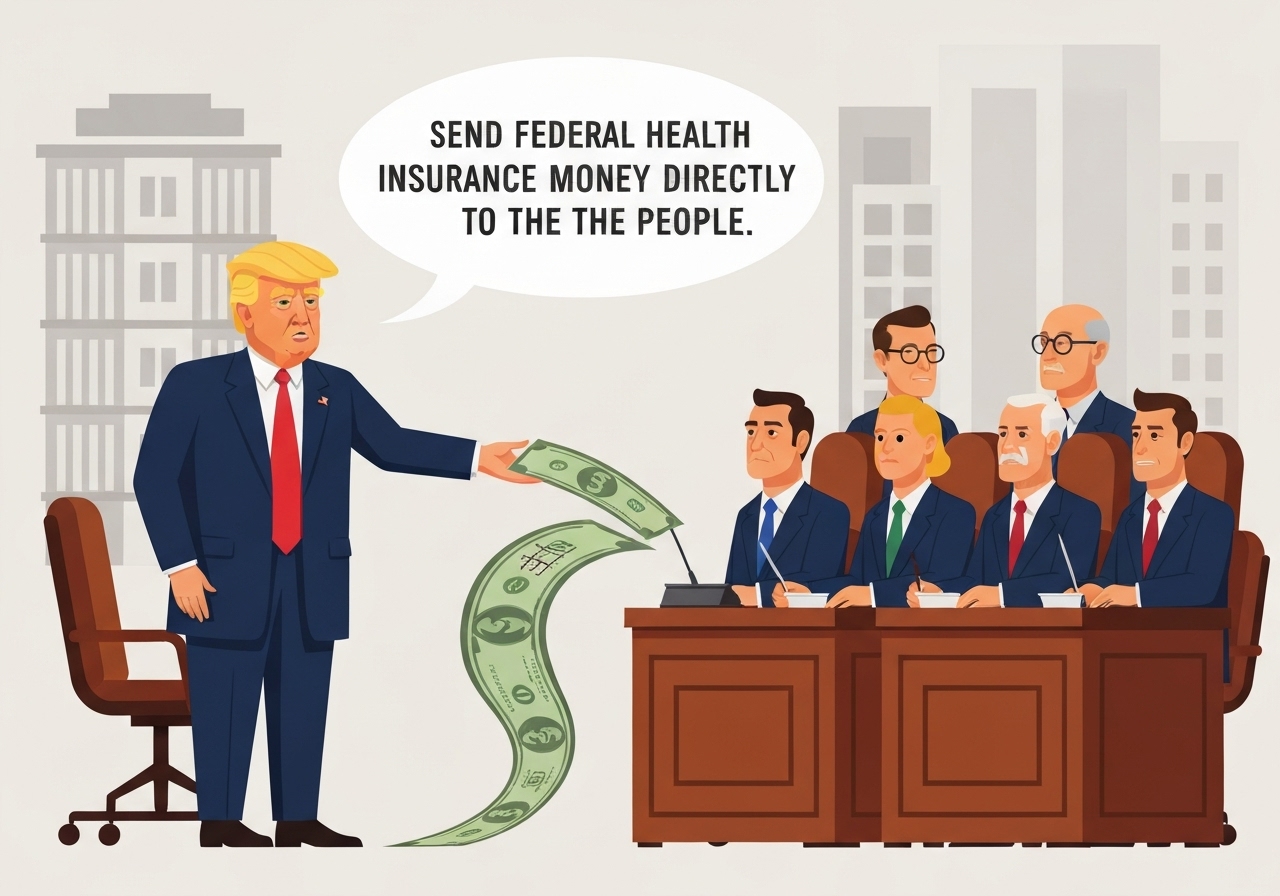
Lead: President Donald Trump on Saturday proposed that federal payments now routed to insurers under the Affordable Care Act be sent straight to Americans, an idea he posted on Truth Social as lawmakers remained deadlocked over a government funding fight. The proposal arrived a day after Senate Republicans rejected a short-term deal from Democratic leader Chuck Schumer that would have reopened the government. The federal shutdown, which began Oct. 1, 2025, has become the longest in U.S. history, and key ACA subsidies are set to lapse at the end of December for tens of millions of beneficiaries.
Key Takeaways
- Trump recommended that “hundreds of billions of dollars” that currently go to insurers under Obamacare be redirected as direct payments to individuals, though he provided no implementation details.
- The suggestion appeared on Truth Social on Saturday, Nov. 8, 2025, one day after Senate Republicans blocked a Schumer-led proposal to reopen government funding.
- The shutdown began on Oct. 1, 2025; it is now the longest U.S. federal shutdown on record and continues to disrupt services and pay for federal workers.
- Federal ACA subsidies, which more than 20 million Americans currently use, will expire at the end of December unless Congress acts; Democrats say about 24 million people would be affected by changes in subsidy policy.
- Senate Republicans, including Majority Leader John Thune (R-S.D.), called the Democrats’ temporary subsidy-protection proposal a “non-starter.”
- Trump also urged ending the Senate filibuster, a move that would require GOP unity (they hold 53 seats) to change the 60-vote threshold for most legislation.
- The White House had not provided a formal explanation of how the proposed direct-payment plan would operate as of the publication of this article.
Background
Congress has been unable to pass a funding measure since Oct. 1, 2025, triggering a partial government shutdown that has affected agencies, federal contractors and workers. Lawmakers remain divided: Democrats insist that any stopgap bill include protections for Affordable Care Act (ACA) premium subsidies, while many Republicans want a clean continuing resolution to reopen government first.
The ACA premium tax credits, expanded in prior years, currently help millions afford marketplace coverage. Policymakers and analysts disagree on whether redirecting insurer-bound funds into direct payments could replicate current subsidy structures and maintain coverage levels or cost controls. Previous attempts to alter ACA funding and marketplace design have run into legal, administrative and partisan obstacles.
Main Event
On Saturday, President Trump posted a proposal on Truth Social recommending that the federal funds now paid to insurance companies under the ACA be delivered directly to individuals so they could buy private coverage. He characterized the current flows as money being sent to “money sucking Insurance Companies” and said direct payments would allow people to buy “much better” plans, though he did not supply calculations or a legislative path.
The timing was notable: the post came a day after Senate Republicans rejected a Schumer-backed compromise intended to reopen the government. Schumer’s plan would have preserved ACA subsidies for at least one year in exchange for Democrats dropping a demand for a longer-term extension in the immediate funding bill.
Senate Majority Leader John Thune called the Democrats’ Friday proposal a “non-starter,” reflecting GOP resistance to linking funding for other priorities to a continuing resolution. Senate arithmetic complicates unilateral action: Republicans hold 53 seats, Democrats 45 plus two independents who caucus with them, and the filibuster typically requires 60 votes for major measures.
The White House did not immediately provide details on how the direct-payment idea would work, and offices for leading lawmakers had not given formal responses at the time of reporting. Congressional aides and budget analysts noted there are legal and logistical hurdles to converting insurer payments into individual cash transfers under existing statutes.
Analysis & Implications
Operationally, routing existing ACA subsidy flows directly to individuals would require statutory changes, regulatory adjustments and new administrative systems at the Treasury and Health and Human Services. Current premium tax credit calculations depend on income verification, plan selection and marketplace mechanics that do not translate easily into a flat cash payment without risking gaps in coverage or affordability.
Financially, Trump’s mention of “hundreds of billions” implies a scale of reallocation that would affect federal budgets and insurer revenues. If enacted, such a shift could disrupt insurer rate-setting, provider contracts and marketplace stability, possibly prompting narrower networks or premium spikes if safeguards are not included.
Politically, the proposal appears aimed at pressuring Senate Republicans by offering a headline alternative while also pushing for filibuster reform. Changing the filibuster would be a consequential move: Republicans control 53 seats and would need to replace or alter Senate rules to pass sweeping ACA reforms without bipartisan support.
Internationally and economically, prolonged uncertainty over subsidies and the shutdown could affect markets and healthcare access for millions. Insurers and state marketplace administrators have warned that abrupt policy reversals or funding gaps could increase premiums and administrative churn ahead of open enrollment periods.
Comparison & Data
| Metric | Value |
|---|---|
| Shutdown start | Oct. 1, 2025 |
| Shutdown status | Longest in U.S. history (ongoing) |
| ACA subsidy users (reported) | More than 20 million |
| Democrats’ figure for affected | 24 million |
| Senate composition | Republicans 53, Democrats 45 + 2 independents |
The table highlights the core numerical facts shaping negotiations: the shutdown timeline, the scale of subsidy reliance, and the Senate math that governs legislative options. Analysts caution that headline numbers—”hundreds of billions”—need specification to evaluate fiscal impact, and that 20–24 million estimates reflect slightly different reporting or policy scopes.
Reactions & Quotes
“I am recommending … that the Hundreds of Billions of Dollars currently being sent to money sucking Insurance Companies … BE SENT DIRECTLY TO THE PEOPLE,”
President Donald Trump (Truth Social post)
This excerpt reflects the president’s core proposal, though the post did not detail mechanisms or legislative steps.
“The Democrats’ proposal is a non-starter,”
Sen. John Thune (R-S.D.)
Sen. Thune’s comment signaled continuing GOP opposition to tying a funding stopgap to longer-term subsidy guarantees.
“Protecting subsidies in any short-term bill is central to preventing coverage losses at year-end,”
Sen. Chuck Schumer (D-N.Y.)
Schumer framed the dispute as an effort to preserve marketplace affordability for millions if Congress fails to act before December.
Unconfirmed
- No official cost estimate or legal pathway for redirecting insurer-bound ACA funds into direct payments has been released; the president’s “hundreds of billions” figure is not itemized.
- It is unconfirmed whether direct payments would preserve current income-based targeting and protections that prevent higher-income individuals from receiving excessive subsidies.
- There is no confirmed plan for how coverage continuity, network adequacy or insurer solvency would be safeguarded under the proposed approach.
Bottom Line
President Trump’s proposal to send ACA-related federal payments directly to individuals reframes the subsidy debate but lacks operational detail. Without a legislative roadmap, cost breakdown or administrative design, the idea remains a high-level political proposition rather than an actionable policy alternative.
Practically, preserving coverage for those who rely on ACA subsidies requires either a short-term congressional fix or a clearly articulated replacement mechanism that maintains affordability and continuity. The ongoing impasse in Congress and the Senate’s current rules mean that any substantive change will face major procedural and political hurdles in the coming weeks.
Sources
- CNBC — News report on Trump’s Truth Social post and Senate reactions (media)
- Reuters — Photo and coverage related to White House announcements (media/photo)
- Office of Sen. John Thune — Official statements and Senate leadership information (official)
- Office of Sen. Chuck Schumer — Official statements and negotiating text references (official)