
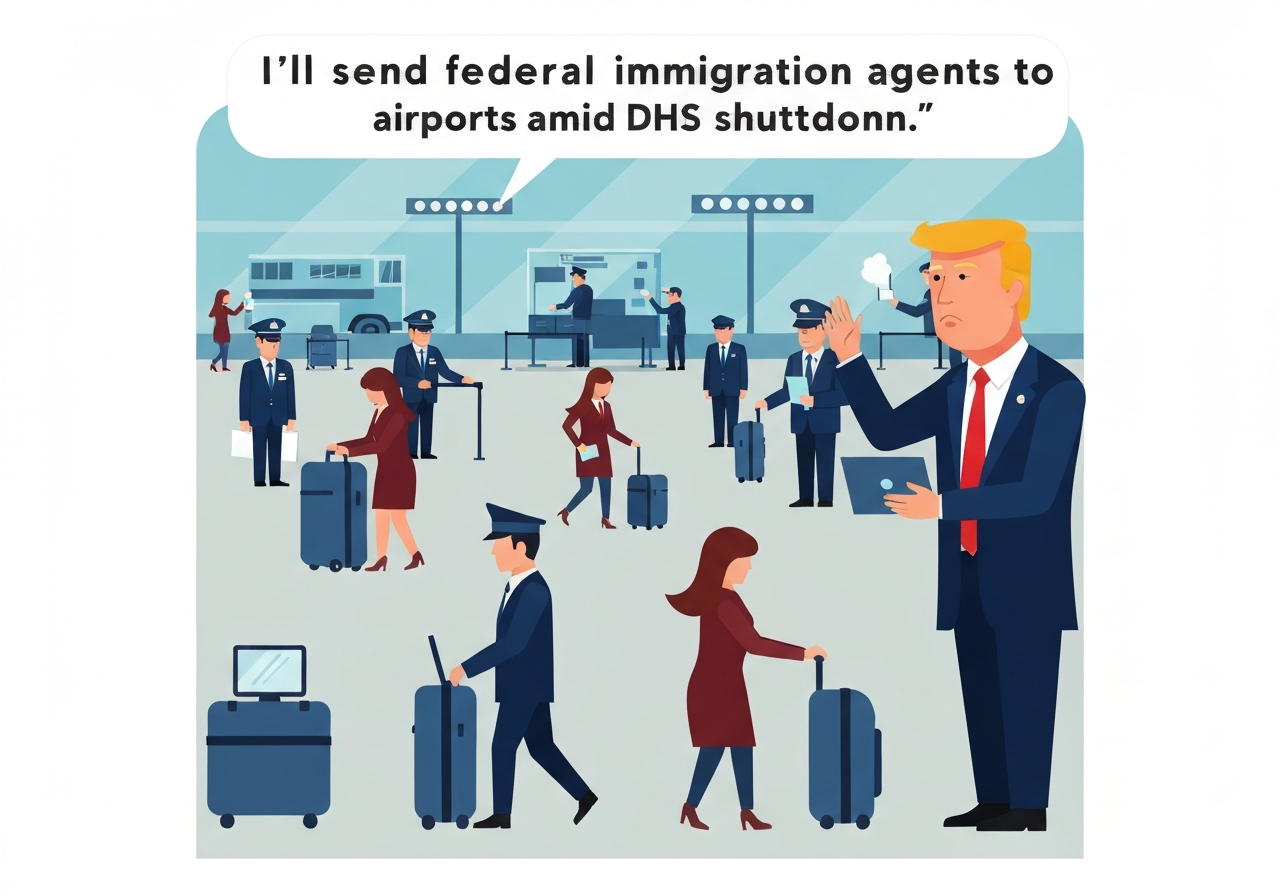
President Donald Trump on Saturday announced plans to deploy U.S. Immigration and Customs Enforcement (ICE) officers to airports nationwide on Monday as a standoff in Congress over Department of Homeland Security (DHS) funding continues. The move came after Senate Republicans blocked a Democratic bid to pass a standalone bill to fund the Transportation Security Administration (TSA) in a 41-49 vote, and a broader impasse left parts of DHS operating without full appropriations since mid-February. Trump framed the deployment as a response to mounting airport lines and unpaid TSA workers, telling followers on his platform that ICE should “GET READY.” Lawmakers from both parties disputed responsibility for the disruption as negotiations continued on Capitol Hill.
Key Takeaways
- President Trump said on Saturday he will order ICE agents to airports on Monday to provide security amid a partial DHS funding lapse.
- Senate Republicans blocked a Democratic measure to fund TSA in a 41-49 vote on Saturday, prolonging the partial shutdown that began in mid-February.
- The partial DHS shutdown has left many TSA officers unpaid, triggering mass callouts and prolonged airport security lines nationwide.
- ICE is not constrained by the shutdown: it received roughly $75 billion in additional funding last year under the administration’s major legislative package.
- Democrats have conditioned a DHS funding deal on new oversight measures for ICE, including visible identification and limits on face coverings.
- Two civilian deaths in Minnesota in January during an immigration enforcement action helped drive Democrats’ demand for reforms to ICE operations.
- Senators from both parties have proposed compromises such as body cameras, training enhancements and restricted enforcement in sensitive locations; negotiators say talks have renewed energy this week.
Background
The partial lapse in DHS funding began in mid-February after Senate votes failed to produce a bipartisan agreement. TSA — the agency responsible for passenger and baggage screening at U.S. airports — has been operating amid staffing shortages and unpaid workers, which has led to longer lines and operational strain at major airports. Republicans in the Senate have resisted a standalone funding bill for TSA unless broader ICE funding and policy changes remain in play, while Democrats have pushed for enforceable reforms to immigration enforcement as the price of reopening DHS funds.
Tensions escalated after an aggressive federal immigration operation in Minnesota in January that resulted in two civilian deaths, Renee Good and Alex Pretti, intensified calls among Democrats for tighter controls on ICE tactics. That event helped shape Democrats’ demands this month for measures such as visible agent identification, bans on face coverings during operations, and greater transparency. Meanwhile, ICE’s budget was bolstered last year when the administration secured about $75 billion in additional appropriations through a large legislative package, leaving the agency currently funded despite the partial DHS shutdown.
Main Event
On Saturday, President Trump posted a pair of messages on his social platform threatening to send ICE agents to airports if Democrats did not accept terms he described as necessary to keep “our Airports…FREE and SAFE again.” Later the same day he reiterated that ICE should “GET READY” to deploy on Monday. The statements followed a failed Saturday Senate roll call in which Republicans blocked a Democratic proposal to fund TSA as a standalone bill by a 41-49 margin.
Sen. Patty Murray, D-Wash., one of the lead Democratic negotiators on DHS, accused Republicans of linking TSA pay to additional funding and flexibility for ICE. She argued that Republicans were refusing to pay TSA workers while insisting on provisions to expand or protect ICE operations without reforms. Senate Republican leaders countered that Democrats bear responsibility for prolonging the disruption by refusing to accept compromises tied to agency-wide funding.
Negotiators from both parties have discussed a range of potential concessions this week. Sen. John Hoeven, R-N.D., described offers that included body cameras for agents, expanded training, and restrictions on arrests in sensitive places like hospitals, churches and schools. Separately, Trump’s homeland security nominee moves continued: the president has said Secretary Kristi Noem would step down at the end of March and that Sen. Markwayne Mullin, R-Okla., is the expected nominee to lead DHS.
Analysis & Implications
Operationally, deploying ICE to airports is likely to complicate an already strained security environment. TSA officers handle checkpoint screening and passenger processing; ICE focuses on immigration enforcement and has different mandates and legal authorities. Introducing a federal immigration presence into terminals could shift resource allocation, change passenger workflows, and raise legal and jurisdictional questions about who conducts which functions at checkpoints.
Politically, the announcement is aimed at increasing leverage for Republicans in stalled funding talks. By promising a visible law-enforcement response to heightened lines, the administration seeks to place pressure on Democrats to accept negotiable items tied to ICE. Democrats, however, have signaled that they will not trade immediate TSA pay and staffing for expanded ICE authority without enforceable oversight and operational limits.
There are also potential legal and liability risks. Airports are complex jurisdictional environments with local, state and federal actors; adding ICE to checkpoint operations may spark litigation over authority, civil liberties and the scope of enforcement in sensitive locations. That prospect could intensify demands from advocates and some lawmakers for statutory guardrails on ICE activity, which Democrats are already pushing in funding talks.
Comparison & Data
| Item | Detail |
|---|---|
| Senate vote on standalone TSA funding | 41-49 against Democrats’ measure (Saturday) |
| DHS funding status | Partial shutdown since mid-February |
| ICE supplemental funding | ~$75 billion added in last year’s legislative package |
The table highlights the core numerical facts shaping the current standoff: the narrow Senate vote that kept TSA from receiving a standalone appropriation, the timing of the partial DHS shutdown, and the substantial supplemental resources ICE secured previously. Those figures frame both the operational gaps at airports and the bargaining space for negotiators on Capitol Hill.
Reactions & Quotes
Senate leaders offered contrasting public diagnoses of the causes and cures for the disruptions at airports. Republican leaders blamed Democrats for blocking full DHS funding; Democrats said Republicans were holding TSA pay hostage to unrelated ICE priorities. Below are representative remarks made on the Senate floor and in public statements.
“The situation at U.S. airports continues to worsen thanks to Democrats’ refusal to fund the Department of Homeland Security.”
Sen. John Thune (R-S.D.), Senate Republican leader
Thune framed the gridlock as a Democratic obstruction that has forced Homeland Security employees to work without pay and worsened airport operations. His remarks were part of an argument that immediate funding would ease lines and staffing shortages.
“It is unacceptable for workers and travelers in entire airports to get taken hostage in political games.”
Sen. Chuck Schumer (D-N.Y.), Senate Democratic leader
Schumer accused Republicans of attaching TSA funding to expanded ICE funding without reforms, insisting Democrats want TSA workers paid immediately and without strings. His comment underscores the Democratic insistence on oversight measures for ICE as part of any broader DHS settlement.
“We’ve offered body cams, more training, limiting arrests for sensitive areas like churches and hospitals…I think the Democrats need to come back to us now.”
Sen. John Hoeven (R-N.D.), Republican negotiator
Hoeven summarized some Republican bargaining points intended to narrow differences, pointing to a list of specific operational reforms offered to Democrats during recent talks.
Unconfirmed
- Whether ICE agents will perform traditional TSA screening functions if deployed on Monday remains unclear; official operational orders have not been publicly released.
- The immediate impact on airport wait times and legal exposure from an ICE deployment is speculative until detailed deployment plans and jurisdictional arrangements are disclosed.
Bottom Line
The president’s announcement to move ICE to airports is a high-stakes political maneuver layered atop a practical personnel and funding crisis at the Transportation Security Administration. It signals an attempt to shift public attention and bargaining leverage toward demands tied to immigration enforcement, even as essential aviation screening work has been disrupted by unpaid TSA staff and longer lines for travelers.
Resolution depends on bipartisan movement in the Senate to decouple immediate TSA payroll and staffing fixes from broader ICE policy fights or to craft enforceable reforms that can win cross-party support. In the near term, travelers and airport operators should expect continued uncertainty as lawmakers negotiate and as officials determine whether and how any ICE deployment would be operationalized.
Sources
- NBC News — news reporting on the president’s statements and Senate votes