
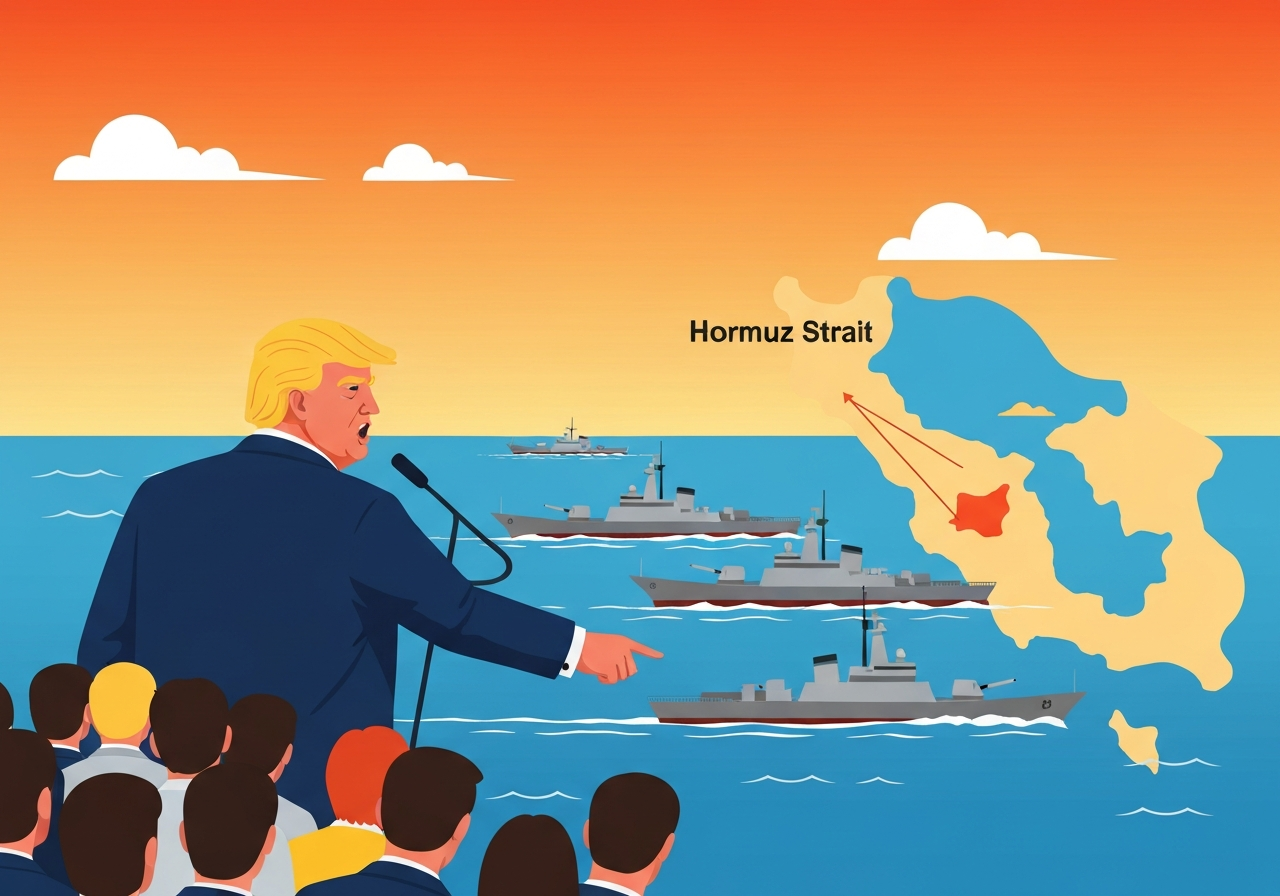
U.S. President Donald Trump intensified calls to reopen the Strait of Hormuz on March 14, urging allied and partner countries to deploy warships near Iran’s coast so commercial vessels can transit safely. He posted the appeal on Truth Social and used the word “hopefully” when describing the expected arrival of naval forces, without offering a timeline. The statement came hours after he ordered strikes on military sites on Kharg Island, a key export hub from which Iran ships almost all of its oil. The moves further escalated a Middle East conflict that had persisted for more than two weeks.
Key Takeaways
- President Donald Trump publicly urged other countries to send naval vessels to the Strait of Hormuz on March 14, 2026; his post was made on Truth Social and did not specify dates.
- The appeal followed U.S. strikes on military targets on Kharg Island, the island through which Iran exports nearly all of its oil, contributing to heightened tensions.
- The confrontation is part of a broader Middle East war that has been active for over two weeks as of March 14, 2026, with no immediate sign of de-escalation.
- The Strait of Hormuz is a global chokepoint: roughly 20% of seaborne oil trade moves through the waterway, making any disruption economically significant.
- Trump framed the naval deployments as protective escorts to allow commercial shipping to transit near Iran’s coast safely, while not providing operational details or international commitments.
- There is no public confirmation from allied governments that they have agreed to station warships in the area as of the latest updates on March 14, 2026.
- The strikes on Kharg Island mark a notable expansion of U.S. military action in the region, targeting sites tied to Iran’s oil export infrastructure.
Background
The Strait of Hormuz runs between the Persian Gulf and the Gulf of Oman and is one of the world’s most critical maritime chokepoints. Analysts estimate roughly 20% of globally seaborne oil passes through the strait, so disruptions there can quickly ripple through energy markets and global supply chains. Iran has in past crises threatened to close the waterway in response to sanctions or military pressure, making any indication of naval escalation particularly sensitive.
Kharg Island, located off Iran’s southern coast, handles the bulk of Iran’s crude exports and associated port operations. Strikes on facilities there can impede exports and amplify economic and diplomatic fallout. The present confrontation follows a string of hostile incidents and strikes over recent weeks that have drawn in regional and external powers, increasing the risk of broader maritime confrontation and economic volatility.
Main Event
On March 14, 2026, President Trump used his Truth Social account to call for a multinational naval presence near Iran’s coast to ensure merchant vessels could pass through the Strait of Hormuz. He said warships would “hopefully” be sent to the area to protect commercial traffic, but he did not provide a timetable or list of participating countries. The post came shortly after the administration ordered precision strikes on Iranian military sites on Kharg Island earlier that day, an action the White House described as targeting military infrastructure.
The strikes on Kharg Island targeted facilities linked to Iran’s export and military logistics; media reporting indicates the island handles almost all of Iran’s crude shipments. U.S. officials framed the action as aimed at degrading Iranian military capabilities tied to recent attacks on commercial shipping and regional forces. Iranian state accounts condemned the strikes and warned of further consequences, raising the possibility of retaliatory steps that could affect commercial navigation in the Gulf.
Details about any immediate damage, casualties, or how the strikes affected oil flow from Kharg remain limited in publicly available reporting at the time of the latest update. Shipping companies were reported to be reviewing routing and insurance arrangements amid greater uncertainty, and some insurers have indicated higher premiums for transits in the region. Ports and operators that rely on Gulf oil shipments are monitoring developments closely for potential supply disruptions.
Analysis & Implications
Calling for allied warships to escort commercial vessels is both a military and diplomatic signal. Militarily, it aims to provide immediate protection to merchant shipping and deter attacks on neutral carriers. Diplomatically, the request tests the willingness of partner navies to be drawn into direct operations near Iranian territorial waters, which could complicate alliances and raise legal questions about rules of engagement in contested seas.
Economically, any sustained restriction or perceived risk to traffic through Hormuz would pressure global oil markets and refine product supply chains. Even temporary disruptions in the strait have in past episodes sent Brent oil prices higher and prompted stockpiling and rerouting that increase shipping costs. Given Kharg Island’s central role in Iran’s exports, strikes there could reduce Iranian shipments and tighten regional supply unless alternative export routes or compensating production are arranged.
Regionally, the request risks widening involvement in an already volatile conflict. Neighboring states must weigh the benefits of keeping sea lanes open against the political and military costs of operating near Iranian forces. For the U.S., any multinational naval operation would also carry the burden of coordinating rules of engagement, legal mandates, and clear political objectives to avoid inadvertent escalation.
Comparison & Data
| Metric | Typical Value / Context |
|---|---|
| Share of seaborne oil via Hormuz | Approximately 20% of global seaborne oil |
| Duration of current regional war | More than two weeks as of March 14, 2026 |
| Primary export hub targeted | Kharg Island — handles almost all of Iran’s oil exports |
The table above summarizes the immediate strategic parameters. Even a short-term reduction in capacity or a spike in transit risk tends to amplify oil-price volatility because refineries and traders have limited immediate alternatives for replacing Gulf supplies. That makes the stability of Hormuz a focal point for both energy markets and military planners.
Reactions & Quotes
Officials and observers offered swift reactions after the president’s call and the Kharg Island strikes, reflecting a mix of support, caution and alarm.
“Hopefully warships will be sent to ensure commercial traffic can pass safely,”
Donald Trump (Truth Social)
This short phrasing from the president framed the administration’s intent to mobilize allied naval resources but did not offer operational details or confirm partner commitments.
“The strike on Kharg Island targeted military sites linked to the current campaign,”
U.S. administration statement (reported)
The administration characterized the operations as narrowly focused on military infrastructure, aiming to disrupt capabilities believed to be contributing to attacks on shipping and regional forces.
“Any attempts to secure the strait must account for regional sovereignty and the risk of escalation,”
Regional diplomat (commenting on condition of anonymity)
Regional stakeholders emphasized the delicate balance between keeping trade routes open and avoiding actions that could widen the conflict.
Unconfirmed
- Which countries, if any, have formally agreed to send warships to the Strait of Hormuz remains unconfirmed as of the latest update on March 14, 2026.
- Casualty figures and the full extent of damage from the Kharg Island strikes have not been publicly verified by independent sources.
- Whether the strikes will materially reduce Iran’s export capacity in the medium term is not yet clear and depends on repair times and alternative routing.
Bottom Line
President Trump’s public call for allied warships to reopen the Strait of Hormuz escalates the maritime dimension of a conflict already more than two weeks old and follows U.S. strikes on Kharg Island, a key node in Iran’s oil exports. The request functions as both a practical measure to protect shipping and a political probe of international willingness to engage directly near Iranian waters.
Short-term impacts will hinge on whether partners commit naval forces, how Iran responds, and the effect of the Kharg Island strikes on export capacity. Policymakers, energy markets, and commercial shippers should expect continued volatility and closely watch diplomatic signals for indications of de-escalation or wider involvement.