
Lead
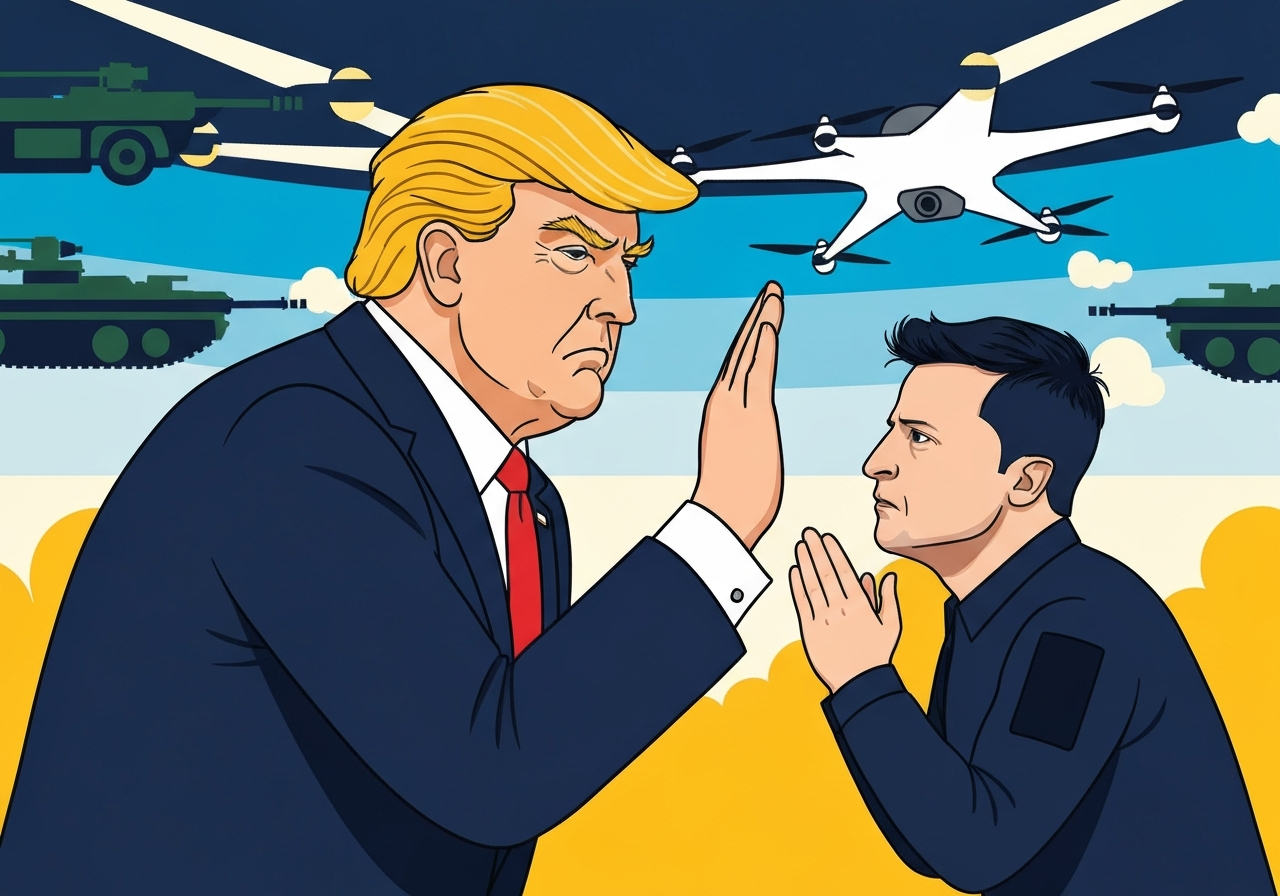
Former President Donald Trump publicly rejected an apparent Ukrainian offer to provide counter‑drone expertise and systems, according to recent reporting, while reiterating plans to intensify U.S. strikes on Iran. The exchange follows reports that Kyiv discussed supplying interceptor drones and specialist teams to protect U.S. facilities, including bases in Jordan. Trump made the comments on Fox News and in an interview cited by The New York Times, framing U.S. strikes as already severely degrading Iranian missile and drone capabilities. The development adds a diplomatic and operational layer to the widening regional confrontation.
Key Takeaways
- Trump publicly declined Ukraine’s reported offer of anti‑drone assistance, a move first detailed in recent news reporting and attributed to Kyiv outreach to Gulf partners and the U.S.
- The New York Times reported Trump said Kyiv had deployed interceptor drones and a team of drone specialists to help protect U.S. military bases in Jordan.
- POLITICO reported Ukrainian officials were discussing exchanges of counter‑UAS technology and expertise with Persian Gulf states and U.S. interlocutors for financial and diplomatic leverage.
- On Fox News, Trump vowed to strike Iran “very hard over the next week,” claiming U.S. forces have knocked out most Iranian missiles and many drones.
- The episode highlights competing priorities: Kyiv seeking financial support and political leverage, and Washington signaling direct military response to Iranian attacks.
- Public and expert reaction is split between concerns about escalation and arguments that leveraging Ukrainian capabilities could sharpen regional defenses against Iranian drone strikes.
Background
Since late 2022 and into 2023, the Russian invasion of Ukraine has driven rapid Ukrainian development in drones and counter‑drone systems. Kyiv’s wartime improvisation produced both commercially adapted and purpose‑built unmanned systems, and it has offered technical assistance to partners under security and financing arrangements. That expertise has become sought after by states facing Iranian drone and missile threats in the Middle East, especially in the Persian Gulf and Red Sea regions.
POLITICO’s recent reporting said Ukrainian officials were engaged in talks with Gulf countries and U.S. representatives to trade anti‑drone know‑how and equipment for financial support and greater diplomatic leverage with Washington. For Kyiv, these talks are framed by a need to diversify funding and secure broader backing while sustaining its defense industrial tempo amid an extended conflict with Russia.
Main Event
The story crystallized after Trump gave interviews in which he addressed both U.S. strikes on Iran and comments about Ukrainian involvement. According to reporting, Trump told The New York Times that Kyiv had sent interceptor drones and specialists to protect U.S. bases in Jordan—an assertion presented as a factual account of deployment. Separately, POLITICO said Ukrainian officials had been exploring offers of anti‑drone support to Gulf partners and the United States in exchange for aid and diplomatic leverage.
On Fox News, Trump escalated rhetoric about the campaign against Iran’s forces. He said American strikes had significantly degraded Iranian missiles and drones and promised intensification of operations in the coming days. His language—emphasizing unprecedented scale—has been presented by his team as justification for continued kinetic pressure on Iran following recent attacks on regional targets and U.S. positions.
Ukrainian officials have not publicly confirmed the full scope or terms of any formal offer to Gulf states or the United States. The reporting indicates diplomatic channels were used to explore mutually beneficial arrangements, but it is unclear whether concrete agreements were finalized or implemented beyond the deployments Trump described.
Analysis & Implications
Strategically, the episode underscores how Ukrainian military innovation has become a transregional commodity. Kyiv’s counter‑UAS experience—born of fighting in eastern Europe—has direct application against the types of drones and loitering munitions used in attacks across the Middle East. If traded for funding or political concessions, those capabilities could materially bolster partners facing persistent Iranian threats.
Politically, Trump’s public refusal to accept or acknowledge Ukraine’s assistance (as reported) signals competing U.S. priorities: direct retaliation against Iran versus deeper operational collaboration with Kyiv. The choice carries diplomatic costs; declining assistance may reduce Kyiv’s leverage with Washington and complicate trilateral options for shared defense in the region.
Operationally, claims that U.S. strikes have ‘‘knocked out most’’ Iranian missiles and ‘‘many’’ drones are significant if accurate, but they require verification. Even where Iranian launch capability is degraded, dispersed and asymmetric tactics—proxy forces, sea‑launched drones, and small cruise missiles—can sustain the threat. Incorporating foreign counter‑UAS expertise could close gaps in base defense, but such integration involves logistics, rules of engagement, and political constraints.
Comparison & Data
| Actor | Suggested Contribution | Intended Benefit |
|---|---|---|
| Ukraine (reported) | Counter‑drone systems, interceptor drones, specialist teams | Financial support, diplomatic leverage with U.S./Gulf states |
| United States (Trump’s stance) | Direct military strikes on Iran | Degrade Iranian strike capability, deterrence |
The table summarizes the roles described in reporting: Kyiv as a potential supplier of counter‑UAS expertise and Washington as an actor pursuing kinetic degradation of Iranian capabilities. The two approaches address the same problem—reducing Iranian strike efficacy—but operate on differing timeframes and risk profiles.
Reactions & Quotes
Trump’s public statements framed the episode as part of a broader campaign against Iranian capabilities, emphasizing the effectiveness of U.S. strikes.
“We are decimating them. We’ve knocked out most of their missiles. We’ve knocked out many of their drones… We’re hitting them harder than anybody’s been hit since World War II.”
Donald Trump, Fox News interview (as reported)
Separately, Trump told The New York Times that Kyiv had sent assets to help protect U.S. bases in Jordan—an assertion that, if verified, would indicate direct Ukrainian operational support on U.S. facilities abroad.
“Kyiv had deployed interceptor drones and a team of drone specialists to help protect U.S. military bases in Jordan,”
Donald Trump, interview cited in The New York Times (as reported)
Unconfirmed
- Whether formal, signed agreements exist between Ukraine and Gulf states or the United States to exchange counter‑drone systems for funding remains unverified.
- The reported deployment of Ukrainian interceptor drones and specialist teams to Jordan is based on a presidential claim and has not been independently confirmed in all details.
- The precise scale and permanence of damage to Iranian missile and drone inventories reported by Trump lack comprehensive open verification and may change as new assessments appear.
Bottom Line
The episode illustrates how innovations from the Ukraine war have broader geopolitical utility but also how political calculations in Washington can complicate operational cooperation. Kyiv’s outreach to Gulf partners and the U.S. was presented as a pragmatic attempt to translate military expertise into financial and diplomatic gains. Washington’s public dismissal of or distancing from that offer (as reported) signals friction between immediate retaliatory posture toward Iran and a willingness to harness allied capabilities in the region.
For policymakers, the key choices are whether to integrate foreign counter‑UAS assets into base defenses and how to balance escalation risks from kinetic strikes with longer‑term coalition building. Observers should watch for independent verification of deployments and any formal memoranda of understanding that would commit parties to equipment transfers or joint operations.
Sources
- POLITICO (news report) — reporting on Ukrainian outreach to Gulf states and the U.S. about anti‑drone assistance.
- The New York Times (news report) — cited interview in which Trump described Ukrainian deployments to protect U.S. bases in Jordan.
- Fox News (broadcast/interview) — Trump interview cited for statements on strikes against Iran.