
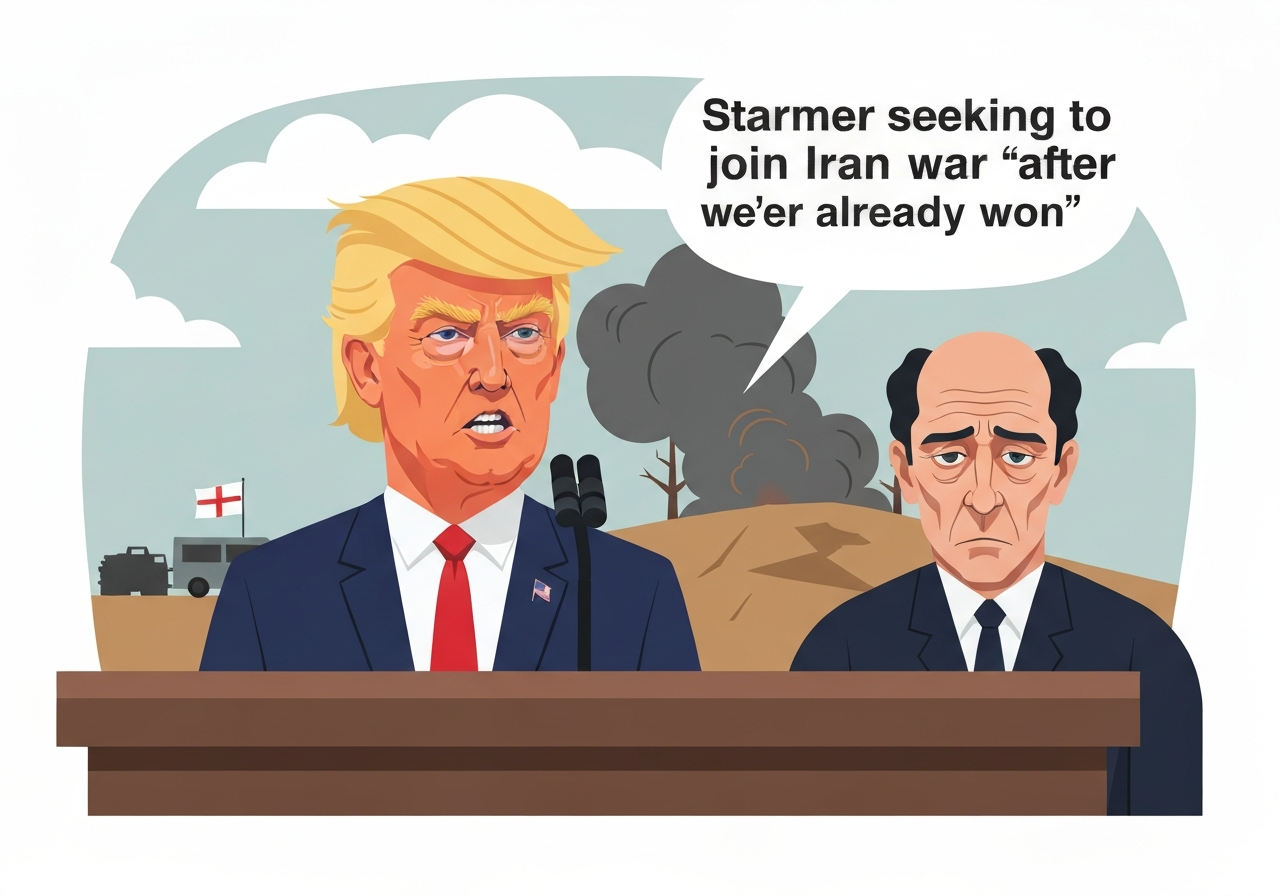
Former U.S. President Donald Trump this month attacked Labour leader Keir Starmer, saying Starmer was “seeking to join” a potential conflict with Iran “after we’ve already won.” The comments came amid renewed public focus on U.S.-Iran tensions and diplomatic activity involving Israel and Western capitals. The exchange has added friction to political debate in London and Washington over how closely the UK should align with U.S. policy should hostilities with Iran escalate. It also intersected with separate diplomatic rows — including Denmark rejecting a U.S. hospital ship — that have complicated allied messaging.
Key takeaways
- Trump publicly criticized Labour leader Keir Starmer this month, claiming Starmer wanted the UK to join action against Iran “after we’ve already won,” a phrase Trump used to underline his own posture on the conflict.
- The remarks arrived as U.S.-Iran tensions remain elevated; Israeli Prime Minister Benjamin Netanyahu planned to meet with Trump about Iran diplomacy on Feb. 8, according to public reports.
- Denmark publicly rebuffed a U.S. offer of a hospital ship sent to Greenland, with Danish Prime Minister Mette Frederiksen defending local health systems and urging the U.S. to halt threats, according to reporting dated Feb. 22.
- The exchange highlights strain in transatlantic coordination: domestic politics in the U.K. and U.S. could shape whether Britain follows Washington into military steps against Iran.
- Observers warn that rhetorical escalation risks narrowing diplomatic options with Tehran and complicating coalition-building among NATO and other Western partners.
- At stake is both short-term crisis management — avoiding unintended escalation — and longer-term UK domestic politics ahead of future electoral contests.
Background
Relations between the United States and Iran have oscillated between limited diplomacy and sharp confrontation since the 2018 U.S. withdrawal from the Iran nuclear deal. Incidents at sea, proxy attacks in the region and differing approaches among allies have repeatedly tested Western cohesion. Recent months saw heightened attention to Iran from Washington and allied capitals after a series of provocations and countermeasures in the wider Middle East.
In the U.K., Keir Starmer leads the Labour Party as its elected leader and has been under pressure from both political opponents and his own party to articulate a clear stance on foreign policy. Historically, British participation in U.S.-led military operations has been a contentious domestic issue, shaping coalition dynamics and party messaging. Those debates re-emerged as senior figures in allied states weighed how to support deterrence and diplomacy with Iran.
Main event
Trump’s comments framed Starmer’s posture as eagerness to join combat after the decisive phase, a characterization meant to contrast British timidity or opportunism with Trump’s own claim of having achieved results. The remark was delivered in public remarks that were rapidly rebroadcast by political media and social platforms, drawing immediate responses in London and Washington. Politicians in the U.K. responded variably, with some opponents seizing on the exchange to question Starmer’s foreign policy priorities and some allies warning against escalation of rhetoric.
Concurrently, Israeli Prime Minister Benjamin Netanyahu scheduled a meeting with President Trump to discuss U.S. talks with Iran, underlining how the matter has regional implications that reach beyond bilateral U.S.-Iran relations. That meeting, reported to be set for Feb. 8, reflects Israel’s central role in conversations about deterrence, intelligence sharing and potential military options in the region.
Elsewhere, Denmark publicly declined a U.S. hospital ship sent to Greenland, prompting Copenhagen to highlight the adequacy of its own health services and to press the United States to refrain from threats. Danish Prime Minister Mette Frederiksen’s remarks emphasized national sovereignty and the sensitivities around displays of military or humanitarian assets in closely allied territories.
Analysis & implications
Politically, Trump’s attack on Starmer serves multiple audiences: it reinforces his image among U.S. supporters as decisive on security, it seeks to influence British domestic debate by casting Labour as interventionist, and it aims to frame the wider narrative about who should set the terms of any confrontation with Iran. For Starmer, the moment forces a clearer public articulation of the Labour Party’s thresholds for military involvement and how the UK would engage diplomatically with both the U.S. and European partners.
Strategically, the rhetoric matters because it can constrain bargaining space. If leaders publicly signal a readiness to join kinetic action, Tehran may recalibrate its own deterrence and escalation calculus. Conversely, strong public opposition to involvement by key allies can limit the U.S. options for assembling a coalition for coercive measures. That dynamic affects not only military planning but also the effectiveness of sanctions, information campaigns and diplomatic outreach.
At the transatlantic level, the incident underscores divergent domestic incentives in allied capitals. U.S. administrations often assume a degree of allied alignment in crises, but political leaders in Europe must balance alliance commitments with domestic constraints. Denmark’s rejection of the hospital ship is illustrative: allied gestures, even humanitarian ones, can be read through a political lens and prompt public pushback.
Looking ahead, the most immediate risk is that hostile rhetoric narrows diplomatic openings. If public statements harden positions on all sides, backchannel negotiations and compromise become harder. Policymakers interested in de-escalation will need to separate domestic political signaling from practical operational choices to preserve room for negotiation.
Comparison & data
| Date | Event |
|---|---|
| Jan. 4 | UK and France conducted a strike on an IS arms bunker in Syria (reported military action) |
| Feb. 8 | Israeli PM Benjamin Netanyahu planned to meet President Trump about Iran talks (reported) |
| Feb. 22 | U.S. hospital ship dispatched to Greenland; Denmark publicly declined the assistance (reported) |
The table above places the recent rhetoric alongside a short timeline of regional and allied actions reported in media coverage. The juxtaposition shows how diplomatic meetings, military strikes and symbolic offers of assistance have clustered in recent weeks, intensifying public attention and political stakes.
Reactions & quotes
Public and political responses were swift: some U.K. officials pressed for clarity on Labour’s defense posture while analysts warned that blunt rhetoric could reduce diplomatic flexibility. Danish leaders used the moment to assert national competence and to push back on what they described as unnecessary U.S. posturing.
“He is seeking to join the war after we’ve already won,”
Donald Trump
The quotation above was central to the headlines and was used by Trump to frame Starmer’s stance as backward-looking and opportunistic. Media amplification of the line intensified political debate in both countries.
“I would strongly urge that the United States stop the threats against a historically close ally,”
Mette Frederiksen, Danish prime minister
Frederiksen’s comment, reported in connection with the hospital ship episode, emphasized Danish displeasure at perceived U.S. pressure and underscored the sensitivity of allied relations when military or humanitarian assets intersect with sovereignty concerns.
Unconfirmed
- Whether Keir Starmer has privately committed the U.K. to join any specific U.S. military operation against Iran remains unclear and is not established by public records cited in the reporting.
- Trump’s assertion that a conflict with Iran would be already “won” is a political claim and not an independently verifiable statement about battlefield outcomes or Tehran’s capacities.
Bottom line
The episode is less about a discrete new policy than about political signaling: Trump’s comments aim to shape public perceptions of foreign-policy competence and to pressure allied leaders. For the U.K., the episode intensifies scrutiny of Labour’s defense posture and complicates cross-party consensus on crisis response.
For diplomats and defense planners, the immediate task is to decouple domestic rhetoric from operational planning to preserve options for de-escalation and coalition management. Observers should watch whether public statements harden into synchronized policy steps or give way to quieter diplomacy.
Sources
- Politico Europe — news reporting on Trump’s remarks and related allied reactions (news).