
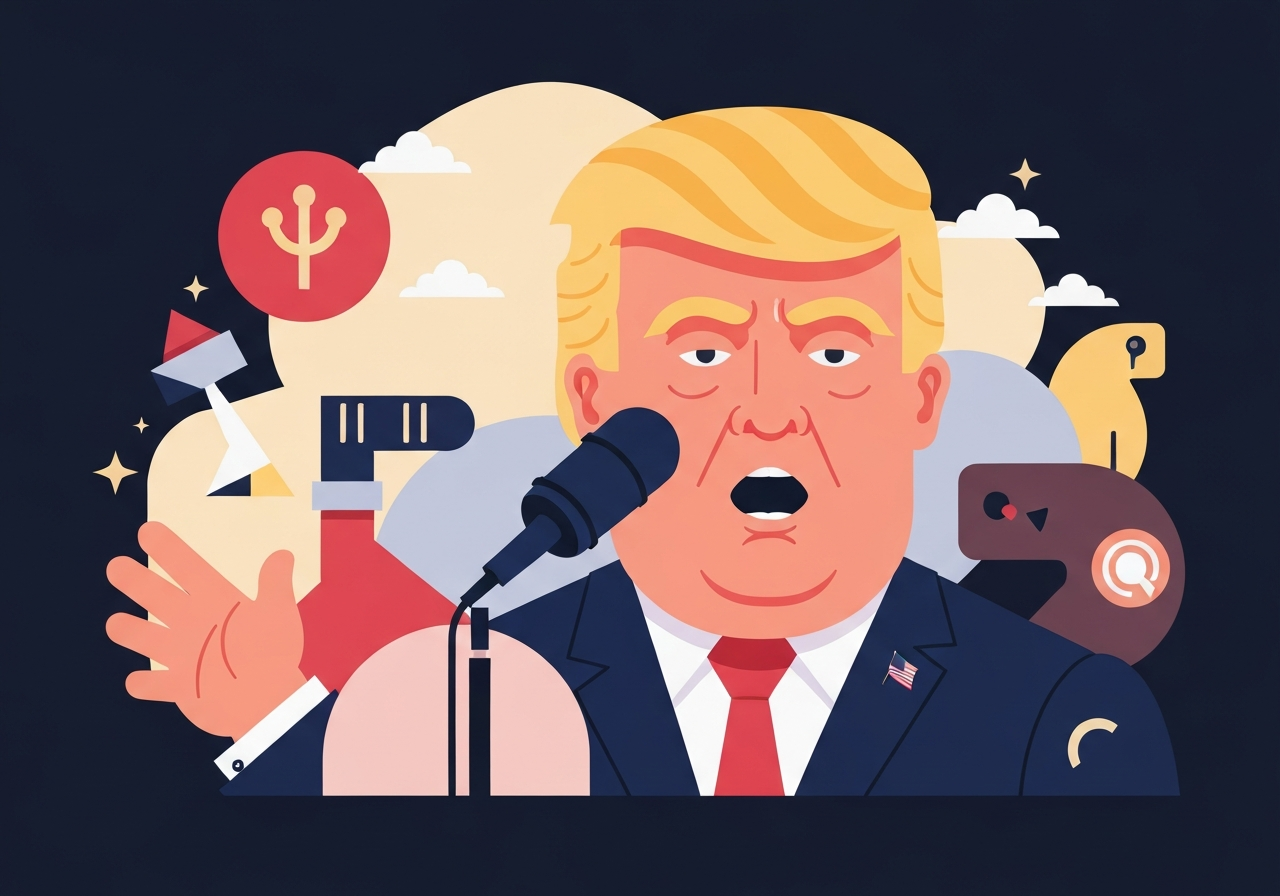
Lead: President Donald Trump delivered a State of the Union address to a joint session of Congress at the US Capitol tonight, focusing on the economy, immigration and healthcare while touting tariff-driven gains. He repeatedly framed the speech as proof the nation is “winning again,” and named members of the US men’s Olympic hockey team. The address drew mixed reactions: applause from Republicans, visible Democratic absences and at least one lawmaker escorted from the chamber.
Key Takeaways
- Trump said inflation has fallen to its “lowest level in more than five years” and claimed the stock market has recorded 53 all-time highs since the election.
- The president asserted more than $18 trillion in private investment came to the US within his first year in office, a figure he attributed to his policies.
- On immigration, Trump claimed the “flow of deadly fentanyl” over the border is down by a record 56% in one year and described the border as the “strongest and most secure” in history.
- He defended tariffs as an economic tool, called the Supreme Court ruling against many of his global tariffs “disappointing,” and said 15% tariffs would expire in 150 days unless Congress acts.
- About fifty Democratic lawmakers stayed away from the chamber in protest; at least one Democrat, Rep. Al Green, was escorted out for holding a sign alleging racial denigration.
- The arrival of the US men’s Olympic hockey team prompted the first major stir among Democrats; the women’s team had declined the invitation.
Background
The State of the Union is an annual presidential address to Congress where the president outlines policy priorities and achievements. Trump is delivering the speech in his second term, after a first term marked by repeated attempts to repeal the Affordable Care Act (ACA); that repeal effort failed. Tonight he acknowledged the ACA remains in place and shifted emphasis toward lowering healthcare costs and prescription prices rather than repeal.
Tariffs have been a signature economic policy for this administration. A recent Supreme Court decision struck down sweeping global tariffs, a ruling Trump called “disappointing,” yet he pledged to pursue alternative legal routes and seek congressional help. The political setting is polarized: many Democrats staged a partial boycott of the chamber as a protest, while Republicans generally greeted the president with applause and cheers.
Main Event
The address opened with Trump asserting “our nation is back” and declaring the state of the union strong. The president highlighted job- and market-related metrics, pointing to record highs on the S&P and a string of market milestones he credits to his economic stewardship. He named and praised the US men’s Olympic hockey team and announced his intention to award the team goaltender the Presidential Medal of Freedom.
On healthcare, Trump called high medical costs “one of the biggest rip-offs of our times,” blaming insurers and promising price-transparency measures and lower prescription-drug prices. He repeatedly contrasted his administration’s actions with those of his predecessor while acknowledging the Affordable Care Act remains law more than a decade after enactment. Democrats in the chamber responded with visible skepticism at parts of the healthcare and economic sections.
Tariffs and trade featured prominently. Trump framed tariffs as central to an economic turnaround, criticized the Supreme Court’s recent ruling, and said he would seek statutory fixes to preserve import taxes. The mention of tariffs drew mixed reactions in the chamber — initial silence, then rumblings — and resonated with some Republicans when he suggested tariffs could one day replace the income tax.
Security and immigration were on the agenda as well. The president claimed sharp reductions in illegal crossings and in the flow of fentanyl, framing border enforcement as a major accomplishment. Protest actions and the absence of roughly fifty legislators underscored the partisan tenor of the night, and a Democratic congressman, Rep. Al Green, was removed after displaying a sign critical of the president.
Analysis & Implications
Politically, the address aimed to consolidate support behind core themes — economy, law-and-order, and border security — while offering policy levers that require congressional cooperation. Tariffs in particular cannot be sustained indefinitely without Congress: the administration faces a deadline for temporary tariff measures and must secure legislative backing or risk rollback. If Republicans can translate tariff policy into tax or trade legislation, it would reshape fiscal debates and provoke sustained negotiation with Democrats and the business community.
On healthcare, the shift from attempting repeal toward cost-containment and price-transparency is politically significant. It acknowledges the long-term durability of the ACA while opening space for bipartisan measures that address drug prices and out-of-pocket costs. However, the effectiveness of transparency initiatives depends on rule design and enforcement, and on whether insurers and providers participate in new pricing regimes.
Economically, Trump’s reliance on market milestones and headline inflation figures is a mixed political tactic: markets respond to expectations and policy signals, but public sentiment often diverges from index performance. Polling cited in coverage indicates many Americans remain uneasy about the economy’s direction despite stock-market gains. That gap can shape midterm and legislative outcomes if economic frustrations persist among swing voters.
Comparison & Data
| Claim | Stated Figure | Verification Status |
|---|---|---|
| Fentanyl flow reduction | Down 56% in one year | Claim reported; requires agency data review |
| Investment attracted | More than $18tn in one year | Stated by president; not independently verified in live coverage |
| Stock-market records | 53 all-time highs since election | Reported as president’s assertion; market data can confirm count |
| Tariff timeline | 15% tariffs expire in 150 days | Administration timeline claim; depends on statutory action |
The table above summarizes principal numeric claims made during the address and notes verification status based on live reporting. Independent confirmation requires agency releases (Customs/Border Protection for fentanyl and crossings), official Treasury or Commerce records for investment flows, and historical market-data checks for record counts.
Reactions & Quotes
Republicans generally responded with applause to economic and security claims, while Democrats remained largely skeptical and staged a partial boycott. The arrival of the Olympic athletes briefly shifted the chamber’s tone. Journalists and analysts noted the mixed reception and flagged claims that will require verification.
Context before quote: Responding to healthcare costs, the president positioned his agenda as consumer-focused and blamed insurers and existing programs for high prices.
“One of the biggest rip-offs of our times, the crushing cost of healthcare.”
President Donald Trump
Context after quote: The line framed subsequent policy proposals on price transparency and drug costs; legislative follow-through will determine whether those proposals translate into measurable reductions for patients.
Context before quote: Opening his remarks, the president framed the speech as proof the nation is “winning again,” citing the economy and international posture as signs of success.
“Our nation is back. The state of our union is strong.”
President Donald Trump
Context after quote: The rhetorical theme of recovery underpinned much of the speech; opponents and some poll data, however, point to persistent economic unease among portions of the electorate.
Context before quote: On immigration and border control the president stressed enforcement achievements and public-safety results.
“The flow of deadly fentanyl across our border is down by a record 56% in one year.”
President Donald Trump
Context after quote: Law enforcement and health agencies must corroborate such a precise percentage through seizure and overdose data; the claim is consequential if confirmed but requires independent verification.
Unconfirmed
- President’s claim that private investment reached “more than $18tn” in the administration’s first year has not been independently verified in live reporting.
- Assertion that fentanyl flow is down 56% in one year requires confirmation from Customs/Border Protection and public-health agencies.
- Count of “53 all-time record highs” for the stock market is a presidential claim that should be checked against market data providers.
- Whether 15% tariff measures can be preserved beyond 150 days depends on congressional action and legal options, and is not final.
Bottom Line
The address consolidated a set of campaign-era themes — economic success, strong borders, and aggressive trade policy — while shifting strategy in some areas such as healthcare from repeal to cost-reduction. Many of the president’s numeric claims are consequential and will drive media and analyst scrutiny in coming days as data agencies and fact-checkers examine them.
Policy impact hinges on Congress: tariffs and many domestic reforms the president outlined require legislative or regulatory follow-through. Expect debate over statutory authority for tariffs, concrete rules to implement price transparency, and further partisan clashes as both sides shape the post-speech narrative.
Sources
- BBC — Live coverage of the State of the Union — news outlet (live reporting)