
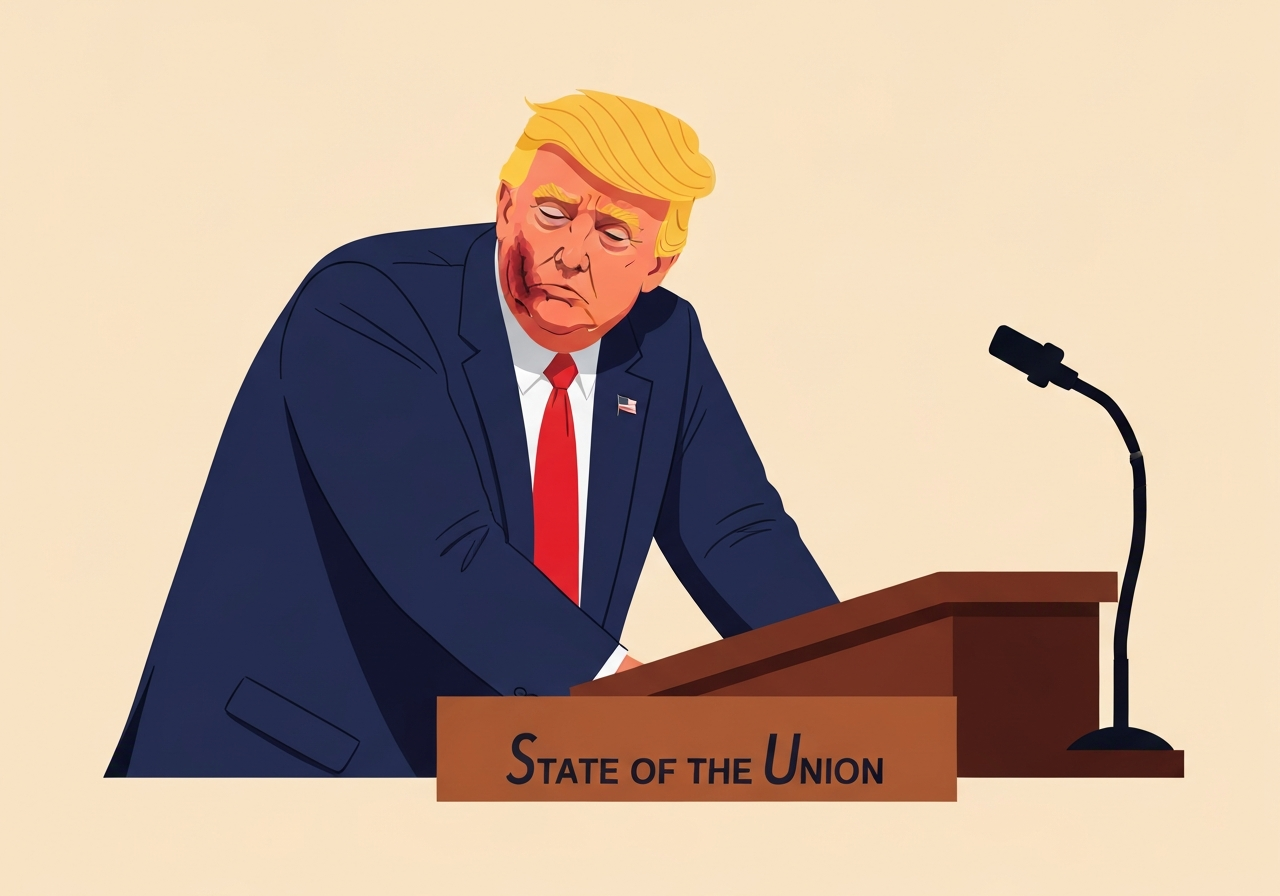
Lead: President Donald Trump will use the State of the Union address on Tuesday as a centerpiece of a broader effort to shift public opinion ahead of the November midterm elections. He arrives at the lectern after a recent Supreme Court ruling that undercut a signature trade policy, slipping approval ratings and a partial federal government shutdown. The White House plans to highlight recent economic indicators and border gains while asking voters to reward the administration’s agenda. The address is widely seen as a strategic bid to blunt Democratic momentum and shore up Republican prospects for control of the House.
Key takeaways
- Trump is delivering the State of the Union on Tuesday amid the lowest approval ratings of his presidency since he returned to office; polls show broad disapproval on economy and immigration issues.
- Last week the Supreme Court delivered a major setback to the administration by rejecting or limiting the legal basis for the administration’s sweeping tariffs on multiple countries.
- The federal government is in a partial shutdown, complicating messaging and raising stakes for party control of Congress.
- The White House will tout economic points: January employment gains that came in at more than twice economists’ expectations, lower gasoline prices, and a 12% rise in the Dow Jones Industrial Average in the past year.
- Administration plans to emphasize border results and crime trends, noting a sharp decline in illegal crossings and a reported nationwide drop in murders compared with the prior year.
- Military spending and personnel measures will be highlighted, including a one-time bonus payment of $1,776 distributed to about 1.5 million service members.
- Republicans face a real risk of losing the House; Democratic control would enable aggressive oversight and investigations into the president’s second-term agenda.
Background
Mr. Trump’s speech comes at a politically fraught moment. Approval measures have slid since he returned to the White House, and many voters now express dissatisfaction on issues — the economy and immigration — that were central to his earlier electoral appeals. That erosion of support is reflected across multiple national polls showing a clear shift in public sentiment.
Compounding the political pressure is a Supreme Court decision last week that undercut the legal foundation for the administration’s broad tariff program, removing a key policy achievement from Mr. Trump’s toolkit. The ruling reduces the administration’s leverage on trade and invites legislative and legal recalibration.
At the same time, the federal government has entered a partial shutdown, curtailing some public services and reshaping the administration’s communications calendar. With control of the House in play, Republican losses would hand Democrats the investigative power to scrutinize the president’s actions in his second year.
Main event
The president will present a catalog of accomplishments and promises — standard fare for a State of the Union — while framing his record as a turnaround from recent economic and security challenges. The administration intends to spotlight January’s job gains, which exceeded economists’ expectations by more than double the forecasted rate, and to connect market gains, such as a roughly 12 percent rise in the Dow over the last 12 months, to its policies.
On immigration, the White House plans to claim measurable progress at the border, citing a pronounced drop in illegal crossings. It will also point to a reported nationwide decline in homicides from the prior year as evidence that law-and-order initiatives are working. Senior officials will argue these trends justify continued Republican stewardship.
Trade and the Supreme Court decision will present a thornier moment. Administration aides have warned that the ruling constrains unilateral tariff authority, forcing a pivot to either new legal strategies or Congressional action. Expect the president to acknowledge trade friction while emphasizing domestic gains and national security investments.
Analysis & implications
The speech is as much a political gambit as a policy outline. With several months to the midterms, the address offers Mr. Trump a high-visibility platform to try to crystallize a positive narrative. If his rhetoric resonates, it can blunt Democratic attacks and narrow the margins in competitive House districts; if it fails, Democratic messaging about economic management and the court setback could gain traction.
The Supreme Court’s ruling on tariffs changes the operating environment for trade policy. It removes a primary executive tool for imposing broad levies and shifts pressure to Congress and the administration’s ability to craft narrower, legally defensible measures. International partners and markets will watch closely for any shift in U.S. trade posture that could affect supply chains and tariffs already in place.
Operationally, a partial shutdown restricts the administration’s capacity to deliver some programmatic wins and may sharpen voter frustration on governance. The political math is straightforward: losing the House would enable Congressional investigations that could consume the administration’s political bandwidth and complicate legislative and regulatory priorities.
Comparison & data
| Metric | Recent figure | Context |
|---|---|---|
| Dow Jones Industrial Average | +12% (past year) | Used by White House to signal market confidence |
| January employment growth | >2× economists’ expectation | Administration will cite as evidence of economic momentum |
| Military bonus | $1,776 to ~1.5M service members | Framed as investment in the armed forces |
| Border crossings | Described as “sharply declined” | Administration claims substantial improvement |
The table condenses the administration’s main numerical claims. While market indices and job gains are concrete and reported by private data sources, crime and border statistics often rest on differing federal and local measures; drawing direct causal links between policy and trends requires longer-term analysis.
Reactions & quotes
“In one year, President Trump has turned our country around from the brink of disaster…the state of our union is strong, prosperous and respected,”
White House Press Secretary Karoline Leavitt (official statement)
The White House framed the address as validation of the administration’s approach, stressing economic, security and military gains. Officials intend to use specific numbers to bolster credibility with undecided voters.
“If Democrats secure the House, they will use oversight powers to examine the administration’s policies and conduct,”
Democratic leadership (party statement, paraphrase)
Democrats have signaled plans to pursue investigations if they regain the House, portraying the midterms as a referendum on both policy outcomes and governance. That prospect has become central to campaign messaging on both sides.
Unconfirmed
- Whether the State of the Union will materially change national approval ratings in polls; short-term speech effects are uncertain.
- The precise legal and policy path the administration will take to replace or restore tariff authority following the Supreme Court decision remains undecided.
- Exact causal links between administration policies and recent crime declines are not fully verified and may vary by locality.
Bottom line
The State of the Union will serve as a high-stakes attempt by President Trump to reclaim the narrative after legal and political setbacks. The administration will lean on economic indicators, border metrics and military measures to present a record of achievement, but the Supreme Court ruling and a partial government shutdown complicate the messaging.
Political consequence is immediate: the address may affect voter perceptions heading into the midterms, but structural factors — poll trends, control of the House and competing news cycles — will determine whether the speech produces lasting change. Observers should watch shifts in early polling, how opponents frame the speech, and any concrete policy moves announced in its aftermath.
Sources
- The New York Times — News report (Feb. 24, 2026)